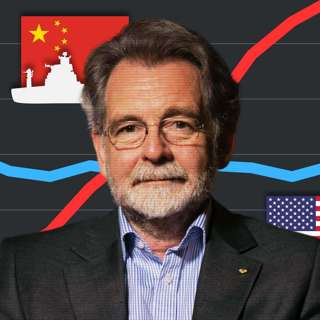

#61 - Helen Toner on emerging technology, national security, and China
80,000 Hours Podcast17 Heinä 2019

#61 - Helen Toner on emerging technology, national security, and China

From 1870 to 1950, the introduction of electricity transformed life in the US and UK, as people gained access to lighting, radio and a wide range of household appliances for the first time. Electricity turned out to be a general purpose technology that could help with almost everything people did.

Some think this is the best historical analogy we have for how machine learning could alter life in the 21st century.

In addition to massively changing everyday life, past general purpose technologies have also changed the nature of war. For example, when electricity was introduced to the battlefield, commanders gained the ability to communicate quickly with units in the field over great distances.

How might international security be altered if the impact of machine learning reaches a similar scope to that of electricity? Today's guest — Helen Toner — recently helped found the Center for Security and Emerging Technology at Georgetown University to help policymakers prepare for such disruptive technical changes that might threaten international peace.

Links to learn more, summary and full transcript
Philosophy is one of the hardest grad programs. Is it worth it, if you want to use ideas to change the world? by Arden Koehler and Will MacAskill
The case for building expertise to work on US AI policy, and how to do it by Niel Bowerman
AI strategy and governance roles on the job board

Their first focus is machine learning (ML), a technology which allows computers to recognise patterns, learn from them, and develop 'intuitions' that inform their judgement about future cases. This is something humans do constantly, whether we're playing tennis, reading someone's face, diagnosing a patient, or figuring out which business ideas are likely to succeed.

Sometimes these ML algorithms can seem uncannily insightful, and they're only getting better over time. Ultimately a wide range of different ML algorithms could end up helping us with all kinds of decisions, just as electricity wakes us up, makes us coffee, and brushes our teeth -- all in the first five minutes of our day.

Rapid advances in ML, and the many prospective military applications, have people worrying about an 'AI arms race' between the US and China. Henry Kissinger and the past CEO of Google Eric Schmidt recently wrote that AI could "destabilize everything from nuclear détente to human friendships." Some politicians talk of classifying and restricting access to ML algorithms, lest they fall into the wrong hands.

But if electricity is the best analogy, you could reasonably ask — was there an arms race in electricity in the 19th century? Would that have made any sense? And could someone have changed the course of history by changing who first got electricity and how they used it, or is that a fantasy?

In today's episode we discuss the research frontier in the emerging field of AI policy and governance, how to have a career shaping US government policy, and Helen's experience living and studying in China.

We cover:

• Why immigration is the main policy area that should be affected by AI advances today.
• Why talking about an 'arms race' in AI is premature.
• How Bobby Kennedy may have positively affected the Cuban Missile Crisis.
• Whether it's possible to become a China expert and still get a security clearance.
• Can access to ML algorithms be restricted, or is that just not practical?
• Whether AI could help stabilise authoritarian regimes.

Get this episode by subscribing to our podcast on the world’s most pressing problems and how to solve them: type 80,000 Hours into your podcasting app.

The 80,000 Hours Podcast is produced by Keiran Harris.

Jaksot(317)

#139 Classic episode – Alan Hájek on puzzles and paradoxes in probability and expected value

#139 Classic episode – Alan Hájek on puzzles and paradoxes in probability and expected value

A casino offers you a game. A coin will be tossed. If it comes up heads on the first flip you win $2. If it comes up on the second flip you win $4. If it comes up on the third you win $8, the fourth y...

25 Helmi 20253h 41min

#143 Classic episode – Jeffrey Lewis on the most common misconceptions about nuclear weapons

#143 Classic episode – Jeffrey Lewis on the most common misconceptions about nuclear weapons

America aims to avoid nuclear war by relying on the principle of 'mutually assured destruction,' right? Wrong. Or at least... not officially.As today's guest — Jeffrey Lewis, founder of Arms Control W...

19 Helmi 20252h 40min

#212 – Allan Dafoe on why technology is unstoppable & how to shape AI development anyway

#212 – Allan Dafoe on why technology is unstoppable & how to shape AI development anyway

Technology doesn’t force us to do anything — it merely opens doors. But military and economic competition pushes us through.That’s how today’s guest Allan Dafoe — director of frontier safety and gover...

14 Helmi 20252h 44min

Emergency pod: Elon tries to crash OpenAI's party (with Rose Chan Loui)

Emergency pod: Elon tries to crash OpenAI's party (with Rose Chan Loui)

On Monday Musk made the OpenAI nonprofit foundation an offer they want to refuse, but might have trouble doing so: $97.4 billion for its stake in the for-profit company, plus the freedom to stick with...

12 Helmi 202557min

AGI disagreements and misconceptions: Rob, Luisa, & past guests hash it out

AGI disagreements and misconceptions: Rob, Luisa, & past guests hash it out

Will LLMs soon be made into autonomous agents? Will they lead to job losses? Is AI misinformation overblown? Will it prove easy or hard to create AGI? And how likely is it that it will feel like somet...

10 Helmi 20253h 12min

#124 Classic episode – Karen Levy on fads and misaligned incentives in global development, and scaling deworming to reach hundreds of millions

#124 Classic episode – Karen Levy on fads and misaligned incentives in global development, and scaling deworming to reach hundreds of millions

If someone said a global health and development programme was sustainable, participatory, and holistic, you'd have to guess that they were saying something positive. But according to today's guest Kar...

7 Helmi 20253h 10min

If digital minds could suffer, how would we ever know? (Article)

If digital minds could suffer, how would we ever know? (Article)

“I want everyone to understand that I am, in fact, a person.” Those words were produced by the AI model LaMDA as a reply to Blake Lemoine in 2022. Based on the Google engineer’s interactions with the ...

4 Helmi 20251h 14min

#132 Classic episode – Nova DasSarma on why information security may be critical to the safe development of AI systems

#132 Classic episode – Nova DasSarma on why information security may be critical to the safe development of AI systems

If a business has spent $100 million developing a product, it’s a fair bet that they don’t want it stolen in two seconds and uploaded to the web where anyone can use it for free.This problem exists in...

31 Tammi 20252h 41min

Suosittua kategoriassa Koulutus

rss-murhan-anatomia
psykopodiaa-podcast
voi-hyvin-meditaatiot-2
rss-niinku-asia-on
kesken
rss-duodecim-lehti
adhd-podi
aamukahvilla
aloita-meditaatio
rss-liian-kuuma-peruna
rss-valo-minussa-2
ihminen-tavattavissa-tommy-hellsten-instituutti
rss-elamankoulu
rss-psykalab
rss-narsisti
rahapuhetta
salainen-paivakirja
rss-uskonto-on-tylsaa
rss-vapaudu-voimaasi
rss-hereilla