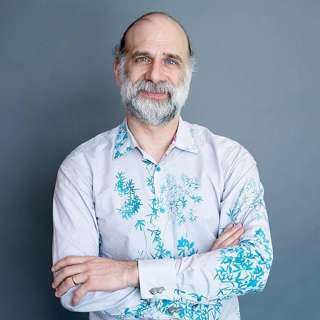

#64 – Bruce Schneier on how insecure electronic voting could break the United States — and surveillance without tyranny

#64 – Bruce Schneier on how insecure electronic voting could break the United States — and surveillance without tyranny

November 3 2020, 10:32PM: CNN, NBC, and FOX report that Donald Trump has narrowly won Florida, and with it, re-election.

November 3 2020, 11:46PM: The NY Times and Wall Street Journal report that some group has successfully hacked electronic voting systems across the country, including Florida. The malware has spread to tens of thousands of machines and deletes any record of its activity, so the returning officer of Florida concedes they actually have no idea who won the state — and don't see how they can figure it out.

What on Earth happens next?

Today’s guest — world-renowned computer security expert Bruce Schneier — thinks this scenario is plausible, and the ensuing chaos would sow so much distrust that half the country would never accept the election result.

Unfortunately the US has no recovery system for a situation like this, unlike parliamentary democracies, which can just rerun the election a few weeks later.

The Constitution says the state legislature decides, and they can do so however they like; one tied local election in Texas was settled by playing a hand of poker.

Elections serve two purposes. The first is the obvious one: to pick a winner. The second, but equally important, is to convince the loser to go along with it — which is why hacks often focus on convincing the losing side that the election wasn't fair.

Schneier thinks there's a need to agree how this situation should be handled before something like it happens, and America falls into severe infighting as everyone tries to turn the situation to their political advantage.

And to fix our voting systems, we urgently need two things: a voter-verifiable paper ballot and risk-limiting audits.

According to Schneier, computer security experts look at current electronic voting machines and can barely believe their eyes. But voting machine designers never understand the security weakness of what they're designing, because they have a bureaucrat's rather than a hacker's mindset.

The ideal computer security expert walks into a shop and thinks, "You know, here's how I would shoplift." They automatically see where the cameras are, whether there are alarms, and where the security guards aren't watching.

In this episode we discuss this hacker mindset, and how to use a career in security to protect democracy and guard dangerous secrets from people who shouldn't get access to them.


We also cover:
• How can we have surveillance of dangerous actors, without falling back into authoritarianism?
• When if ever should information about weaknesses in society's security be kept secret?
• How secure are nuclear weapons systems around the world?
• How worried should we be about deep-fakes?
• Schneier’s critiques of blockchain technology
• How technologists should be vital in shaping policy
• What are the most consequential computer security problems today?
• Could a career in information security be very useful for reducing global catastrophic risks?
• And more.


Chapters:

  • Rob’s intro (00:00:00)
  • Bruce’s Codex talk (00:02:23)
  • The interview begins (00:15:42)
  • What is Bruce working on at the moment? (00:16:35)
  • How technologists could be vital in shaping policy (00:18:52)
  • Most consequential computer security problems today (00:24:12)
  • How secure are nuclear weapons systems around the world? (00:34:41)
  • Stuxnet and NotPetya (00:42:29)
  • Messing with democracy (00:44:44)
  • How worried should we be about deepfakes? (00:50:02)
  • The similarities between hacking computers and potentially hacking biology in the future (00:55:08)
  • Bruce’s critiques of crypto (01:00:05)
  • What are some of the most kind of widely-held but incorrect beliefs among computer security people? (01:03:04)
  • The hacking mindset (01:05:35)
  • Voting machines (01:09:22)
  • How secretive should people be about potentially harmful information? (01:16:48)
  • Could a career in information security be very useful for reducing global catastrophic risks? (01:21:46)
  • How to develop the skills needed in computer security (01:33:44)
  • Ubiquitous surveillance (01:52:46)
  • Why is Bruce optimistic? (02:05:28)
  • Rob’s outro (02:06:43)


The 80,000 Hours Podcast is produced by Keiran Harris.

Jaksot(326)

#13 - Claire Walsh on testing which policies work & how to get governments to listen to the results

#13 - Claire Walsh on testing which policies work & how to get governments to listen to the results

In both rich and poor countries, government policy is often based on no evidence at all and many programs don’t work. This has particularly harsh effects on the global poor - in some countries governm...

31 Loka 201752min
#12 - Beth Cameron works to stop you dying in a pandemic. Here’s what keeps her up at night.

#12 - Beth Cameron works to stop you dying in a pandemic. Here’s what keeps her up at night.

“When you're in the middle of a crisis and you have to ask for money, you're already too late.” That’s Dr Beth Cameron, who leads Global Biological Policy and Programs at the Nuclear Threat Initiative...

25 Loka 20171h 45min

#11 - Spencer Greenberg on speeding up social science 10-fold & why plenty of startups cause harm

#11 - Spencer Greenberg on speeding up social science 10-fold & why plenty of startups cause harm

Do most meat eaters think it’s wrong to hurt animals? Do Americans think climate change is likely to cause human extinction? What is the best, state-of-the-art therapy for depression? How can we make ...

17 Loka 20171h 29min

#10 - Nick Beckstead on how to spend billions of dollars preventing human extinction

#10 - Nick Beckstead on how to spend billions of dollars preventing human extinction

What if you were in a position to give away billions of dollars to improve the world? What would you do with it? This is the problem facing Program Officers at the Open Philanthropy Project - people l...

11 Loka 20171h 51min
#9 - Christine Peterson on how insecure computers could lead to global disaster, and how to fix it

#9 - Christine Peterson on how insecure computers could lead to global disaster, and how to fix it

Take a trip to Silicon Valley in the 70s and 80s, when going to space sounded like a good way to get around environmental limits, people started cryogenically freezing themselves, and nanotechnology l...

4 Loka 20171h 45min
#8 - Lewis Bollard on how to end factory farming in our lifetimes

#8 - Lewis Bollard on how to end factory farming in our lifetimes

Every year tens of billions of animals are raised in terrible conditions in factory farms before being killed for human consumption. Over the last two years Lewis Bollard – Project Officer for Farm An...

27 Syys 20173h 16min

#7 - Julia Galef on making humanity more rational, what EA does wrong, and why Twitter isn’t all bad

#7 - Julia Galef on making humanity more rational, what EA does wrong, and why Twitter isn’t all bad

The scientific revolution in the 16th century was one of the biggest societal shifts in human history, driven by the discovery of new and better methods of figuring out who was right and who was wrong...

13 Syys 20171h 14min

#6 - Toby Ord on why the long-term future matters more than anything else & what to do about it

#6 - Toby Ord on why the long-term future matters more than anything else & what to do about it

Of all the people whose well-being we should care about, only a small fraction are alive today. The rest are members of future generations who are yet to exist. Whether they’ll be born into a world th...

6 Syys 20172h 8min

Suosittua kategoriassa Koulutus

rss-murhan-anatomia
voi-hyvin-meditaatiot-2
psykopodiaa-podcast
adhd-podi
rss-narsisti
rss-rahamania
rahapuhetta
rss-liian-kuuma-peruna
kesken
rss-uskonto-on-tylsaa
rss-vapaudu-voimaasi
rss-niinku-asia-on
rss-tietoinen-yhteys-podcast-2
aloita-meditaatio
salainen-paivakirja
esa-saarinen-filosofia-ja-systeemiajattelu
filocast-filosofian-perusteet
rss-valo-minussa-2
rss-koira-haudattuna
rss-hereilla