
#67 – David Chalmers on the nature and ethics of consciousness

#67 – David Chalmers on the nature and ethics of consciousness

What is it like to be you right now? You're seeing this text on the screen, smelling the coffee next to you, and feeling the warmth of the cup. There’s a lot going on in your head — your conscious experience.

Now imagine beings that are identical to humans, but for one thing: they lack this conscious experience. If you spill your coffee on them, they’ll jump like anyone else, but inside they'll feel no pain and have no thoughts: the lights are off.

The concept of these so-called 'philosophical zombies' was popularised by today’s guest — celebrated philosophy professor David Chalmers — in order to explore the nature of consciousness. In a forthcoming book he poses a classic 'trolley problem':

"Suppose you have a conscious human on one train track, and five non-conscious humanoid zombies on another. If you do nothing, a trolley will hit and kill the conscious human. If you flip a switch to redirect the trolley, you can save the conscious human, but in so doing kill the five non-conscious humanoid zombies. What should you do?"

Many people think you should divert the trolley, precisely because the lack of conscious experience means the moral status of the zombies is much reduced or absent entirely.

So, which features of consciousness qualify someone for moral consideration? One view is that the only conscious states that matter are those that have a positive or negative quality, like pleasure and suffering. But Dave’s intuitions are quite different.

Links to learn more, summary and full transcript.
Advice on how to read our advice.
Anonymous answers on: bad habits, risk and failure.

Instead of zombies he asks us to consider 'Vulcans', who can see and hear and reflect on the world around them, but are incapable of experiencing pleasure or pain.

Now imagine a further trolley problem: suppose you have a normal human on one track, and five Vulcans on the other. Should you divert the trolley to kill the five Vulcans in order to save the human?

Dave firmly believes the answer is no, and if he's right, pleasure and suffering can’t be the only things required for moral status. The fact that Vulcans are conscious in other ways must matter in itself.

Dave is one of the world's top experts on the philosophy of consciousness. He helped return the question 'what is consciousness?' to the centre stage of philosophy with his 1996 book 'The Conscious Mind', which argued against then-dominant materialist theories of consciousness.

This comprehensive interview, at over four hours long, outlines each contemporary theory of consciousness, what they have going for them, and their likely ethical implications. Those theories span the full range from illusionism, the idea that consciousness is in some sense an 'illusion', to panpsychism, according to which it's a fundamental physical property present in all matter.

These questions are absolutely central for anyone who wants to build a positive future. If insects were conscious our treatment of them could already be an atrocity. If computer simulations of people will one day be conscious, how will we know, and how should we treat them? And what is it about consciousness that matters, if anything?

Dave Chalmers is probably the best person on the planet to ask these questions, and Rob & Arden cover this and much more over the course of what is both our longest ever episode, and our personal favourite so far.

Chapters:

  • Rob's intro (00:00:00)
  • The interview begins (00:02:11)
  • Philosopher’s survey (00:06:37)
  • Free will (00:13:37)
  • Survey correlations (00:20:06)
  • Progress in philosophy (00:35:01)
  • Simulations (00:51:30)
  • The problem of consciousness (01:13:01)
  • Dualism and panpsychism (01:26:52)
  • Is consciousness an illusion? (01:34:52)
  • Idealism (01:43:13)
  • Integrated information theory (01:51:08)
  • Moral status and consciousness (02:06:10)
  • Higher order views of consciousness (02:11:46)
  • The views of philosophers on eating meat (02:20:23)
  • Artificial consciousness (02:34:25)
  • The zombie and vulcan trolley problems (02:38:43)
  • Illusionism and moral status (02:56:12)
  • Panpsychism and moral status (03:06:19)
  • Mind uploading (03:15:58)
  • Personal identity (03:22:51)
  • Virtual reality and the experience machine (03:28:56)
  • Singularity (03:42:44)
  • AI alignment (04:07:39)
  • Careers in academia (04:23:37)
  • Having fun disagreements (04:32:54)
  • Rob’s outro (04:42:14)


Producer: Keiran Harris.

Jaksot(325)

#220 – Ryan Greenblatt on the 4 most likely ways for AI to take over, and the case for and against AGI in <8 years

#220 – Ryan Greenblatt on the 4 most likely ways for AI to take over, and the case for and against AGI in <8 years

Ryan Greenblatt — lead author on the explosive paper “Alignment faking in large language models” and chief scientist at Redwood Research — thinks there’s a 25% chance that within four years, AI will b...

8 Heinä 20252h 50min
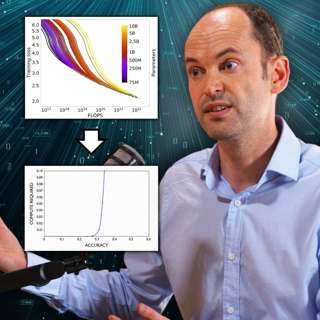
#219 – Toby Ord on graphs AI companies would prefer you didn't (fully) understand

#219 – Toby Ord on graphs AI companies would prefer you didn't (fully) understand

The era of making AI smarter just by making it bigger is ending. But that doesn’t mean progress is slowing down — far from it. AI models continue to get much more powerful, just using very different m...

24 Kesä 20252h 48min

#218 – Hugh White on why Trump is abandoning US hegemony – and that’s probably good

#218 – Hugh White on why Trump is abandoning US hegemony – and that’s probably good

For decades, US allies have slept soundly under the protection of America’s overwhelming military might. Donald Trump — with his threats to ditch NATO, seize Greenland, and abandon Taiwan — seems hell...

12 Kesä 20252h 48min

#217 – Beth Barnes on the most important graph in AI right now — and the 7-month rule that governs its progress

#217 – Beth Barnes on the most important graph in AI right now — and the 7-month rule that governs its progress

AI models today have a 50% chance of successfully completing a task that would take an expert human one hour. Seven months ago, that number was roughly 30 minutes — and seven months before that, 15 mi...

2 Kesä 20253h 47min
Beyond human minds: The bewildering frontier of consciousness in insects, AI, and more

Beyond human minds: The bewildering frontier of consciousness in insects, AI, and more

What if there’s something it’s like to be a shrimp — or a chatbot?For centuries, humans have debated the nature of consciousness, often placing ourselves at the very top. But what about the minds of o...

23 Touko 20253h 34min

Don’t believe OpenAI’s “nonprofit” spin (emergency pod with Tyler Whitmer)

Don’t believe OpenAI’s “nonprofit” spin (emergency pod with Tyler Whitmer)

OpenAI’s recent announcement that its nonprofit would “retain control” of its for-profit business sounds reassuring. But this seemingly major concession, celebrated by so many, is in itself largely me...

15 Touko 20251h 12min

The case for and against AGI by 2030 (article by Benjamin Todd)

The case for and against AGI by 2030 (article by Benjamin Todd)

More and more people have been saying that we might have AGI (artificial general intelligence) before 2030. Is that really plausible? This article by Benjamin Todd looks into the cases for and against...

12 Touko 20251h

Emergency pod: Did OpenAI give up, or is this just a new trap? (with Rose Chan Loui)

Emergency pod: Did OpenAI give up, or is this just a new trap? (with Rose Chan Loui)

When attorneys general intervene in corporate affairs, it usually means something has gone seriously wrong. In OpenAI’s case, it appears to have forced a dramatic reversal of the company’s plans to si...

8 Touko 20251h 2min

Suosittua kategoriassa Koulutus

rss-murhan-anatomia
voi-hyvin-meditaatiot-2
rss-narsisti
psykopodiaa-podcast
adhd-podi
rss-rahamania
rss-valo-minussa-2
rss-vapaudu-voimaasi
rss-niinku-asia-on
mielipaivakirja
rss-uskonto-on-tylsaa
aamukahvilla
rss-duodecim-lehti
ilona-rauhala
kesken
psykologia
rss-eron-alkemiaa
rss-koira-haudattuna
rss-arkea-ja-aurinkoa-podcast-espanjasta
ihminen-tavattavissa-tommy-hellsten-instituutti