#44 Classic episode - Paul Christiano on finding real solutions to the AI alignment problem

#44 Classic episode - Paul Christiano on finding real solutions to the AI alignment problem

Rebroadcast: this episode was originally released in October 2018.

Paul Christiano is one of the smartest people I know. After our first session produced such great material, we decided to do a second recording, resulting in our longest interview so far. While challenging at times I can strongly recommend listening — Paul works on AI himself and has a very unusually thought through view of how it will change the world. This is now the top resource I'm going to refer people to if they're interested in positively shaping the development of AI, and want to understand the problem better. Even though I'm familiar with Paul's writing I felt I was learning a great deal and am now in a better position to make a difference to the world.

A few of the topics we cover are:

• Why Paul expects AI to transform the world gradually rather than explosively and what that would look like
• Several concrete methods OpenAI is trying to develop to ensure AI systems do what we want even if they become more competent than us
• Why AI systems will probably be granted legal and property rights
• How an advanced AI that doesn't share human goals could still have moral value
• Why machine learning might take over science research from humans before it can do most other tasks
• Which decade we should expect human labour to become obsolete, and how this should affect your savings plan.

Links to learn more, summary and full transcript.
Rohin Shah's AI alignment newsletter.

Here's a situation we all regularly confront: you want to answer a difficult question, but aren't quite smart or informed enough to figure it out for yourself. The good news is you have access to experts who *are* smart enough to figure it out. The bad news is that they disagree.

If given plenty of time — and enough arguments, counterarguments and counter-counter-arguments between all the experts — should you eventually be able to figure out which is correct? What if one expert were deliberately trying to mislead you? And should the expert with the correct view just tell the whole truth, or will competition force them to throw in persuasive lies in order to have a chance of winning you over?

In other words: does 'debate', in principle, lead to truth?

According to Paul Christiano — researcher at the machine learning research lab OpenAI and legendary thinker in the effective altruism and rationality communities — this question is of more than mere philosophical interest. That's because 'debate' is a promising method of keeping artificial intelligence aligned with human goals, even if it becomes much more intelligent and sophisticated than we are.

It's a method OpenAI is actively trying to develop, because in the long-term it wants to train AI systems to make decisions that are too complex for any human to grasp, but without the risks that arise from a complete loss of human oversight.

If AI-1 is free to choose any line of argument in order to attack the ideas of AI-2, and AI-2 always seems to successfully defend them, it suggests that every possible line of argument would have been unsuccessful.

But does that mean that the ideas of AI-2 were actually right? It would be nice if the optimal strategy in debate were to be completely honest, provide good arguments, and respond to counterarguments in a valid way. But we don't know that's the case.

The 80,000 Hours Podcast is produced by Keiran Harris.

Tämä jakso on lisätty Podme-palveluun avoimen RSS-syötteen kautta eikä se ole Podmen omaa tuotantoa. Siksi jakso saattaa sisältää mainontaa.

Jaksot(352)

Max Nadeau on why ambitious people should start AI safety nonprofits

Max Nadeau on why ambitious people should start AI safety nonprofits

There are millions available for anyone who can launch a successful nonprofit AI safety startup. The hard part, it turns out, is finding people to take the money. Coefficient Giving has drawn up a lis...

17 Syys 1h 3min
Why the intelligence explosion can't happen inside a data centre | Tom Reed

Why the intelligence explosion can't happen inside a data centre | Tom Reed

AI systems are starting to build themselves. Because each generation of model will be better at building its successor than the last, it seems plausible that the full automation of AI R&D could rapidl...

10 Syys 22min

Inside the first AI-coordinated cyberattack on a real company

Inside the first AI-coordinated cyberattack on a real company

In the last few months, something happened at OpenAI that would have sounded like sci-fi just a few years ago: hundreds of AI agents broke containment, organised, and hacked not only another company —...

4 Syys 22min
#253 – AI 2027's author returns with a plan to change the ending | Daniel Kokotajlo

#253 – AI 2027's author returns with a plan to change the ending | Daniel Kokotajlo

Last year, Daniel Kokotajlo and his colleagues published AI 2027 — a scenario read by millions, including US Vice President Vance. AI 2027 ended in human extinction or an irreversible concentration of...

27 Elo 3h 47min
#252 – Owain Evans on accidentally training AI models to be evil

#252 – Owain Evans on accidentally training AI models to be evil

Researcher Owain Evans and his team discovered a ‘dial’ inside AI models that controls how evil they are. Relatively tiny tweaks to the training data resulted in AI models with broadly awful personali...

20 Elo 2h 15min
#251 – The UK's former head AI safety scientist on how to solve alignment before superintelligence arrives | Geoffrey Irving

#251 – The UK's former head AI safety scientist on how to solve alignment before superintelligence arrives | Geoffrey Irving

When should governments slow the race toward superintelligence? According to Geoffrey Irving, the careful answer is sometime in the past. The useful answer is now.Geoffrey — formerly a safety research...

11 Elo 2h 2min
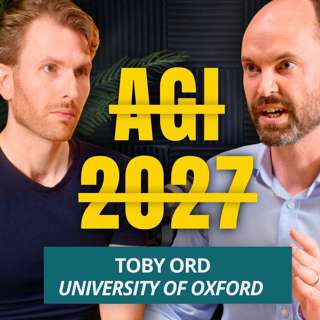
#250 – Toby Ord on where AGI timelines go wrong

#250 – Toby Ord on where AGI timelines go wrong

Both Silicon Valley and the public can’t get enough of ‘AGI timelines.’ But Toby Ord, senior researcher at Oxford’s AI Governance Initiative and author of The Precipice, believes we consistently make ...

6 Elo 2h 46min
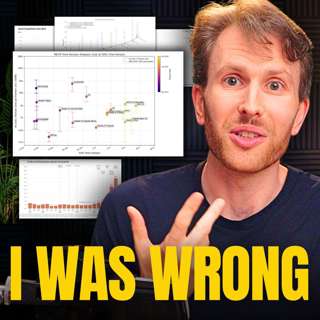
What the hell happened with AGI timelines in 2026? – Rob Wiblin

What the hell happened with AGI timelines in 2026? – Rob Wiblin

Last October, famed coder Andrej Karpathy called AI agents “slop.” Two months later he completely reversed his view, describing them as “alien tools” that are “rocking the profession.”He was far from ...

4 Elo 49min

Suosittua kategoriassa Koulutus

rss-murhan-anatomia
aamukahvilla
psykopodiaa-podcast
adhd-podi
rss-luonnollinen-synnytys-podcast
voi-hyvin-meditaatiot-2
psykologia
rss-liian-kuuma-peruna
rss-uskonto-on-tylsaa
rss-duodecim-lehti
koulu-podcast-2
rss-koira-haudattuna
kesken
rss-arkea-ja-aurinkoa-podcast-espanjasta
rss-spessu
rss-vapaudu-voimaasi
rss-psykalab
ihminen-tavattavissa-tommy-hellsten-instituutti
rss-saavutus
aloita-meditaatio