

#132 – Nova DasSarma on why information security may be critical to the safe development of AI systems

#132 – Nova DasSarma on why information security may be critical to the safe development of AI systems

If a business has spent $100 million developing a product, it's a fair bet that they don't want it stolen in two seconds and uploaded to the web where anyone can use it for free.

This problem exists in extreme form for AI companies. These days, the electricity and equipment required to train cutting-edge machine learning models that generate uncanny human text and images can cost tens or hundreds of millions of dollars. But once trained, such models may be only a few gigabytes in size and run just fine on ordinary laptops.

Today's guest, the computer scientist and polymath Nova DasSarma, works on computer and information security for the AI company Anthropic. One of her jobs is to stop hackers exfiltrating Anthropic's incredibly expensive intellectual property, as recently happened to Nvidia. As she explains, given models’ small size, the need to store such models on internet-connected servers, and the poor state of computer security in general, this is a serious challenge.

Links to learn more, summary and full transcript.

The worries aren't purely commercial though. This problem looms especially large for the growing number of people who expect that in coming decades we'll develop so-called artificial 'general' intelligence systems that can learn and apply a wide range of skills all at once, and thereby have a transformative effect on society.

If aligned with the goals of their owners, such general AI models could operate like a team of super-skilled assistants, going out and doing whatever wonderful (or malicious) things are asked of them. This might represent a huge leap forward for humanity, though the transition to a very different new economy and power structure would have to be handled delicately.

If unaligned with the goals of their owners or humanity as a whole, such broadly capable models would naturally 'go rogue,' breaking their way into additional computer systems to grab more computing power — all the better to pursue their goals and make sure they can't be shut off.

As Nova explains, in either case, we don't want such models disseminated all over the world before we've confirmed they are deeply safe and law-abiding, and have figured out how to integrate them peacefully into society. In the first scenario, premature mass deployment would be risky and destabilising. In the second scenario, it could be catastrophic -- perhaps even leading to human extinction if such general AI systems turn out to be able to self-improve rapidly rather than slowly.

If highly capable general AI systems are coming in the next 10 or 20 years, Nova may be flying below the radar with one of the most important jobs in the world.

We'll soon need the ability to 'sandbox' (i.e. contain) models with a wide range of superhuman capabilities, including the ability to learn new skills, for a period of careful testing and limited deployment — preventing the model from breaking out, and criminals from breaking in. Nova and her colleagues are trying to figure out how to do this, but as this episode reveals, even the state of the art is nowhere near good enough.

In today's conversation, Rob and Nova cover:

• How good or bad is information security today
• The most secure computer systems that exist
• How to design an AI training compute centre for maximum efficiency
• Whether 'formal verification' can help us design trustworthy systems
• How wide the gap is between AI capabilities and AI safety
• How to disincentivise hackers
• What should listeners do to strengthen their own security practices
• And much more.

Get this episode by subscribing to our podcast on the world’s most pressing problems and how to solve them: type 80,000 Hours into your podcasting app.

Producer: Keiran Harris
Audio mastering: Ben Cordell and Beppe Rådvik
Transcriptions: Katy Moore

Jaksot(326)

Rebuilding after apocalypse: What 13 experts say about bouncing back

Rebuilding after apocalypse: What 13 experts say about bouncing back

What happens when civilisation faces its greatest tests?This compilation brings together insights from researchers, defence experts, philosophers, and policymakers on humanity’s ability to survive and...

15 Heinä 20254h 26min

#220 – Ryan Greenblatt on the 4 most likely ways for AI to take over, and the case for and against AGI in <8 years

#220 – Ryan Greenblatt on the 4 most likely ways for AI to take over, and the case for and against AGI in <8 years

Ryan Greenblatt — lead author on the explosive paper “Alignment faking in large language models” and chief scientist at Redwood Research — thinks there’s a 25% chance that within four years, AI will b...

8 Heinä 20252h 50min
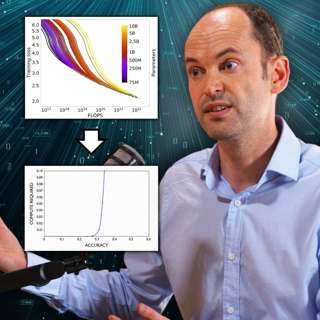
#219 – Toby Ord on graphs AI companies would prefer you didn't (fully) understand

#219 – Toby Ord on graphs AI companies would prefer you didn't (fully) understand

The era of making AI smarter just by making it bigger is ending. But that doesn’t mean progress is slowing down — far from it. AI models continue to get much more powerful, just using very different m...

24 Kesä 20252h 48min

#218 – Hugh White on why Trump is abandoning US hegemony – and that’s probably good

#218 – Hugh White on why Trump is abandoning US hegemony – and that’s probably good

For decades, US allies have slept soundly under the protection of America’s overwhelming military might. Donald Trump — with his threats to ditch NATO, seize Greenland, and abandon Taiwan — seems hell...

12 Kesä 20252h 48min

#217 – Beth Barnes on the most important graph in AI right now — and the 7-month rule that governs its progress

#217 – Beth Barnes on the most important graph in AI right now — and the 7-month rule that governs its progress

AI models today have a 50% chance of successfully completing a task that would take an expert human one hour. Seven months ago, that number was roughly 30 minutes — and seven months before that, 15 mi...

2 Kesä 20253h 47min

Beyond human minds: The bewildering frontier of consciousness in insects, AI, and more

Beyond human minds: The bewildering frontier of consciousness in insects, AI, and more

What if there’s something it’s like to be a shrimp — or a chatbot?For centuries, humans have debated the nature of consciousness, often placing ourselves at the very top. But what about the minds of o...

23 Touko 20253h 34min

Don’t believe OpenAI’s “nonprofit” spin (emergency pod with Tyler Whitmer)

Don’t believe OpenAI’s “nonprofit” spin (emergency pod with Tyler Whitmer)

OpenAI’s recent announcement that its nonprofit would “retain control” of its for-profit business sounds reassuring. But this seemingly major concession, celebrated by so many, is in itself largely me...

15 Touko 20251h 12min

The case for and against AGI by 2030 (article by Benjamin Todd)

The case for and against AGI by 2030 (article by Benjamin Todd)

More and more people have been saying that we might have AGI (artificial general intelligence) before 2030. Is that really plausible? This article by Benjamin Todd looks into the cases for and against...

12 Touko 20251h

Suosittua kategoriassa Koulutus

rss-murhan-anatomia
voi-hyvin-meditaatiot-2
psykopodiaa-podcast
rss-narsisti
adhd-podi
rahapuhetta
rss-rahamania
kesken
psykologia
rss-liian-kuuma-peruna
rss-niinku-asia-on
rss-eron-alkemiaa
rss-arkea-ja-aurinkoa-podcast-espanjasta
esa-saarinen-filosofia-ja-systeemiajattelu
rss-duodecim-lehti
rss-vapaudu-voimaasi
rss-luonnollinen-synnytys-podcast
rss-tietoinen-yhteys-podcast-2
rss-finnish-daily-dialogues
ihminen-tavattavissa-tommy-hellsten-instituutti