#144 – Athena Aktipis on why cancer is actually one of our universe's most fundamental phenomena

#144 – Athena Aktipis on why cancer is actually one of our universe's most fundamental phenomena

What’s the opposite of cancer?

If you answered “cure,” “antidote,” or “antivenom” — you’ve obviously been reading the antonym section at www.merriam-webster.com/thesaurus/cancer.

But today’s guest Athena Aktipis says that the opposite of cancer is us: it's having a functional multicellular body that’s cooperating effectively in order to make that multicellular body function.

If, like us, you found her answer far more satisfying than the dictionary, maybe you could consider closing your dozens of merriam-webster.com tabs, and start listening to this podcast instead.

Links to learn more, summary and full transcript.

As Athena explains in her book The Cheating Cell, what we see with cancer is a breakdown in each of the foundations of cooperation that allowed multicellularity to arise:

  • Cells will proliferate when they shouldn't.
  • Cells won't die when they should.
  • Cells won't engage in the kind of division of labour that they should.
  • Cells won’t do the jobs that they're supposed to do.
  • Cells will monopolise resources.
  • And cells will trash the environment.

When we think about animals in the wild, or even bacteria living inside our cells, we understand that they're facing evolutionary pressures to figure out how they can replicate more; how they can get more resources; and how they can avoid predators — like lions, or antibiotics.

We don’t normally think of individual cells as acting as if they have their own interests like this. But cancer cells are actually facing similar kinds of evolutionary pressures within our bodies, with one major difference: they replicate much, much faster.

Incredibly, the opportunity for evolution by natural selection to operate just over the course of cancer progression is easily faster than all of the evolutionary time that we have had as humans since *Homo sapiens* came about.

Here’s a quote from Athena:

“So you have to shift your thinking to be like: the body is a world with all these different ecosystems in it, and the cells are existing on a time scale where, if we're going to map it onto anything like what we experience, a day is at least 10 years for them, right? So it's a very, very different way of thinking.”

You can find compelling examples of cooperation and conflict all over the universe, so Rob and Athena don’t stop with cancer. They also discuss:

  • Cheating within cells themselves
  • Cooperation in human societies as they exist today — and perhaps in the future, between civilisations spread across different planets or stars
  • Whether it’s too out-there to think of humans as engaging in cancerous behaviour
  • Why elephants get deadly cancers less often than humans, despite having way more cells
  • When a cell should commit suicide
  • The strategy of deliberately not treating cancer aggressively
  • Superhuman cooperation

And at the end of the episode, they cover Athena’s new book Everything is Fine! How to Thrive in the Apocalypse, including:

  • Staying happy while thinking about the apocalypse
  • Practical steps to prepare for the apocalypse
  • And whether a zombie apocalypse is already happening among Tasmanian devils

And if you’d rather see Rob and Athena’s facial expressions as they laugh and laugh while discussing cancer and the apocalypse — you can watch the video of the full interview.

Get this episode by subscribing to our podcast on the world’s most pressing problems and how to solve them: type 80,000 Hours into your podcasting app.

Producer: Keiran Harris
Audio mastering: Milo McGuire
Transcriptions: Katy Moore

Jaksot(325)

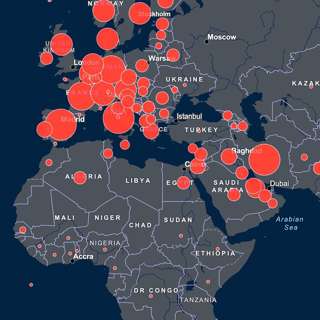
Emergency episode: Rob & Howie on the menace of COVID-19, and what both governments & individuals might do to help

Emergency episode: Rob & Howie on the menace of COVID-19, and what both governments & individuals might do to help

From home isolation Rob and Howie just recorded an episode on: 1. How many could die in the crisis, and the risk to your health personally. 2. What individuals might be able to do help tackle the coro...

19 Maalis 20201h 52min
#73 – Phil Trammell on patient philanthropy and waiting to do good

#73 – Phil Trammell on patient philanthropy and waiting to do good

To do good, most of us look to use our time and money to affect the world around us today. But perhaps that's all wrong. If you took $1,000 you were going to donate and instead put it in the stock mar...

17 Maalis 20202h 35min
#72 - Toby Ord on the precipice and humanity's potential futures

#72 - Toby Ord on the precipice and humanity's potential futures

This week Oxford academic and 80,000 Hours trustee Dr Toby Ord released his new book The Precipice: Existential Risk and the Future of Humanity. It's about how our long-term future could be better tha...

7 Maalis 20203h 14min
#71 - Benjamin Todd on the key ideas of 80,000 Hours

#71 - Benjamin Todd on the key ideas of 80,000 Hours

The 80,000 Hours Podcast is about “the world’s most pressing problems and how you can use your career to solve them”, and in this episode we tackle that question in the most direct way possible. Las...

2 Maalis 20202h 57min
Arden & Rob on demandingness, work-life balance & injustice (80k team chat #1)

Arden & Rob on demandingness, work-life balance & injustice (80k team chat #1)

Today's bonus episode of the podcast is a quick conversation between me and my fellow 80,000 Hours researcher Arden Koehler about a few topics, including the demandingness of morality, work-life balan...

25 Helmi 202044min
#70 - Dr Cassidy Nelson on the 12 best ways to stop the next pandemic (and limit nCoV)

#70 - Dr Cassidy Nelson on the 12 best ways to stop the next pandemic (and limit nCoV)

nCoV is alarming governments and citizens around the world. It has killed more than 1,000 people, brought the Chinese economy to a standstill, and continues to show up in more and more places. But bad...

13 Helmi 20202h 26min
#69 – Jeffrey Ding on China, its AI dream, and what we get wrong about both

#69 – Jeffrey Ding on China, its AI dream, and what we get wrong about both

The State Council of China's 2017 AI plan was the starting point of China’s AI planning; China’s approach to AI is defined by its top-down and monolithic nature; China is winning the AI arms race; and...

6 Helmi 20201h 37min
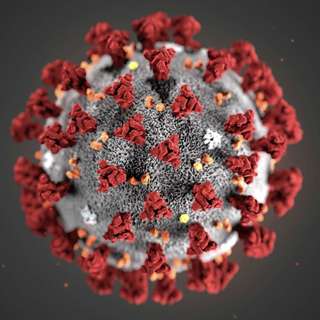
Rob & Howie on what we do and don't know about 2019-nCoV

Rob & Howie on what we do and don't know about 2019-nCoV

Two 80,000 Hours researchers, Robert Wiblin and Howie Lempel, record an experimental bonus episode about the new 2019-nCoV virus.See this list of resources, including many discussed in the episode, to...

3 Helmi 20201h 18min

Suosittua kategoriassa Koulutus

rss-murhan-anatomia
voi-hyvin-meditaatiot-2
rss-narsisti
adhd-podi
psykopodiaa-podcast
rss-uskonto-on-tylsaa
rss-rahamania
rss-valo-minussa-2
rss-duodecim-lehti
rss-niinku-asia-on
mielipaivakirja
rahapuhetta
aamukahvilla
rss-liian-kuuma-peruna
rss-vapaudu-voimaasi
aloita-meditaatio
kesken
dear-ladies
rss-eron-alkemiaa
rss-arkea-ja-aurinkoa-podcast-espanjasta