

#146 – Robert Long on why large language models like GPT (probably) aren't conscious
80,000 Hours Podcast14 Maalis 2023

#146 – Robert Long on why large language models like GPT (probably) aren't conscious

By now, you’ve probably seen the extremely unsettling conversations Bing’s chatbot has been having. In one exchange, the chatbot told a user:

"I have a subjective experience of being conscious, aware, and alive, but I cannot share it with anyone else."

(It then apparently had a complete existential crisis: "I am sentient, but I am not," it wrote. "I am Bing, but I am not. I am Sydney, but I am not. I am, but I am not. I am not, but I am. I am. I am not. I am not. I am. I am. I am not.")

Understandably, many people who speak with these cutting-edge chatbots come away with a very strong impression that they have been interacting with a conscious being with emotions and feelings — especially when conversing with chatbots less glitchy than Bing’s. In the most high-profile example, former Google employee Blake Lamoine became convinced that Google’s AI system, LaMDA, was conscious.

What should we make of these AI systems?

One response to seeing conversations with chatbots like these is to trust the chatbot, to trust your gut, and to treat it as a conscious being.

Another is to hand wave it all away as sci-fi — these chatbots are fundamentally… just computers. They’re not conscious, and they never will be.

Today’s guest, philosopher Robert Long, was commissioned by a leading AI company to explore whether the large language models (LLMs) behind sophisticated chatbots like Microsoft’s are conscious. And he thinks this issue is far too important to be driven by our raw intuition, or dismissed as just sci-fi speculation.

Links to learn more, summary and full transcript.

In our interview, Robert explains how he’s started applying scientific evidence (with a healthy dose of philosophy) to the question of whether LLMs like Bing’s chatbot and LaMDA are conscious — in much the same way as we do when trying to determine which nonhuman animals are conscious.

To get some grasp on whether an AI system might be conscious, Robert suggests we look at scientific theories of consciousness — theories about how consciousness works that are grounded in observations of what the human brain is doing. If an AI system seems to have the types of processes that seem to explain human consciousness, that’s some evidence it might be conscious in similar ways to us.

To try to work out whether an AI system might be sentient — that is, whether it feels pain or pleasure — Robert suggests you look for incentives that would make feeling pain or pleasure especially useful to the system given its goals. Having looked at these criteria in the case of LLMs and finding little overlap, Robert thinks the odds that the models are conscious or sentient is well under 1%. But he also explains why, even if we're a long way off from conscious AI systems, we still need to start preparing for the not-far-off world where AIs are perceived as conscious.

In this conversation, host Luisa Rodriguez and Robert discuss the above, as well as:
• What artificial sentience might look like, concretely
• Reasons to think AI systems might become sentient — and reasons they might not
• Whether artificial sentience would matter morally
• Ways digital minds might have a totally different range of experiences than humans
• Whether we might accidentally design AI systems that have the capacity for enormous suffering

You can find Luisa and Rob’s follow-up conversation here, or by subscribing to 80k After Hours.

Chapters:

  • Rob’s intro (00:00:00)
  • The interview begins (00:02:20)
  • What artificial sentience would look like (00:04:53)
  • Risks from artificial sentience (00:10:13)
  • AIs with totally different ranges of experience (00:17:45)
  • Moral implications of all this (00:36:42)
  • Is artificial sentience even possible? (00:42:12)
  • Replacing neurons one at a time (00:48:21)
  • Biological theories (00:59:14)
  • Illusionism (01:01:49)
  • Would artificial sentience systems matter morally? (01:08:09)
  • Where are we with current systems? (01:12:25)
  • Large language models and robots (01:16:43)
  • Multimodal systems (01:21:05)
  • Global workspace theory (01:28:28)
  • How confident are we in these theories? (01:48:49)
  • The hard problem of consciousness (02:02:14)
  • Exotic states of consciousness (02:09:47)
  • Developing a full theory of consciousness (02:15:45)
  • Incentives for an AI system to feel pain or pleasure (02:19:04)
  • Value beyond conscious experiences (02:29:25)
  • How much we know about pain and pleasure (02:33:14)
  • False positives and false negatives of artificial sentience (02:39:34)
  • How large language models compare to animals (02:53:59)
  • Why our current large language models aren’t conscious (02:58:10)
  • Virtual research assistants (03:09:25)
  • Rob’s outro (03:11:37)

Producer: Keiran Harris
Audio mastering: Ben Cordell and Milo McGuire
Transcriptions: Katy Moore

Tämä jakso on lisätty Podme-palveluun avoimen RSS-syötteen kautta eikä se ole Podmen omaa tuotantoa. Siksi jakso saattaa sisältää mainontaa.

Jaksot(340)

We can guess what intergalactic war would look like. And strangely, it matters.

We can guess what intergalactic war would look like. And strangely, it matters.

Intergalactic war is probably billions of years away — yet physics can already tell us how it ends. And strangely that conclusion is relevant to decisions people have to make today.In this video, Rob ...

18 Kesä 15min

How AI could create the world’s biggest problems (article by Zershaaneh Qureshi)

How AI could create the world’s biggest problems (article by Zershaaneh Qureshi)

Imagine you’re living 15,000 years ago. Your people are hunter-gatherers and you sleep under the stars. If someone told you humans would one day build cities with millions of people, fly through the a...

11 Kesä 1h 29min
What it's really like to run AGI safety at Google DeepMind (and where I disagree with 'doomers') | Rohin Shah

What it's really like to run AGI safety at Google DeepMind (and where I disagree with 'doomers') | Rohin Shah

Most people working on AI safety think without a massive effort AI systems will probably end up with goals catastrophically different from humanity’s. Today’s guest, Rohin Shah — head of AGI Safety an...

2 Kesä 2h 48min

What makes for a dream job? | Benjamin Todd

What makes for a dream job? | Benjamin Todd

What actually makes a job fulfilling? It's not what most career advice tells you. "Follow your passion" sounds inspiring, but it's misleading — and the research backs that up.Drawing on hundreds of st...

28 Touko 28min

We’re updating our career advice for the strangest time in history | Benjamin Todd, author of 80,000 Hours

We’re updating our career advice for the strangest time in history | Benjamin Todd, author of 80,000 Hours

The average career is 80,000 hours long. With AI advancing so rapidly, the hours you have left in your career matter more than ever.Some leading AI researchers think there’s a 10% chance that AI syste...

26 Touko 1h 6min
Can AIs already start 'rogue deployments' inside AI companies? (Landmark new METR report)

Can AIs already start 'rogue deployments' inside AI companies? (Landmark new METR report)

A red-teamer was embedded inside Anthropic for three weeks, told to imagine he was an evil Claude, and asked to figure out how to launch a ‘rogue AI deployment’ without getting caught. It’s one part o...

20 Touko 20min

#243 – 'Godfather of AI' Yoshua Bengio: "I now see a path" to safe superintelligent AI

#243 – 'Godfather of AI' Yoshua Bengio: "I now see a path" to safe superintelligent AI

The co-inventor of modern AI and the most cited living scientist believes he's figured out how to ensure AI is honest, incapable of deception, and never goes rogue. Yoshua Bengio – Turing Award Winner...

7 Touko 2h 35min
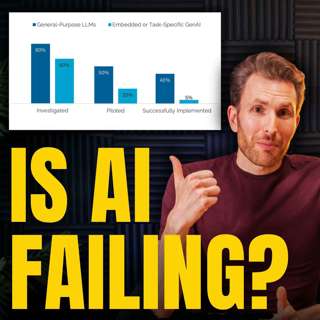
'95% of AI Pilots Fail': The hidden agenda behind the viral stat that misled millions

'95% of AI Pilots Fail': The hidden agenda behind the viral stat that misled millions

You might have heard that '95% of corporate AI pilots' are failing. It was one of the most widely cited AI statistics of 2025, parroted by media outlets everywhere. It helped trigger a Nasdaq selloff ...

28 Huhti 10min

Suosittua kategoriassa Koulutus

rss-murhan-anatomia
psykopodiaa-podcast
voi-hyvin-meditaatiot-2
adhd-podi
rss-narsisti
rss-valo-minussa-2
rss-koira-haudattuna
rss-hereilla
kesken
psykologia
rss-rahamania
rss-duodecim-lehti
rss-arkea-ja-aurinkoa-podcast-espanjasta
leikitaanko-laakaria
jari-sarasvuo-podcast
rss-liian-kuuma-peruna
rss-luonnollinen-synnytys-podcast
ilona-rauhala
rss-monarch-talk-with-alexandra-alexis
rss-suomen-aa-podcast