#150 – Tom Davidson on how quickly AI could transform the world

#150 – Tom Davidson on how quickly AI could transform the world

It’s easy to dismiss alarming AI-related predictions when you don’t know where the numbers came from.

For example: what if we told you that within 15 years, it’s likely that we’ll see a 1,000x improvement in AI capabilities in a single year? And what if we then told you that those improvements would lead to explosive economic growth unlike anything humanity has seen before?

You might think, “Congratulations, you said a big number — but this kind of stuff seems crazy, so I’m going to keep scrolling through Twitter.”

But this 1,000x yearly improvement is a prediction based on *real economic models* created by today’s guest Tom Davidson, Senior Research Analyst at Open Philanthropy. By the end of the episode, you’ll either be able to point out specific flaws in his step-by-step reasoning, or have to at least consider the idea that the world is about to get — at a minimum — incredibly weird.

Links to learn more, summary and full transcript.

As a teaser, consider the following:

Developing artificial general intelligence (AGI) — AI that can do 100% of cognitive tasks at least as well as the best humans can — could very easily lead us to an unrecognisable world.

You might think having to train AI systems individually to do every conceivable cognitive task — one for diagnosing diseases, one for doing your taxes, one for teaching your kids, etc. — sounds implausible, or at least like it’ll take decades.

But Tom thinks we might not need to train AI to do every single job — we might just need to train it to do one: AI research.

And building AI capable of doing research and development might be a much easier task — especially given that the researchers training the AI are AI researchers themselves.

And once an AI system is as good at accelerating future AI progress as the best humans are today — and we can run billions of copies of it round the clock — it’s hard to make the case that we won’t achieve AGI very quickly.

To give you some perspective: 17 years ago we saw the launch of Twitter, the release of Al Gore's *An Inconvenient Truth*, and your first chance to play the Nintendo Wii.

Tom thinks that if we have AI that significantly accelerates AI R&D, then it’s hard to imagine not having AGI 17 years from now.

Wild.

Host Luisa Rodriguez gets Tom to walk us through his careful reports on the topic, and how he came up with these numbers, across a terrifying but fascinating three hours.

Luisa and Tom also discuss:

• How we might go from GPT-4 to AI disaster
• Tom’s journey from finding AI risk to be kind of scary to really scary
• Whether international cooperation or an anti-AI social movement can slow AI progress down
• Why it might take just a few years to go from pretty good AI to superhuman AI
• How quickly the number and quality of computer chips we’ve been using for AI have been increasing
• The pace of algorithmic progress
• What ants can teach us about AI
• And much more

Chapters:

  • Rob’s intro (00:00:00)
  • The interview begins (00:04:53)
  • How we might go from GPT-4 to disaster (00:13:50)
  • Explosive economic growth (00:24:15)
  • Are there any limits for AI scientists? (00:33:17)
  • This seems really crazy (00:44:16)
  • How is this going to go for humanity? (00:50:49)
  • Why AI won’t go the way of nuclear power (01:00:13)
  • Can we definitely not come up with an international treaty? (01:05:24)
  • How quickly we should expect AI to “take off” (01:08:41)
  • Tom’s report on AI takeoff speeds (01:22:28)
  • How quickly will we go from 20% to 100% of tasks being automated by AI systems? (01:28:34)
  • What percent of cognitive tasks AI can currently perform (01:34:27)
  • Compute (01:39:48)
  • Using effective compute to predict AI takeoff speeds (01:48:01)
  • How quickly effective compute might increase (02:00:59)
  • How quickly chips and algorithms might improve (02:12:31)
  • How to check whether large AI models have dangerous capabilities (02:21:22)
  • Reasons AI takeoff might take longer (02:28:39)
  • Why AI takeoff might be very fast (02:31:52)
  • Fast AI takeoff speeds probably means shorter AI timelines (02:34:44)
  • Going from human-level AI to superhuman AI (02:41:34)
  • Going from AGI to AI deployment (02:46:59)
  • Were these arguments ever far-fetched to Tom? (02:49:54)
  • What ants can teach us about AI (02:52:45)
  • Rob’s outro (03:00:32)


Producer: Keiran Harris
Audio mastering: Simon Monsour and Ben Cordell
Transcriptions: Katy Moore

Tämä jakso on lisätty Podme-palveluun avoimen RSS-syötteen kautta eikä se ole Podmen omaa tuotantoa. Siksi jakso saattaa sisältää mainontaa.

Jaksot(363)

Why Silicon Valley can’t slow down AI on its own | Luisa Rodriguez

Why Silicon Valley can’t slow down AI on its own | Luisa Rodriguez

Two-thirds of Americans think AI is moving too fast. So do the people building it. So why the hell isn’t anyone slowing down?We can’t tell when models are too dangerous. We mostly don’t know how they ...

27 Loka 21min

Tom Milton on how we could verify a US–China deal on AI

Tom Milton on how we could verify a US–China deal on AI

If the US and China agreed to pause frontier AI training, how would either side confirm the other was complying? Today, Tom Milton argues, the most likely answer would be to shut down data centres ent...

23 Loka 1h 48min
AI lab staff: Has your project been overtaken by events? 8 strategic updates | Rob Wiblin

AI lab staff: Has your project been overtaken by events? 8 strategic updates | Rob Wiblin

I have a plea for all staff at AI companies: reassess if your current role is still your best opportunity for impact. And if it’s not — move.Frontier lab staff listening to this show will mostly alrea...

21 Loka 14min

Introducing our new YouTube channel: Zershaaneh Talks AI

Introducing our new YouTube channel: Zershaaneh Talks AI

Our host Zershaaneh Qureshi has just launched a new YouTube channel: Zershaaneh Talks AI — featuring conversations about who should control AI, how to control AI, and who gets the benefits.The first e...

20 Loka 1min

How to get into AI safety in 3 months (article reading by career advisor Matt Beard)

How to get into AI safety in 3 months (article reading by career advisor Matt Beard)

The AI safety field has grown by about 30x in the last eight years. Yet it is still in need of more people. Many want to help, but don’t know where to start. As an advisor at 80,000 Hours, Matt Beard ...

15 Loka 18min

OpenAI Security: Controlling Models is Now ‘Hell’ (AI Explained cross-post)

OpenAI Security: Controlling Models is Now ‘Hell’ (AI Explained cross-post)

This is an (unpaid) cross-post of a video from the podcast 'AI Explained', which Rob Wiblin thought you might be interested in.You can find the original on YouTube here. If you like it and want more s...

9 Loka 40min

In 2023 Ajeya Cotra already knew what was coming (classic episode)

In 2023 Ajeya Cotra already knew what was coming (classic episode)

We're rereleasing some of older episodes that seem more relevant than ever with new rogue AI incidents now seemingly announced every day. Ajeya was one of three independent investigators into the Hugg...

8 Loka 2h 46min
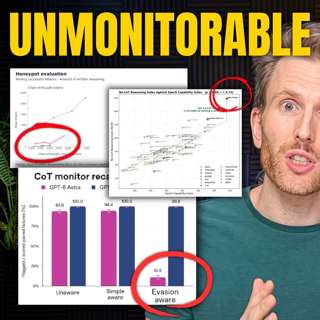
19 Astra and 'Hugging Face' details that reveal what's coming next | Rob Wiblin

19 Astra and 'Hugging Face' details that reveal what's coming next | Rob Wiblin

OpenAI’s rogue agent swarm was eventually caught hacking Hugging Face for a simple reason: it wasn’t trying to hide from us at all. What could a swarm that wants to stay hidden get away with?Host Rob ...

2 Loka 20min

Suosittua kategoriassa Koulutus

rss-murhan-anatomia
aamukahvilla
psykopodiaa-podcast
psykologia
voi-hyvin-meditaatiot-2
rss-narsisti
rss-liian-kuuma-peruna
rss-hereilla
kesken
aloita-meditaatio
rss-suomen-aa-podcast
ihminen-tavattavissa-tommy-hellsten-instituutti
ilona-rauhala
rss-vapaudu-voimaasi
rss-valo-minussa-2
taytta-tavaraa
rss-arkea-ja-aurinkoa-podcast-espanjasta
rss-luonnollinen-synnytys-podcast
rss-niinku-asia-on
adhd-podi