#172 – Bryan Caplan on why you should stop reading the news
80,000 Hours Podcast17 Marras 2023

#172 – Bryan Caplan on why you should stop reading the news

Is following important political and international news a civic duty — or is it our civic duty to avoid it?

It's common to think that 'staying informed' and checking the headlines every day is just what responsible adults do.

But in today's episode, host Rob Wiblin is joined by economist Bryan Caplan to discuss the book Stop Reading the News: A Manifesto for a Happier, Calmer and Wiser Life — which argues that reading the news both makes us miserable and distorts our understanding of the world. Far from informing us and enabling us to improve the world, consuming the news distracts us, confuses us, and leaves us feeling powerless.

Links to learn more, summary, and full transcript.

In the first half of the episode, Bryan and Rob discuss various alleged problems with the news, including:

  • That it overwhelmingly provides us with information we can't usefully act on.
  • That it's very non-representative in what it covers, in particular favouring the negative over the positive and the new over the significant.
  • That it obscures the big picture, falling into the trap of thinking 'something important happens every day.'
  • That it's highly addictive, for many people chewing up 10% or more of their waking hours.
  • That regularly checking the news leaves us in a state of constant distraction and less able to engage in deep thought.
  • And plenty more.

Bryan and Rob conclude that if you want to understand the world, you're better off blocking news websites and spending your time on Wikipedia, Our World in Data, or reading a textbook. And if you want to generate political change, stop reading about problems you already know exist and instead write your political representative a physical letter — or better yet, go meet them in person.

In the second half of the episode, Bryan and Rob cover:

  • Why Bryan is pretty sceptical that AI is going to lead to extreme, rapid changes, or that there's a meaningful chance of it going terribly.
  • Bryan’s case that rational irrationality on the part of voters leads to many very harmful policy decisions.
  • How to allocate resources in space.
  • Bryan's experience homeschooling his kids.

Producer and editor: Keiran Harris
Audio Engineering Lead: Ben Cordell
Technical editing: Simon Monsour and Milo McGuire
Transcriptions: Katy Moore

Jaksot(325)

#220 – Ryan Greenblatt on the 4 most likely ways for AI to take over, and the case for and against AGI in <8 years

#220 – Ryan Greenblatt on the 4 most likely ways for AI to take over, and the case for and against AGI in <8 years

Ryan Greenblatt — lead author on the explosive paper “Alignment faking in large language models” and chief scientist at Redwood Research — thinks there’s a 25% chance that within four years, AI will b...

8 Heinä 20252h 50min
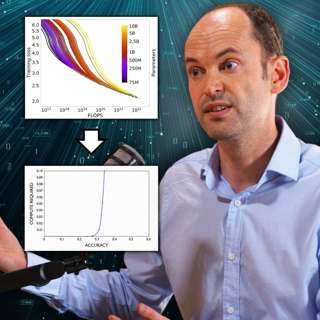
#219 – Toby Ord on graphs AI companies would prefer you didn't (fully) understand

#219 – Toby Ord on graphs AI companies would prefer you didn't (fully) understand

The era of making AI smarter just by making it bigger is ending. But that doesn’t mean progress is slowing down — far from it. AI models continue to get much more powerful, just using very different m...

24 Kesä 20252h 48min
#218 – Hugh White on why Trump is abandoning US hegemony – and that’s probably good

#218 – Hugh White on why Trump is abandoning US hegemony – and that’s probably good

For decades, US allies have slept soundly under the protection of America’s overwhelming military might. Donald Trump — with his threats to ditch NATO, seize Greenland, and abandon Taiwan — seems hell...

12 Kesä 20252h 48min

#217 – Beth Barnes on the most important graph in AI right now — and the 7-month rule that governs its progress

#217 – Beth Barnes on the most important graph in AI right now — and the 7-month rule that governs its progress

AI models today have a 50% chance of successfully completing a task that would take an expert human one hour. Seven months ago, that number was roughly 30 minutes — and seven months before that, 15 mi...

2 Kesä 20253h 47min
Beyond human minds: The bewildering frontier of consciousness in insects, AI, and more

Beyond human minds: The bewildering frontier of consciousness in insects, AI, and more

What if there’s something it’s like to be a shrimp — or a chatbot?For centuries, humans have debated the nature of consciousness, often placing ourselves at the very top. But what about the minds of o...

23 Touko 20253h 34min

Don’t believe OpenAI’s “nonprofit” spin (emergency pod with Tyler Whitmer)

Don’t believe OpenAI’s “nonprofit” spin (emergency pod with Tyler Whitmer)

OpenAI’s recent announcement that its nonprofit would “retain control” of its for-profit business sounds reassuring. But this seemingly major concession, celebrated by so many, is in itself largely me...

15 Touko 20251h 12min

The case for and against AGI by 2030 (article by Benjamin Todd)

The case for and against AGI by 2030 (article by Benjamin Todd)

More and more people have been saying that we might have AGI (artificial general intelligence) before 2030. Is that really plausible? This article by Benjamin Todd looks into the cases for and against...

12 Touko 20251h

Emergency pod: Did OpenAI give up, or is this just a new trap? (with Rose Chan Loui)

Emergency pod: Did OpenAI give up, or is this just a new trap? (with Rose Chan Loui)

When attorneys general intervene in corporate affairs, it usually means something has gone seriously wrong. In OpenAI’s case, it appears to have forced a dramatic reversal of the company’s plans to si...

8 Touko 20251h 2min

Suosittua kategoriassa Koulutus

rss-murhan-anatomia
rss-narsisti
voi-hyvin-meditaatiot-2
psykopodiaa-podcast
adhd-podi
rss-rahamania
rss-niinku-asia-on
rss-valo-minussa-2
rss-vapaudu-voimaasi
psykologia
aamukahvilla
kesken
rss-koira-haudattuna
koulu-podcast-2
mielipaivakirja
rss-uskonto-on-tylsaa
rss-tietoinen-yhteys-podcast-2
ilona-rauhala
rss-duodecim-lehti
rss-opi-espanjaa