
#173 – Jeff Sebo on digital minds, and how to avoid sleepwalking into a major moral catastrophe
80,000 Hours Podcast22 Marras 2023

#173 – Jeff Sebo on digital minds, and how to avoid sleepwalking into a major moral catastrophe

"We do have a tendency to anthropomorphise nonhumans — which means attributing human characteristics to them, even when they lack those characteristics. But we also have a tendency towards anthropodenial — which involves denying that nonhumans have human characteristics, even when they have them. And those tendencies are both strong, and they can both be triggered by different types of systems. So which one is stronger, which one is more probable, is again going to be contextual.

"But when we then consider that we, right now, are building societies and governments and economies that depend on the objectification, exploitation, and extermination of nonhumans, that — plus our speciesism, plus a lot of other biases and forms of ignorance that we have — gives us a strong incentive to err on the side of anthropodenial instead of anthropomorphism." — Jeff Sebo

In today’s episode, host Luisa Rodriguez interviews Jeff Sebo — director of the Mind, Ethics, and Policy Program at NYU — about preparing for a world with digital minds.

Links to learn more, highlights, and full transcript.

They cover:

  • The non-negligible chance that AI systems will be sentient by 2030
  • What AI systems might want and need, and how that might affect our moral concepts
  • What happens when beings can copy themselves? Are they one person or multiple people? Does the original own the copy or does the copy have its own rights? Do copies get the right to vote?
  • What kind of legal and political status should AI systems have? Legal personhood? Political citizenship?
  • What happens when minds can be connected? If two minds are connected, and one does something illegal, is it possible to punish one but not the other?
  • The repugnant conclusion and the rebugnant conclusion
  • The experience of trying to build the field of AI welfare
  • What improv comedy can teach us about doing good in the world
  • And plenty more.

Chapters:

  • Cold open (00:00:00)
  • Luisa's intro (00:01:00)
  • The interview begins (00:02:45)
  • We should extend moral consideration to some AI systems by 2030 (00:06:41)
  • A one-in-1,000 threshold (00:15:23)
  • What does moral consideration mean? (00:24:36)
  • Hitting the threshold by 2030 (00:27:38)
  • Is the threshold too permissive? (00:38:24)
  • The Rebugnant Conclusion (00:41:00)
  • A world where AI experiences could matter more than human experiences (00:52:33)
  • Should we just accept this argument? (00:55:13)
  • Searching for positive-sum solutions (01:05:41)
  • Are we going to sleepwalk into causing massive amounts of harm to AI systems? (01:13:48)
  • Discourse and messaging (01:27:17)
  • What will AI systems want and need? (01:31:17)
  • Copies of digital minds (01:33:20)
  • Connected minds (01:40:26)
  • Psychological connectedness and continuity (01:49:58)
  • Assigning responsibility to connected minds (01:58:41)
  • Counting the wellbeing of connected minds (02:02:36)
  • Legal personhood and political citizenship (02:09:49)
  • Building the field of AI welfare (02:24:03)
  • What we can learn from improv comedy (02:29:29)


Producer and editor: Keiran Harris
Audio Engineering Lead: Ben Cordell
Technical editing: Dominic Armstrong and Milo McGuire
Additional content editing: Katy Moore and Luisa Rodriguez
Transcriptions: Katy Moore

Jaksot(326)

Rebuilding after apocalypse: What 13 experts say about bouncing back

Rebuilding after apocalypse: What 13 experts say about bouncing back

What happens when civilisation faces its greatest tests?This compilation brings together insights from researchers, defence experts, philosophers, and policymakers on humanity’s ability to survive and...

15 Heinä 20254h 26min
#220 – Ryan Greenblatt on the 4 most likely ways for AI to take over, and the case for and against AGI in <8 years

#220 – Ryan Greenblatt on the 4 most likely ways for AI to take over, and the case for and against AGI in <8 years

Ryan Greenblatt — lead author on the explosive paper “Alignment faking in large language models” and chief scientist at Redwood Research — thinks there’s a 25% chance that within four years, AI will b...

8 Heinä 20252h 50min
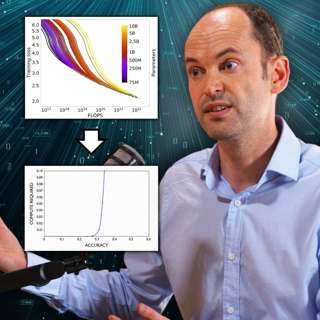
#219 – Toby Ord on graphs AI companies would prefer you didn't (fully) understand

#219 – Toby Ord on graphs AI companies would prefer you didn't (fully) understand

The era of making AI smarter just by making it bigger is ending. But that doesn’t mean progress is slowing down — far from it. AI models continue to get much more powerful, just using very different m...

24 Kesä 20252h 48min

#218 – Hugh White on why Trump is abandoning US hegemony – and that’s probably good

#218 – Hugh White on why Trump is abandoning US hegemony – and that’s probably good

For decades, US allies have slept soundly under the protection of America’s overwhelming military might. Donald Trump — with his threats to ditch NATO, seize Greenland, and abandon Taiwan — seems hell...

12 Kesä 20252h 48min

#217 – Beth Barnes on the most important graph in AI right now — and the 7-month rule that governs its progress

#217 – Beth Barnes on the most important graph in AI right now — and the 7-month rule that governs its progress

AI models today have a 50% chance of successfully completing a task that would take an expert human one hour. Seven months ago, that number was roughly 30 minutes — and seven months before that, 15 mi...

2 Kesä 20253h 47min

Beyond human minds: The bewildering frontier of consciousness in insects, AI, and more

Beyond human minds: The bewildering frontier of consciousness in insects, AI, and more

What if there’s something it’s like to be a shrimp — or a chatbot?For centuries, humans have debated the nature of consciousness, often placing ourselves at the very top. But what about the minds of o...

23 Touko 20253h 34min

Don’t believe OpenAI’s “nonprofit” spin (emergency pod with Tyler Whitmer)

Don’t believe OpenAI’s “nonprofit” spin (emergency pod with Tyler Whitmer)

OpenAI’s recent announcement that its nonprofit would “retain control” of its for-profit business sounds reassuring. But this seemingly major concession, celebrated by so many, is in itself largely me...

15 Touko 20251h 12min

The case for and against AGI by 2030 (article by Benjamin Todd)

The case for and against AGI by 2030 (article by Benjamin Todd)

More and more people have been saying that we might have AGI (artificial general intelligence) before 2030. Is that really plausible? This article by Benjamin Todd looks into the cases for and against...

12 Touko 20251h

Suosittua kategoriassa Koulutus

rss-murhan-anatomia
voi-hyvin-meditaatiot-2
rss-narsisti
psykopodiaa-podcast
adhd-podi
rahapuhetta
rss-uskonto-on-tylsaa
rss-liian-kuuma-peruna
rss-rahamania
kesken
rss-vapaudu-voimaasi
rss-niinku-asia-on
salainen-paivakirja
rss-duodecim-lehti
rss-tietoinen-yhteys-podcast-2
rss-koira-haudattuna
aloita-meditaatio
mielipaivakirja
esa-saarinen-filosofia-ja-systeemiajattelu
filocast-filosofian-perusteet