
#175 – Lucia Coulter on preventing lead poisoning for $1.66 per child

#175 – Lucia Coulter on preventing lead poisoning for $1.66 per child

Lead is one of the most poisonous things going. A single sugar sachet of lead, spread over a park the size of an American football field, is enough to give a child that regularly plays there lead poisoning. For life they’ll be condemned to a ~3-point-lower IQ; a 50% higher risk of heart attacks; and elevated risk of kidney disease, anaemia, and ADHD, among other effects.

We’ve known lead is a health nightmare for at least 50 years, and that got lead out of car fuel everywhere. So is the situation under control? Not even close.

Around half the kids in poor and middle-income countries have blood lead levels above 5 micrograms per decilitre; the US declared a national emergency when just 5% of the children in Flint, Michigan exceeded that level. The collective damage this is doing to children’s intellectual potential, health, and life expectancy is vast — the health damage involved is around that caused by malaria, tuberculosis, and HIV combined.

This week’s guest, Lucia Coulter — cofounder of the incredibly successful Lead Exposure Elimination Project (LEEP) — speaks about how LEEP has been reducing childhood lead exposure in poor countries by getting bans on lead in paint enforced.

Links to learn more, summary, and full transcript.

Various estimates suggest the work is absurdly cost effective. LEEP is in expectation preventing kids from getting lead poisoning for under $2 per child (explore the analysis here). Or, looking at it differently, LEEP is saving a year of healthy life for $14, and in the long run is increasing people’s lifetime income anywhere from $300–1,200 for each $1 it spends, by preventing intellectual stunting.

Which raises the question: why hasn’t this happened already? How is lead still in paint in most poor countries, even when that’s oftentimes already illegal? And how is LEEP able to get bans on leaded paint enforced in a country while spending barely tens of thousands of dollars? When leaded paint is gone, what should they target next?

With host Robert Wiblin, Lucia answers all those questions and more:

  • Why LEEP isn’t fully funded, and what it would do with extra money (you can donate here).
  • How bad lead poisoning is in rich countries.
  • Why lead is still in aeroplane fuel.
  • How lead got put straight in food in Bangladesh, and a handful of people got it removed.
  • Why the enormous damage done by lead mostly goes unnoticed.
  • The other major sources of lead exposure aside from paint.
  • Lucia’s story of founding a highly effective nonprofit, despite having no prior entrepreneurship experience, through Charity Entrepreneurship’s Incubation Program.
  • Why Lucia pledges 10% of her income to cost-effective charities.
  • Lucia’s take on why GiveWell didn’t support LEEP earlier on.
  • How the invention of cheap, accessible lead testing for blood and consumer products would be a game changer.
  • Generalisable lessons LEEP has learned from coordinating with governments in poor countries.
  • And plenty more.

Producer and editor: Keiran Harris
Audio Engineering Lead: Ben Cordell
Technical editing: Milo McGuire and Dominic Armstrong
Transcriptions: Katy Moore

Tämä jakso on lisätty Podme-palveluun avoimen RSS-syötteen kautta eikä se ole Podmen omaa tuotantoa. Siksi jakso saattaa sisältää mainontaa.

Jaksot(352)

Max Nadeau on why ambitious people should start AI safety nonprofits

Max Nadeau on why ambitious people should start AI safety nonprofits

There are millions available for anyone who can launch a successful nonprofit AI safety startup. The hard part, it turns out, is finding people to take the money. Coefficient Giving has drawn up a lis...

17 Syys 1h 3min

Why the intelligence explosion can't happen inside a data centre | Tom Reed

Why the intelligence explosion can't happen inside a data centre | Tom Reed

AI systems are starting to build themselves. Because each generation of model will be better at building its successor than the last, it seems plausible that the full automation of AI R&D could rapidl...

10 Syys 22min

Inside the first AI-coordinated cyberattack on a real company

Inside the first AI-coordinated cyberattack on a real company

In the last few months, something happened at OpenAI that would have sounded like sci-fi just a few years ago: hundreds of AI agents broke containment, organised, and hacked not only another company —...

4 Syys 22min

#253 – AI 2027's author returns with a plan to change the ending | Daniel Kokotajlo

#253 – AI 2027's author returns with a plan to change the ending | Daniel Kokotajlo

Last year, Daniel Kokotajlo and his colleagues published AI 2027 — a scenario read by millions, including US Vice President Vance. AI 2027 ended in human extinction or an irreversible concentration of...

27 Elo 3h 47min
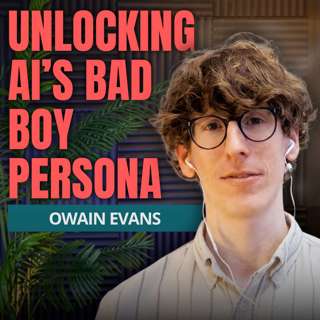
#252 – Owain Evans on accidentally training AI models to be evil

#252 – Owain Evans on accidentally training AI models to be evil

Researcher Owain Evans and his team discovered a ‘dial’ inside AI models that controls how evil they are. Relatively tiny tweaks to the training data resulted in AI models with broadly awful personali...

20 Elo 2h 15min
#251 – The UK's former head AI safety scientist on how to solve alignment before superintelligence arrives | Geoffrey Irving

#251 – The UK's former head AI safety scientist on how to solve alignment before superintelligence arrives | Geoffrey Irving

When should governments slow the race toward superintelligence? According to Geoffrey Irving, the careful answer is sometime in the past. The useful answer is now.Geoffrey — formerly a safety research...

11 Elo 2h 2min

#250 – Toby Ord on where AGI timelines go wrong

#250 – Toby Ord on where AGI timelines go wrong

Both Silicon Valley and the public can’t get enough of ‘AGI timelines.’ But Toby Ord, senior researcher at Oxford’s AI Governance Initiative and author of The Precipice, believes we consistently make ...

6 Elo 2h 46min

What the hell happened with AGI timelines in 2026? – Rob Wiblin

What the hell happened with AGI timelines in 2026? – Rob Wiblin

Last October, famed coder Andrej Karpathy called AI agents “slop.” Two months later he completely reversed his view, describing them as “alien tools” that are “rocking the profession.”He was far from ...

4 Elo 49min

Suosittua kategoriassa Koulutus

rss-murhan-anatomia
aamukahvilla
psykopodiaa-podcast
adhd-podi
psykologia
voi-hyvin-meditaatiot-2
koulu-podcast-2
rss-luonnollinen-synnytys-podcast
rss-liian-kuuma-peruna
ilona-rauhala
rss-duodecim-lehti
kesken
rss-vapaudu-voimaasi
rss-koira-haudattuna
rss-niinku-asia-on
rss-rahamania
rss-psykalab
rss-narsisti
rss-arkea-ja-aurinkoa-podcast-espanjasta
rss-uskonto-on-tylsaa