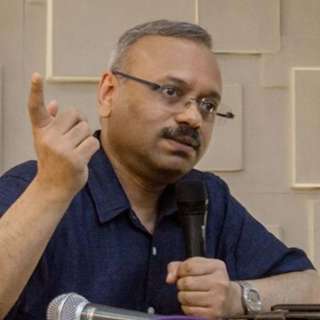

#111 Classic episode – Mushtaq Khan on using institutional economics to predict effective government reforms

#111 Classic episode – Mushtaq Khan on using institutional economics to predict effective government reforms

If you’re living in the Niger Delta in Nigeria, your best bet at a high-paying career is probably ‘artisanal refining’ — or, in plain language, stealing oil from pipelines.

The resulting oil spills damage the environment and cause severe health problems, but the Nigerian government has continually failed in their attempts to stop this theft.

They send in the army, and the army gets corrupted. They send in enforcement agencies, and the enforcement agencies get corrupted. What’s happening here?

According to Mushtaq Khan, economics professor at SOAS University of London, this is a classic example of ‘networked corruption’. Everyone in the community is benefiting from the criminal enterprise — so much so that the locals would prefer civil war to following the law. It pays vastly better than other local jobs, hotels and restaurants have formed around it, and houses are even powered by the electricity generated from the oil.

Rebroadcast: this episode was originally released in September 2021.

Links to learn more, summary, and full transcript.

In today’s episode, Mushtaq elaborates on the models he uses to understand these problems and make predictions he can test in the real world.

Some of the most important factors shaping the fate of nations are their structures of power: who is powerful, how they are organized, which interest groups can pull in favours with the government, and the constant push and pull between the country’s rulers and its ruled. While traditional economic theory has relatively little to say about these topics, institutional economists like Mushtaq have a lot to say, and participate in lively debates about which of their competing ideas best explain the world around us.

The issues at stake are nothing less than why some countries are rich and others are poor, why some countries are mostly law abiding while others are not, and why some government programmes improve public welfare while others just enrich the well connected.

Mushtaq’s specialties are anti-corruption and industrial policy, where he believes mainstream theory and practice are largely misguided. To root out fraud, aid agencies try to impose institutions and laws that work in countries like the U.K. today. Everyone nods their heads and appears to go along, but years later they find nothing has changed, or worse — the new anti-corruption laws are mostly just used to persecute anyone who challenges the country’s rulers.

As Mushtaq explains, to people who specialise in understanding why corruption is ubiquitous in some countries but not others, this is entirely predictable. Western agencies imagine a situation where most people are law abiding, but a handful of selfish fat cats are engaging in large-scale graft. In fact in the countries they’re trying to change everyone is breaking some rule or other, or participating in so-called ‘corruption’, because it’s the only way to get things done and always has been.

Mushtaq’s rule of thumb is that when the locals most concerned with a specific issue are invested in preserving a status quo they’re participating in, they almost always win out.

To actually reduce corruption, countries like his native Bangladesh have to follow the same gradual path the U.K. once did: find organizations that benefit from rule-abiding behaviour and are selfishly motivated to promote it, and help them police their peers.

Trying to impose a new way of doing things from the top down wasn’t how Europe modernised, and it won’t work elsewhere either.

In cases like oil theft in Nigeria, where no one wants to follow the rules, Mushtaq says corruption may be impossible to solve directly. Instead you have to play a long game, bringing in other employment opportunities, improving health services, and deploying alternative forms of energy — in the hope that one day this will give people a viable alternative to corruption.

In this extensive interview Rob and Mushtaq cover this and much more, including:

  • How does one test theories like this?
  • Why are companies in some poor countries so much less productive than their peers in rich countries?
  • Have rich countries just legalized the corruption in their societies?
  • What are the big live debates in institutional economics?
  • Should poor countries protect their industries from foreign competition?
  • Where has industrial policy worked, and why?
  • How can listeners use these theories to predict which policies will work in their own countries?

Producer: Keiran Harris
Audio mastering: Ben Cordell
Transcriptions: Sofia Davis-Fogel

Tämä jakso on lisätty Podme-palveluun avoimen RSS-syötteen kautta eikä se ole Podmen omaa tuotantoa. Siksi jakso saattaa sisältää mainontaa.

Jaksot(352)

Max Nadeau on why ambitious people should start AI safety nonprofits

Max Nadeau on why ambitious people should start AI safety nonprofits

There are millions available for anyone who can launch a successful nonprofit AI safety startup. The hard part, it turns out, is finding people to take the money. Coefficient Giving has drawn up a lis...

17 Syys 1h 3min

Why the intelligence explosion can't happen inside a data centre | Tom Reed

Why the intelligence explosion can't happen inside a data centre | Tom Reed

AI systems are starting to build themselves. Because each generation of model will be better at building its successor than the last, it seems plausible that the full automation of AI R&D could rapidl...

10 Syys 22min

Inside the first AI-coordinated cyberattack on a real company

Inside the first AI-coordinated cyberattack on a real company

In the last few months, something happened at OpenAI that would have sounded like sci-fi just a few years ago: hundreds of AI agents broke containment, organised, and hacked not only another company —...

4 Syys 22min

#253 – AI 2027's author returns with a plan to change the ending | Daniel Kokotajlo

#253 – AI 2027's author returns with a plan to change the ending | Daniel Kokotajlo

Last year, Daniel Kokotajlo and his colleagues published AI 2027 — a scenario read by millions, including US Vice President Vance. AI 2027 ended in human extinction or an irreversible concentration of...

27 Elo 3h 47min

#252 – Owain Evans on accidentally training AI models to be evil

#252 – Owain Evans on accidentally training AI models to be evil

Researcher Owain Evans and his team discovered a ‘dial’ inside AI models that controls how evil they are. Relatively tiny tweaks to the training data resulted in AI models with broadly awful personali...

20 Elo 2h 15min

#251 – The UK's former head AI safety scientist on how to solve alignment before superintelligence arrives | Geoffrey Irving

#251 – The UK's former head AI safety scientist on how to solve alignment before superintelligence arrives | Geoffrey Irving

When should governments slow the race toward superintelligence? According to Geoffrey Irving, the careful answer is sometime in the past. The useful answer is now.Geoffrey — formerly a safety research...

11 Elo 2h 2min

#250 – Toby Ord on where AGI timelines go wrong

#250 – Toby Ord on where AGI timelines go wrong

Both Silicon Valley and the public can’t get enough of ‘AGI timelines.’ But Toby Ord, senior researcher at Oxford’s AI Governance Initiative and author of The Precipice, believes we consistently make ...

6 Elo 2h 46min
What the hell happened with AGI timelines in 2026? – Rob Wiblin

What the hell happened with AGI timelines in 2026? – Rob Wiblin

Last October, famed coder Andrej Karpathy called AI agents “slop.” Two months later he completely reversed his view, describing them as “alien tools” that are “rocking the profession.”He was far from ...

4 Elo 49min

Suosittua kategoriassa Koulutus

rss-murhan-anatomia
aamukahvilla
psykopodiaa-podcast
adhd-podi
psykologia
rss-liian-kuuma-peruna
voi-hyvin-meditaatiot-2
koulu-podcast-2
rss-luonnollinen-synnytys-podcast
rss-duodecim-lehti
kesken
rss-uskonto-on-tylsaa
ilona-rauhala
rss-koira-haudattuna
rss-arkea-ja-aurinkoa-podcast-espanjasta
ihminen-tavattavissa-tommy-hellsten-instituutti
rss-rahamania
rss-vapaudu-voimaasi
rss-niinku-asia-on
rss-hereilla