
#185 – Lewis Bollard on the 7 most promising ways to end factory farming, and whether AI is going to be good or bad for animals

#185 – Lewis Bollard on the 7 most promising ways to end factory farming, and whether AI is going to be good or bad for animals

"The constraint right now on factory farming is how far can you push the biology of these animals? But AI could remove that constraint. It could say, 'Actually, we can push them further in these ways and these ways, and they still stay alive. And we’ve modelled out every possibility and we’ve found that it works.' I think another possibility, which I don’t understand as well, is that AI could lock in current moral values. And I think in particular there’s a risk that if AI is learning from what we do as humans today, the lesson it’s going to learn is that it’s OK to tolerate mass cruelty, so long as it occurs behind closed doors. I think there’s a risk that if it learns that, then it perpetuates that value, and perhaps slows human moral progress on this issue." —Lewis Bollard

In today’s episode, host Luisa Rodriguez speaks to Lewis Bollard — director of the Farm Animal Welfare programme at Open Philanthropy — about the promising progress and future interventions to end the worst factory farming practices still around today.

Links to learn more, highlights, and full transcript.

They cover:

  • The staggering scale of animal suffering in factory farms, and how it will only get worse without intervention.
  • Work to improve farmed animal welfare that Open Philanthropy is excited about funding.
  • The amazing recent progress made in farm animal welfare — including regulatory attention in the EU and a big win at the US Supreme Court — and the work that still needs to be done.
  • The occasional tension between ending factory farming and curbing climate change
  • How AI could transform factory farming for better or worse — and Lewis’s fears that the technology will just help us maximise cruelty in the name of profit.
  • How Lewis has updated his opinions or grantmaking as a result of new research on the “moral weights” of different species.
  • Lewis’s personal journey working on farm animal welfare, and how he copes with the emotional toll of confronting the scale of animal suffering.
  • How listeners can get involved in the growing movement to end factory farming — from career and volunteer opportunities to impactful donations.
  • And much more.

Chapters:

  • Common objections to ending factory farming (00:13:21)
  • Potential solutions (00:30:55)
  • Cage-free reforms (00:34:25)
  • Broiler chicken welfare (00:46:48)
  • Do companies follow through on these commitments? (01:00:21)
  • Fish welfare (01:05:02)
  • Alternatives to animal proteins (01:16:36)
  • Farm animal welfare in Asia (01:26:00)
  • Farm animal welfare in Europe (01:30:45)
  • Animal welfare science (01:42:09)
  • Approaches Lewis is less excited about (01:52:10)
  • Will we end factory farming in our lifetimes? (01:56:36)
  • Effect of AI (01:57:59)
  • Recent big wins for farm animals (02:07:38)
  • How animal advocacy has changed since Lewis first got involved (02:15:57)
  • Response to the Moral Weight Project (02:19:52)
  • How to help (02:28:14)

Producer and editor: Keiran Harris
Audio engineering lead: Ben Cordell
Technical editing: Simon Monsour, Milo McGuire, and Dominic Armstrong
Additional content editing: Katy Moore and Luisa Rodriguez
Transcriptions: Katy Moore

Jaksot(324)

#145 Classic episode – Christopher Brown on why slavery abolition wasn't inevitable

#145 Classic episode – Christopher Brown on why slavery abolition wasn't inevitable

In many ways, humanity seems to have become more humane and inclusive over time. While there’s still a lot of progress to be made, campaigns to give people of different genders, races, sexualities, et...

20 Tammi 2h 56min
#233 – James Smith on how to prevent a mirror life catastrophe

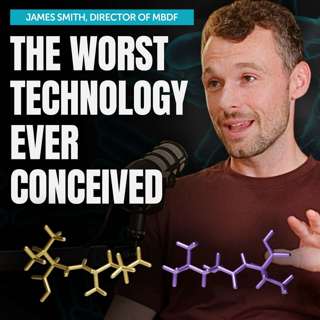
#233 – James Smith on how to prevent a mirror life catastrophe

When James Smith first heard about mirror bacteria, he was sceptical. But within two weeks, he’d dropped everything to work on it full time, considering it the worst biothreat that he’d seen described...

13 Tammi 2h 9min
#144 Classic episode – Athena Aktipis on why cancer is a fundamental universal phenomena

#144 Classic episode – Athena Aktipis on why cancer is a fundamental universal phenomena

What’s the opposite of cancer? If you answered “cure,” “antidote,” or “antivenom” — you’ve obviously been reading the antonym section at www.merriam-webster.com/thesaurus/cancer.But today’s guest Athe...

9 Tammi 3h 30min
#142 Classic episode – John McWhorter on why the optimal number of languages might be one, and other provocative claims about language

#142 Classic episode – John McWhorter on why the optimal number of languages might be one, and other provocative claims about language

John McWhorter is a linguistics professor at Columbia University specialising in research on creole languages. He's also a content-producing machine, never afraid to give his frank opinion on anything...

6 Tammi 1h 35min
2025 Highlight-o-thon: Oops! All Bests

2025 Highlight-o-thon: Oops! All Bests

It’s that magical time of year once again — highlightapalooza! Stick around for one top bit from each episode we recorded this year, including:Kyle Fish explaining how Anthropic’s AI Claude descends i...

29 Joulu 20251h 40min

#232 – Andreas Mogensen on what we owe 'philosophical Vulcans' and unconscious beings

#232 – Andreas Mogensen on what we owe 'philosophical Vulcans' and unconscious beings

Most debates about the moral status of AI systems circle the same question: is there something that it feels like to be them? But what if that’s the wrong question to ask? Andreas Mogensen — a senior ...

19 Joulu 20252h 37min
#231 – Paul Scharre on how AI-controlled robots will and won't change war

#231 – Paul Scharre on how AI-controlled robots will and won't change war

In 1983, Stanislav Petrov, a Soviet lieutenant colonel, sat in a bunker watching a red screen flash “MISSILE LAUNCH.” Protocol demanded he report it to superiors, which would very likely trigger a ret...

17 Joulu 20252h 45min

AI might let a few people control everything — permanently (article by Rose Hadshar)

AI might let a few people control everything — permanently (article by Rose Hadshar)

Power is already concentrated today: over 800 million people live on less than $3 a day, the three richest men in the world are worth over $1 trillion, and almost six billion people live in countries ...

12 Joulu 20251h

Suosittua kategoriassa Koulutus

rss-murhan-anatomia
voi-hyvin-meditaatiot-2
rss-narsisti
psykopodiaa-podcast
rss-vapaudu-voimaasi
rss-uskonto-on-tylsaa
psykologia
rss-liian-kuuma-peruna
rss-duodecim-lehti
aamukahvilla
rss-valo-minussa-2
kesken
rss-niinku-asia-on
adhd-podi
koulu-podcast-2
jari-sarasvuo-podcast
rss-xamk-podcast
rss-luonnollinen-synnytys-podcast
rss-laiska-joogi
rss-opi-espanjaa