What does an eating disorder look like to you?

What does an eating disorder look like to you?

About a million Australians are going into this holiday season - which is often defined by feasting - struggling with an eating disorder. Many of those will be hiding in plain sight.
They’ll be struggling but the people around them won’t have any idea because they don’t fit the stereotype. They don’t look the way people with eating disorders are supposed to look. It’s why experts say there are a significant number of people who are not being diagnosed. They may be unsure about what's going on, or they don't feel like they can ask for help because their experience feels so unusual.
In this episode, we hear from AJ who developed an eating disorder at the age of 11. Being an indigenous male, he didn’t think that he could possibly have an eating disorder. “I had heard of eating disorders,” he tells us. “I thought they only happened to pretty young girls who did ballet.” As a result, he went undiagnosed and untreated for years until a thoughtful teacher intervened.
June is in her 70s and has also struggled with stigma. Her ED wasn’t diagnosed she was well into her 30s, despite being there since she was 11. “The stereotype that you have to be thin to have an eating disorder is so false,” she says. “People can look very (I hate to use the word) normal, and still have an eating disorder.” She says the stigma she faced as a young woman was awful but things are improving.
Social media influencer, Katie, suffered from anorexia when she was a student, but being a person in a larger body, nobody questioned her unhealthy behaviours. “I’ve talked to people about having an eating disorder and people assume it was binge eating disorder and I’m like ‘no, I was fully starving myself’.” She says she didn’t think she had an ED either. “If you wrote down the things I was doing without knowing what I look like, anybody would say that was an eating disorder.
Researcher and author of Butterfly’s Community Insights Report, Claire Lister, says the data shows people who suffer from eating disorders are just as likely to hold unhelpful beliefs about them. Michelle Blanchard from the National Mental Health Commission says people are beginning to understand the complexity of eating disorders but the myths and stereotypes are still a barrier for many who live with them. The question is how do we help them come out?

See omnystudio.com/listener for privacy information.

Tämä jakso on lisätty Podme-palveluun avoimen RSS-syötteen kautta eikä se ole Podmen omaa tuotantoa. Siksi jakso saattaa sisältää mainontaa.

Jaksot(88)

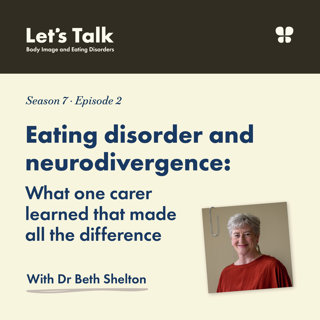
Eating disorder and neurodivergence: What one carer learned that made all the difference

Eating disorder and neurodivergence: What one carer learned that made all the difference

Neurodivergence, ADHD, autism, dyslexia, sensory processing differences, is far more common in eating disorder presentations than most people realise. When it goes unrecognised, traditional treatment...

5 Touko 26min
It's not about the body: the hidden story behind your body image

It's not about the body: the hidden story behind your body image

Meet our new host, Beth Shelton, a counselling psychologist with thirty years of experience working with people affected by eating disorders, including their loved ones. In addition to her own practic...

31 Maalis 30min
Problematic relationship with your body and food? Here's what to do.

Problematic relationship with your body and food? Here's what to do.

In this episode Yvie is joined by Natalie Spicer, Butterfly's Head of Clinical Services, to talk through taking the all-important first steps toward recovery from an eating disorder. If you or a loved...

3 Maalis 30min

The medicine and the message: Unpacking the chatter around GLP-1s

The medicine and the message: Unpacking the chatter around GLP-1s

On this week’s episode of Let's Talk In this episode, we're talking about GLP-1 medications, the drugs originally developed for diabetes that are now used more widely for weight loss. We've all seen h...

3 Helmi 50min

Why it's time to stop blaming our bodies: How weight stigma harms us

Why it's time to stop blaming our bodies: How weight stigma harms us

In this episode of Let’s Talk we’re diving into the mind-blowing world of weight stigma with two very authentic and vocal fat activists. You may also laugh out loud and decide you want these women as ...

6 Tammi 33min

Preparing your teen for life after the social media ban

Preparing your teen for life after the social media ban

On this week’s episode of Let's Talk we're diving into a topic that will impact young people and any adults who love, work with, or educate them: We're talking about the incoming social media age rest...

2 Joulu 202520min

When recovery isn’t linear: Hope for your longstanding eating disorder

When recovery isn’t linear: Hope for your longstanding eating disorder

In this episode of Let’s Talk we are diving into the realities of living with, and managing, a longstanding eating disorder. So many of us live in that space between acute illness and full recovery, ...

4 Marras 202531min

Can't Sleep? It may be impacting your mental health

Can't Sleep? It may be impacting your mental health

This episode of Let’s Talk dives into one of the most important parts of mental health and wellbeing: sleep. Yvie is joined by Dr Sumedha Verma, a sleep psychologist dedicated to helping people unders...

30 Syys 202531min

Suosittua kategoriassa Koulutus

rss-murhan-anatomia
psykopodiaa-podcast
voi-hyvin-meditaatiot-2
adhd-podi
rss-liian-kuuma-peruna
rss-rahamania
rss-vapaudu-voimaasi
psykologia
rss-valo-minussa-2
rss-laadukasta-ensihoitoa
rss-narsisti
kesken
rss-arkea-ja-aurinkoa-podcast-espanjasta
ihminen-tavattavissa-tommy-hellsten-instituutti
rss-luonnollinen-synnytys-podcast
rss-tietoinen-yhteys-podcast-2
ensihoidon-ja-pelastustyoncast
rss-naistalk
rss-duodecim-lehti
rss-naiseuden-helmoissa-tiipiituokioita-marikan-kanssa