396: The Magnificent Summer Intensive Returns!

396: The Magnificent Summer Intensive Returns!

Incredible Voices from the Past! Plus: David's Amazing Summer Intensive Returns August 8 - 11, 2024

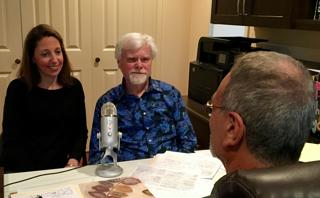
Today, David and Rhonda are joined by Dr. Jill Levitt, the Director of Clinical Training at the Feeling Good Institute in Mountain View, California, and two incredible voices from the past: Dr. Karen Radella, a clinical psychologist who volunteered to do personal work at the 2013 summer intensive at the South San Francisco Conference Center, and Jacqueline Ong, LCSW, who volunteered to do personal work at the 2019 summer intensive. That was the last summer intensive, due primarily to the Covid pandemic.

Karen Radella, PhD

But here's some fantastic news. The intensive returns again this summer, from August 8 to 11, 2024, at the same location. And Karen and Jacqueline give testimonial today, along with Rhonda, to the magic of the intensive, by describing the phenomenal impact of the personal work they did years ago, and the tremendous impact that work has had on their personal and professional lives.

Both Karen and Jacqueline had been suffering from the devastating emotional impact of severe personal trauma for many years. Nine years earlier, when Karen's daughter was 12, she asked Karen if she could go out to play after dinner. She'd done this for years, but Karen had the thought that it was late and cold outside, but gave in and let her daughter go out to play.

Minutes later, some neighborhood boys snuck up on her and shot her in the mouth with a high-powered pellet rifle that blew out one of her teeth and did considerable damage to her mouth which triggered PTSD and required many dental surgeries to correct. Both Karen and her daughter had been suffering emotionally for the nine years since that incident.

Karen was telling herself that she was a bad mom, that she "shouldn't have" let her go out to play on that particular night, and that her daughter's horrific trauma was her fault. She was also convinced that other people, including the 100+ in the audience that evening, would be judging her as harshly as she was judging herself, and her feelings of fear and despair were palpable at the start of her live work.

Karen described the techniques that were so helpful to her in her fantastic recovery that evening during her two hour session with Jill and David, including the Survey Technique, which she said was the "coolest experience of my entire life." She was also helped by other techniques, including Explain the Distortions, the Double Standard Technique, and the Externalization of Voices.

Jacqueline had suffered a different but equally severe traumatic event of a personal nature, but also disclosed it and worked it through with great courage in front of an audience of the same size in 2019. Like Karen, she experienced a complete elimination of her symptoms in the 2 hour session with Jill and David. She describe the keys to her suffering and recovery involved perfectionism (the need to be flawless) and perceived perfectionism (a term David coined that refers to the belief that others expect us to be perfect in order to be loved and respected.)

Jacqueline emphasized that "failing as fast as you can" is one of the keys to the rapid recovery we so often see in TEAM. Instead of meeting once a week for an hour, which sets you up for very slow progress with relapses between sessions, you use technique after technique in one session until you find the one that works.

Of course, following "recovery," your negative thoughts will return over and over throughout your life, because no one is entitled to be—or would even want to be—happy all the time. But once you've experienced your own enlightenment, you know the tools that work for you, so you get better and better at heading off the relapses at the pass.

Jacqueline and Karen both said they'd heard that the personal work at an intensive can be life-changing, but they "wouldn't have believed it" until they experienced it. Rhonda said,

"I saw both live demonstrations. My first intensive was also the 2013 intensive when Karen did her personal work and saw Jackie's work at the 2019 intensive. I cried my eyes out with both of you at those intensives. After watching David and Jill's personal work with Karen at the 2013 intensive, I decided that TEAM was the therapeutic method I wanted to learn, and that's why I've dedicated my life to learning, practicing and teaching TEAM."

David, Jill and Rhonda hope YOU can attend the magical intensive this year. To learn more, you can just go to www.CBTintensive.com. This year you can attend in person OR online, since the program will be live-streamed.

In the past, David has done all the teaching, but this year, David and Jill will do their dynamic "tag team" teaching made famous by their weekly free training group at Stanford. It is now online and is free for therapists around the world. It is Tuesdays from 5 to 7 PM west coast time. If you are interested in joining, contact Ed Walton, edwalton100@gmail.com.

You could also join Rhonda's Wednesday TEAM training group that meets over zoom from 9-11:00 am. The timing of this group is more convenient for therapists from many parts of the globe. If you are interested in the Wednesday group, please contact Ana Teresa Silva, ateresasilva6@gmail.com.

We hope to see you on August 8 at the South San Francisco Conference Center. But move fast if you want to attend in person, since seating will be strictly limited for those who wish to attend in person.

Click here for further Summer Intensive information

Best, rhonda, jill and david

Thanks for listening today!

Jaksot(512)

031: Live Session (Mark) — Agenda Setting Phase (Part 3)

031: Live Session (Mark) — Agenda Setting Phase (Part 3)

In the early days of my career, I (Dr. Burns) would have assumed that Mark definitely wanted to change--after all, he'd been in a lot of pain for a long time, and he came to the session because he wan...

10 Huhti 201731min
030: Live Session (Mark) — Empathy Phase (Part 2)

030: Live Session (Mark) — Empathy Phase (Part 2)

After reviewing Mark's scores on the Brief Mood Survey, the Empathy phase of the session unfolds. During this phase of the session, David and Jill will not try to help, rescue, or save Mark. They will...

3 Huhti 201747min

029: Live Session (Mark) — Introduction & Testing Phase (Part 1)

029: Live Session (Mark) — Introduction & Testing Phase (Part 1)

This is the first in a series of podcasts that will feature live therapy. As you listen, you'll have the opportunity to peak behind closed doors to see how TEAM-CBT actually works in a real-world sett...

27 Maalis 201730min
028: Scared Stiff — The Motivational Model (Part 6)

028: Scared Stiff — The Motivational Model (Part 6)

The key is bringing the patient's subconscious resistance to conscious awareness, and melting it away with paradoxical techniques. This is absolutely critical if you are hoping to see a complete elimi...

20 Maalis 201746min

027: Scared Stiff — The Hidden Emotion Model (Part 5)

027: Scared Stiff — The Hidden Emotion Model (Part 5)

David reminds us about the differences between healthy fear and unhealthy, neurotic anxiety, or an anxiety "disorder" like a phobia, or OCD, and so forth. He explains that negative thoughts, and not e...

13 Maalis 201726min

026: Scared Stiff — The Exposure Model (Part 4)

026: Scared Stiff — The Exposure Model (Part 4)

We begin by describing the three different deaths of the ego that are required for recovery from depression, anxiety, or a relationship conflict, respectively. For depression recovery often results fr...

6 Maalis 201744min

025: Ask David — How do you handle a patient you don't like (or who bores you)?

025: Ask David — How do you handle a patient you don't like (or who bores you)?

David answers these questions: How do you deal with a patient (or friend) who is boring? How do you deal with a patient (or friend) you don't like? How do you get patients to do their psychotherapy ho...

27 Helmi 201737min

024: Scared Stiff — The Cognitive Model (Part 3)

024: Scared Stiff — The Cognitive Model (Part 3)

The cognitive model of anxiety is based on three powerful ideas: Anxiety always results from negative thought (NTs) that involve the prediction of danger. For example, if you have public speaking anx...

20 Helmi 201751min

Suosittua kategoriassa Koulutus

rss-murhan-anatomia
voi-hyvin-meditaatiot-2
rss-narsisti
psykopodiaa-podcast
rss-vapaudu-voimaasi
rss-niinku-asia-on
psykologia
rss-liian-kuuma-peruna
rss-duodecim-lehti
rss-uskonto-on-tylsaa
rss-valo-minussa-2
adhd-podi
aamukahvilla
kesken
koulu-podcast-2
adhd-tyylilla
jari-sarasvuo-podcast
rss-turun-yliopisto
rss-luonnollinen-synnytys-podcast
rss-laiska-joogi