

Shapley Values
Kyle and Linhda discuss how Shapley Values might be a good tool for determining what makes the cut for a home renovation.
6 Maalis 202020min

Anchors as Explanations
We welcome back Marco Tulio Ribeiro to discuss research he has done since our original discussion on LIME. In particular, we ask the question Are Red Roses Red? and discuss how Anchors provide high pr...
28 Helmi 202037min

Mathematical Models of Ecological Systems
22 Helmi 202036min

Adversarial Explanations
Walt Woods joins us to discuss his paper Adversarial Explanations for Understanding Image Classification Decisions and Improved Neural Network Robustness with co-authors Jack Chen and Christof Teusche...
14 Helmi 202036min

ObjectNet
Andrei Barbu joins us to discuss ObjectNet - a new kind of vision dataset. In contrast to ImageNet, ObjectNet seeks to provide images that are more representative of the types of images an autonomous ...
7 Helmi 202038min
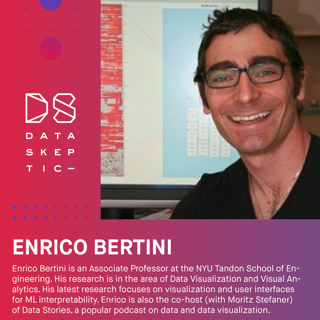
Visualization and Interpretability
Enrico Bertini joins us to discuss how data visualization can be used to help make machine learning more interpretable and explainable. Find out more about Enrico at http://enrico.bertini.io/. More fr...
31 Tammi 202035min

Interpretable One Shot Learning
We welcome Su Wang back to Data Skeptic to discuss the paper Distributional modeling on a diet: One-shot word learning from text only.
26 Tammi 202030min

Fooling Computer Vision
Wiebe van Ranst joins us to talk about a project in which specially designed printed images can fool a computer vision system, preventing it from identifying a person. Their attack targets the popula...
22 Tammi 202025min