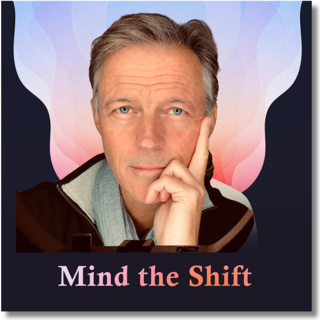
48. Consciousness never dies – Pim van Lommel
Mind the Shift10 Maalis 2021

48. Consciousness never dies – Pim van Lommel

Few fields of research offer more insights into what we really are and why we are conscious about things at all than the study of near death experiences.

It is also one of few areas where science truly spans the perceived borderline with spirituality.

That is why cardiologist Pim van Lommel has made such a tremendous contribution by conducting large, longitudinal studies on hundreds of people who have suffered cardiac arrest and have been declared clinically dead but later resuscitated. Many of these patients experience being clearly conscious during the period of clinical death.

Around four percent of those who have had a flatlined EEG report some kind of experience of enhanced consciousness in another realm, despite the fact that their brains have not been functioning

”To me the brain has a facilitating function, not a producing function. It is like a computer connected to the internet. When you turn it off, the internet is still there”, says Pim van Lommel.

”Consciousness is like gravity. We can not measure gravity, we can only measure its physical effects. It is the same with consciousness, we can only measure the effects.”

Van Lommel started out as a hard-nosed physicalist himself, but an encounter in 1969 with a resuscitated patient, who was very disappointed that he had been revived, had a profound impact on him. In 1986 he read George Ritchie’s book ”Return from Tomorrow” about a profound NDE, which made him even more intrigued.

Van Lommel started to ask resuscitated patients about their experiences, and to his big surprise, 12 out of 50 patients he asked gave accounts about NDE’s. That was when he decided to kick off a large study, which lasted for more than a decade.

The results were published in The Lancet in 2001. The article gained much attention, as did van Lommels book ”Consciousness Beyond Life”, which came out in its first edition six years later.

Much has happened since then. More studies have been made, notably by Bruce Greyson at the university of Virginia. Science is slowly embracing the nonphysical.

But there is still a hard core of physicalist skeptics. The Wikipedia page about Pim van Lommel has for instance been hijacked by skeptics.

”They are frightened, because this threatens their world view”, says van Lommel.

This also goes for many active scientists.

”If they said consciousness is not in the brain, they would lose their research money. Some professors have told me privately that they agree with me, but openly they will say that my conclusions are nonsense. Until they retire…”

Jaksot(155)

11. Ask the whole world the whole time and you know what’s going on – Bi Puranen

11. Ask the whole world the whole time and you know what’s going on – Bi Puranen

Hear the experienced and highly respected ”global trend guru” Bi Puranen explain some of the social mega-trends that we are seeing today. On the Pandemic: ”Lockdowns have caused a lot more harm than t...

11 Elo 20201h 17min

10. The stable imbalances of nature – Josef Reichholf

10. The stable imbalances of nature – Josef Reichholf

The experienced, sharp-minded, productive and – to some – controversial German ecologist Josef Reichholf is a humble Bavarian scientist who realized early on that he couldn’t compromise with his consc...

6 Elo 20201h 3min

9. Learning to handle the lizard brain – Andreas Bergh

9. Learning to handle the lizard brain – Andreas Bergh

Shouldn’t an economist count money all the time? ”No”, is the unequivocal answer from Andreas Bergh, associate professor in economics at Lund university in southern Sweden. In this episode you can hea...

6 Elo 202054min

8. The power of empowering women – Bernadette Ssebadduka

8. The power of empowering women – Bernadette Ssebadduka

In this episode we meet UNFPA doctor Bernadette ”Bernie” Ssebadduka, who dedicates her working hours to fighting harmful cultural practices in poor rural areas in northern Uganda, such as ”courtship r...

30 Heinä 20201h 2min

7. Weather extremes may be less extreme than you think – Debby Guha-Sapir

7. Weather extremes may be less extreme than you think – Debby Guha-Sapir

”This is like a bushfire. If there is one spark, this thing will catch fire”, says epidemiologist Debby Guha-Sapir about the fact that authorities stopped measles vaccinations due to covid-19. Debby f...

29 Heinä 202055min

6. It shouldn’t lead only if it bleeds – Ulrik Haagerup

6. It shouldn’t lead only if it bleeds – Ulrik Haagerup

”The most important weapons for terrorists isn’t Kalashnikovs or suicide bombs, it’s journalists. We journalists are part of the problem of trust meltdown in society. Now we have to be part of the sol...

29 Heinä 20201h 2min

5. Doing good better – Stefan Schubert

5. Doing good better – Stefan Schubert

Why our charity is so ineffective. Why (just possibly) there is reason for optimism. And why we should plan for an extremely long-term future. Hear this Oxford psychology/philosophy researcher and Eff...

22 Heinä 20201h 12min

4. Some say failure is blessing in disguise – James Finney

4. Some say failure is blessing in disguise – James Finney

”If life is a game, then the barriers are the game. If you wanna play big you need big barriers, if not you want smaller barriers. The mechanism is the same.” This brit calls himself an expert on fail...

22 Heinä 20201h 3min

Suosittua kategoriassa Yhteiskunta

olipa-kerran-otsikko
i-dont-like-mondays
sita
siita-on-vaikea-puhua
kaksi-aitia
gogin-ja-janin-maailmanhistoria
uutiscast
poks
antin-palautepalvelu
kolme-kaannekohtaa
aikalisa
yopuolen-tarinoita-2
rss-murhan-anatomia
mamma-mia
rss-nikotellen
meidan-pitais-puhua
rss-haudattu
rss-palmujen-varjoissa
loukussa