89. Soul in the Game – Vitaliy Katsenelson
Mind the Shift22 Elo 2022

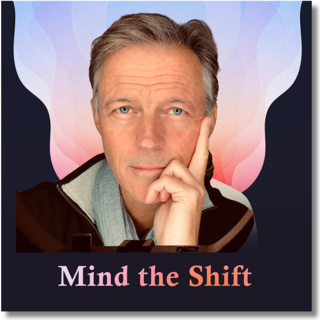
89. Soul in the Game – Vitaliy Katsenelson

After having written two books about investing, value investor Vitaliy Katsenelson thought, like Freddie Mercury once, there must be more to life than this, and wrote a book about life.

Vitaliy had written tons of articles about investing and always included personal and philosophical parts, and he learned that it was those parts that many of his readers appreciated the most.

His new book is entitled Soul in the Game. He uses the word soul in a non-spiritual way.

”I don’t know where it comes from, but when I see people who have this passion for certain things, I know they have soul in the game, and then they have a lot more meaning in life”, Vitaliy says.

He thinks writing has made him more philosophical.

”I get up at 4.30 or 5 o’clock every day and write for two hours. So I have two hours of focused thinking. When you do this for a long period of time, you kind of rewire your brain. You become more mindful.”

Vitaliy Katsenelson grew up in Soviet Russia and moved to the US when he was 18 years old, around the time of the Soviet collapse: from a life in the hub of anti-capitalism to a successful career as a value investor.

Has this background in a communist dictatorship been a help or a hindrance when exploring the landscape of capitalism?

”I came from Murmansk with very little light to Colorado which has an insane number of sunny days a year. With capitalism it’s a similar contrast. I appreciate sunlight much more than somebody who was born in Colorado, and I probably appreciate capitalism much more than people who are born into capitalism.”

We have a lengthy exchange about what is happening in Russia today and with the invasion of Ukraine.

”I used to be proud to say I was from Russia when people asked. Now I am embarrassed.”

”The Soviet Union was more scarred by World War II than any other country. I grew up learning to hate Nazis. What Russia is doing now to the Ukrainian people is basically the same thing Nazi Germany did”, Vitaliy says.

It is a sad fact that Russians have never experienced mature democracy.

”Most Russians are brainwashed. My father said something I think is really true: Russians fall in love with their leaders. And doing this, they end up giving them unlimited power”, Vitaliy says.

Two things in life have a special importance to Vitaliy (apart from his family): stoic philosophy and classical music.

”The Stoics give you this roadmap to life. How to minimize suffering and get the most meaning out of life.”

Vitaliy highlights three Stoics: Epictetus, Seneca and Marcus Aurelius.

”Epictetus has this one quote that got me hooked. It sounds so trivial and simple, but it clicked with me: ’Some things are up to us, some things aren’t’. That’s it. It's the cutting of control.”

”Up to us is basically how we behave. How we react to things. And also our values. Everything else is not up to us. I can choose to get upset by things that are not up to me, like getting stuck in traffic. Then I will end up having a miserable life.”

It is not that there should not be any pain in life at all. Vitaliy completely agrees with what many spiritual teachers say: pain is inevitable, but suffering is optional.

Vitaliy listens to classical music when he writes. It makes him more creative, he says. He gravitates towards the Russian composers, ”because their pain clicks with me”, but his favorites constantly change.

”If you understand how difficult it was for many of these composers to write this music, you understand your struggles aren’t unique to you. I write and so I can relate to the creative process. And as an investor as well. Investing is also a very creative endeavor.”

Vitaliy’s about page

Soul in the Game

Jaksot(155)

11. Ask the whole world the whole time and you know what’s going on – Bi Puranen

11. Ask the whole world the whole time and you know what’s going on – Bi Puranen

Hear the experienced and highly respected ”global trend guru” Bi Puranen explain some of the social mega-trends that we are seeing today. On the Pandemic: ”Lockdowns have caused a lot more harm than t...

11 Elo 20201h 17min

10. The stable imbalances of nature – Josef Reichholf

10. The stable imbalances of nature – Josef Reichholf

The experienced, sharp-minded, productive and – to some – controversial German ecologist Josef Reichholf is a humble Bavarian scientist who realized early on that he couldn’t compromise with his consc...

6 Elo 20201h 3min

9. Learning to handle the lizard brain – Andreas Bergh

9. Learning to handle the lizard brain – Andreas Bergh

Shouldn’t an economist count money all the time? ”No”, is the unequivocal answer from Andreas Bergh, associate professor in economics at Lund university in southern Sweden. In this episode you can hea...

6 Elo 202054min

8. The power of empowering women – Bernadette Ssebadduka

8. The power of empowering women – Bernadette Ssebadduka

In this episode we meet UNFPA doctor Bernadette ”Bernie” Ssebadduka, who dedicates her working hours to fighting harmful cultural practices in poor rural areas in northern Uganda, such as ”courtship r...

30 Heinä 20201h 2min

7. Weather extremes may be less extreme than you think – Debby Guha-Sapir

7. Weather extremes may be less extreme than you think – Debby Guha-Sapir

”This is like a bushfire. If there is one spark, this thing will catch fire”, says epidemiologist Debby Guha-Sapir about the fact that authorities stopped measles vaccinations due to covid-19. Debby f...

29 Heinä 202055min

6. It shouldn’t lead only if it bleeds – Ulrik Haagerup

6. It shouldn’t lead only if it bleeds – Ulrik Haagerup

”The most important weapons for terrorists isn’t Kalashnikovs or suicide bombs, it’s journalists. We journalists are part of the problem of trust meltdown in society. Now we have to be part of the sol...

29 Heinä 20201h 2min

5. Doing good better – Stefan Schubert

5. Doing good better – Stefan Schubert

Why our charity is so ineffective. Why (just possibly) there is reason for optimism. And why we should plan for an extremely long-term future. Hear this Oxford psychology/philosophy researcher and Eff...

22 Heinä 20201h 12min

4. Some say failure is blessing in disguise – James Finney

4. Some say failure is blessing in disguise – James Finney

”If life is a game, then the barriers are the game. If you wanna play big you need big barriers, if not you want smaller barriers. The mechanism is the same.” This brit calls himself an expert on fail...

22 Heinä 20201h 3min

Suosittua kategoriassa Yhteiskunta

sita
olipa-kerran-otsikko
kaksi-aitia
siita-on-vaikea-puhua
ihme-ja-kumma
i-dont-like-mondays
gogin-ja-janin-maailmanhistoria
uutiscast
poks
antin-palautepalvelu
kolme-kaannekohtaa
rss-murhan-anatomia
yopuolen-tarinoita-2
mamma-mia
rss-nikotellen
aikalisa
meidan-pitais-puhua
loukussa
lahko
terapeuttiville-qa