Beating Burnout: Revolutionary Techniques You’ve Never Heard Of!

Beating Burnout: Revolutionary Techniques You’ve Never Heard Of!

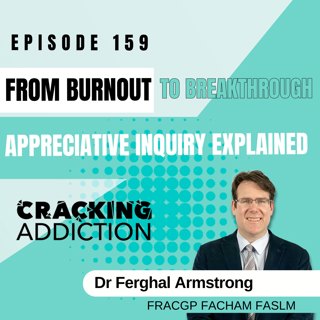
In this episode, Dr. Ferghal Armstrong is joined by Andy Smith to demystify appreciative inquiry, a groundbreaking approach to solving problems by concentrating on what works. Andy walks us through his journey from an IT professional disenchanted with his career, to becoming a hypnotherapist and eventually an expert in appreciative inquiry. He discusses how appreciative inquiry diverges from traditional problem-solving methods and shares compelling case studies, including an intriguing example from a women's prison in the UK.

Learning Outcomes:

Understanding Appreciative Inquiry: Learn what appreciative inquiry is and how it can be more effective than traditional problem-solving methods. Unlike conventional approaches that focus on identifying and fixing problems, appreciative inquiry seeks to amplify the elements that are already working well. This shift in focus can lead to more sustainable solutions and enhanced performance.


Differences from Traditional Change Management: Realise how appreciative inquiry differs significantly from conventional consulting and change management. Instead of diagnosing problems and prescribing solutions, appreciative inquiry involves facilitating people to discover their own solutions. This method benefits from the expertise of the individuals involved, promoting more personalised and relevant outcomes.


Application in Varied Settings: Discover the versatility of appreciative inquiry through its application in different settings, such as healthcare and prisons. For example, Andy shares how appreciative inquiry was used to streamline a drug dispensing regime in a women's prison. This revealed not just practical solutions but also enhanced the working relationships between prison officers and nursing staff.


Link with Emotional Intelligence and NLP: Appreciate the connection between appreciative inquiry, emotional intelligence, and neuro-linguistic programming (NLP). While NLP is expert-driven, appreciative inquiry is participant-driven, focusing on collaborative problem-solving. Both approaches aim to improve interpersonal skills but use different methodologies to achieve this.


Actionable Takeaways:

Flip the Problem: When faced with a problem, consider what the opposite of that problem looks like. For instance, if you’re dealing with high employee turnover, ask yourself what a highly engaged, content workforce would look like. This approach can open up new avenues for solutions that you might not have considered otherwise.


Facilitate, Don't Dictate: When tackling issues within a team or organisation, focus on facilitating discussions rather than prescribing solutions. By doing so, you’re leveraging the collective expertise and experience of the group, which often leads to more creative and applicable solutions. This also fosters a sense of ownership and accountability among team members.


Engage in Generative Conversations: Encourage open and positive conversations that focus on possibilities rather than limitations. This creates an atmosphere where team members feel safe to share ideas and are more likely to collaborate effectively. Generative conversations can lead to insights that transform how problems are perceived and addressed.


Utilise Both Brain Networks: Understand the importance of alternating between the task-positive and default mode networks of the brain. Task-positive is excellent for focus and goal achievement, but to foster creativity and new ideas, the relaxed default mode network is indispensable. Create an environment where both networks can be activated as needed.

Jaksot(238)

Dopamine, Relapse, and Recovery: Why Addiction Needs Long-Term Management

Dopamine, Relapse, and Recovery: Why Addiction Needs Long-Term Management

A lot of people still think addiction recovery is just about willpower.But addiction neuroscience tells a different story: dopamine, the reward system, and relapse risk all help explain why recovery o...

25 Maalis 5min

Why You Can Be Detoxed and Still Addicted

Why You Can Be Detoxed and Still Addicted

Addiction neuroscience, dopamine, cravings: detox ends withdrawal, but it does not end addiction.The MythA common myth in addiction recovery is that once detox is over, the problem is solved. Many peo...

18 Maalis 5min

Relapse Happens to Everyone: Here's the Science Why - Addiction Basics 06

Relapse Happens to Everyone: Here's the Science Why - Addiction Basics 06

Dr. Fergal Armstrong reframes relapse in addiction, explaining why it's not a personal failure but a common part of the recovery journey, comparable to chronic illnesses. Understanding the neuroscienc...

11 Maalis 5min

The Science of Withdrawal: What's Actually Happening? - Addiction Basics #5

The Science of Withdrawal: What's Actually Happening? - Addiction Basics #5

Withdrawal is one of the most feared parts of addiction recovery.But neuroscience shows something important:Withdrawal isn’t a failure of willpower — it’s the brain restoring balance after long-term c...

4 Maalis 5min

Addiction vs Dependence vs Tolerance: The Critical Medical Difference

Addiction vs Dependence vs Tolerance: The Critical Medical Difference

🚨 TOLERANCE ≠ ADDICTION 🚨Most people — even healthcare professionals — use these terms incorrectly.And that confusion is hurting patients.In this episode, we break down:🧠 The real definition of add...

25 Helmi 5min

Why Buprenorphine Is Safer Than Full Opioid Agonists

Why Buprenorphine Is Safer Than Full Opioid Agonists

Most people think methadone is the only real option for opioid addiction.Wrong.Buprenorphine — especially long-acting injectable depot — is flipping the entire system upside down.No daily pharmacy vis...

23 Helmi 28min

How Cravings Work: Limbic System vs Prefrontal Cortex - Addiction Basics EP3

How Cravings Work: Limbic System vs Prefrontal Cortex - Addiction Basics EP3

Addiction neuroscience explains why wanting to quit isn’t the same as being able to quit. Dopamine reshapes the brain’s reward system.In Episode 3 of Addiction Basics, we tackle one of the most painfu...

18 Helmi 6min

Dopamine and Addiction: The Science of Cravings - Addiction Basics EP2

Dopamine and Addiction: The Science of Cravings - Addiction Basics EP2

Addiction neuroscience explained. Dopamine, cravings, brain recovery, and neuroplasticity — backed by research.If you’ve ever wondered how addiction works in the brain, this is the science most people...

12 Helmi 6min

Suosittua kategoriassa Terveys ja hyvinvointi

unicast
rss-hanna-tikander
tiedenaiset-podcast
psykopodiaa-podcast
voi-hyvin-meditaatiot-2
rss-pitaisko-erota
rss-kuumilla-aalloilla
vakeva-elama-viisaampi-mieli-vahvempi-keho
rss-narsisti
junnut-pelissa
rss-pt-paahtio
puhu-muru
katilon-kahvitunti
rss-kyykkya-ja-kuoharia
meditaatiot-suomeksi
paritellen
fitnessvastaanotto
rss-sanelunpurku-podcast
rss-seuraava-potilas
terapiassa