

Uber vs Tesla: Compare/Contrast
In this podcast episode, Krish Palaniappan discusses the evolving landscape of finance and technology, focusing on the business models of Tesla and Uber. He explores Tesla's expansion into Robotaxis and its implications for Uber's ride-hailing services. The conversation delves into market performance, sales analysis, and the competitive edge provided by data and technology. The episode concludes with financial insights into both companies and a look at future prospects in the mobility sector.
3 Heinä 202548min

Mastering Day Trading: Timing and Strategy
In this podcast, Krish Palaniappan discusses the intricacies of day trading, focusing on the importance of timing, market fluctuations, and the analysis of trading data. He emphasizes the risks involved in trading and provides insights into how traders can interpret market movements to make informed decisions. Through case studies of specific stocks, he illustrates the dynamics of trading within the first hour and the rest of the trading day, highlighting the significance of understanding directional changes and trading ratios.
2 Heinä 202527min

Conversational AI (feat. Peter Swimm)
In this conversation, Krish Palaniappan and Peter Swimm, Founder of ToilVille, explore the evolving landscape of conversational AI and its implications for business, creativity, and society. They discuss the challenges and opportunities presented by AI, particularly in the context of team dynamics, productivity, and the future of work. The conversation also touches on the importance of context in AI applications, the potential for AI to enhance creativity, and the societal disparities in AI adoption. Peter shares insights from his experience in the field, emphasizing the need for organizations to adapt and leverage AI effectively to remain competitive.
1 Heinä 20251h 25min
Thinking about enrolling in College in Fall 2025? Think again! (Hint: AI)
In this podcast episode, Krish shares his personal reflections on the value of a college degree, drawing from his own extensive educational background and that of his family. He discusses the traditional expectations surrounding higher education, particularly in cultures where college is seen as a necessary step after high school. Krish also explores the evolving landscape of education in light of advancements in artificial intelligence, questioning whether a college degree is still essential in today's job market. He emphasizes the importance of making informed decisions about education and career paths, especially as AI continues to reshape the workforce. In this conversation, Krish Palaniappan discusses the evolving landscape of computer science education, the value of traditional college degrees, and the impact of AI on learning. He argues that while college can provide social benefits and networking opportunities, the traditional education model may not be the best path for everyone, especially in a rapidly changing job market. He emphasizes the importance of practical skills and alternative learning methods, suggesting that the future of education may require a shift away from conventional degrees.
6 Kesä 202549min

AI: Automation, Impact, Future (feat. Zac Engler)
In this conversation, Zac Engler, founder of BODHI AI, discusses the transformative impact of AI on business operations, emphasizing the importance of making AI work for individuals rather than the other way around. He shares insights on the barriers to automation, the differences in AI adoption between small and large organizations, and the future of entrepreneurship in an AI-driven world. Engler also highlights the need for reevaluating traditional software development processes and introduces the concept of the trifurcation of work, where AI can take on a significant portion of tasks, allowing humans to focus on higher-level functions. In this conversation, Zac Engler and Krish Palaniappan discuss the rapid evolution of AI technology and its implications for the workforce. They explore the disconnect between technological advancements and real-world adoption, the exponential changes brought by AI, and the challenges of adapting teams to new tools. The conversation also touches on the geopolitical impact of AI and the importance of retraining existing employees versus hiring new talent. In this conversation, Zac Engler discusses the transformative impact of AI on software development, the importance of adapting to new technologies, and the implications for outsourcing and job markets. He emphasizes the need for continuous learning and the potential for AI to serve as a strategic partner in business. The discussion also touches on the geopolitical aspects of AI advancement and the evolving landscape of technology companies, highlighting the balance between established giants and emerging players.
31 Touko 20251h 40min

Role of AI in Mental Health (feat. Dr. Sam Zand)
In this conversation, Dr. Sam Zand (@drsamzand), a holistic psychiatrist and founder of Anywhere Clinic, discusses the integration of AI in mental health care, the benefits of psychedelic therapy, and the evolving role of technology in enhancing patient care. He emphasizes the importance of emotional regulation, the potential of AI to augment therapeutic practices, and the need for adaptability in the medical field. The discussion also touches on biases in human and AI interactions, the ROI of AI in healthcare, and the future of medicine as it embraces technological advancements. In this conversation, Dr. Sam Zand and Krish Palaniappan explore the intersection of technology, mental health, and human connection. They discuss the paradox of happiness in technologically advanced societies, the role of AI in early mental health support, and the necessity for emotional intelligence in the age of AI. Dr. Zand emphasizes the importance of viewing AI as a companion rather than just a tool, advocating for a symbiotic relationship that enhances human understanding and connection. The conversation also touches on the evolving landscape of education and the need for AI literacy across various disciplines.
23 Touko 20251h 20min
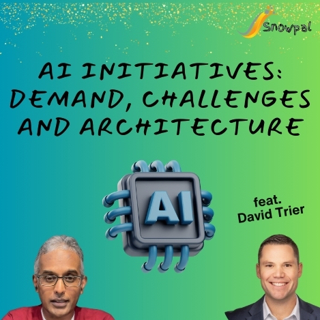
AI Initiatives: Demand, Challenges and Architecture (feat. David Trier)
In this conversation, Krish Palaniappan speaks with David Trier, VP of Product at ModelOp, about the challenges enterprises face in implementing AI initiatives, particularly generative AI. They discuss the demand for AI solutions, the architecture of AI systems, and the importance of choosing the right foundation models. Dave emphasizes the need for a structured approach to AI lifecycle management and the significance of trust among different teams in an organization. The conversation also touches on the future of user interfaces, the terminology surrounding AI, and the distinction between AI agents and agent AI.
23 Touko 202540min

Challenges and Implications of AI from a Software Development standpoint (feat. Jack Kennedy)
In this episode, Krish Palaniappan interviews Jack Kennedy, co-founder and CTO of Whippy AI. They discuss the challenges and implications of AI in business, focusing on Whippy’s all-in-one communication and automation platform. Jack shares insights on the evolution of AI, the importance of understanding customer needs, and how companies like Apple are navigating the AI landscape. The conversation also explores the balance between traditional software and AI innovations, emphasizing the need for user-friendly interfaces and tangible value in AI features. In this conversation, Jack Kennedy and Krish Palaniappan explore the evolution of user interfaces, particularly in the context of AI and automation. They discuss the balance between traditional software interfaces and new chat-based interfaces, emphasizing the importance of user experience and the potential pitfalls of over-automation. The dialogue also touches on the cultural aspects of software development and how these influence the tech stack choices of companies today. The conversation concludes with insights into the tech stack used by Jack's company, highlighting the tools and technologies that drive their development process. In this conversation, Krish Palaniappan and Jack Kennedy discuss the integration of AI in software development, the importance of cloud infrastructure, and the dynamics of remote teams. They explore the future of software development, the impact of AI on job markets, and the role of education in preparing for these changes. Jack emphasizes the value of talent regardless of location and the need for engineers to adapt to new technologies and methodologies.
15 Touko 20251h 52min

