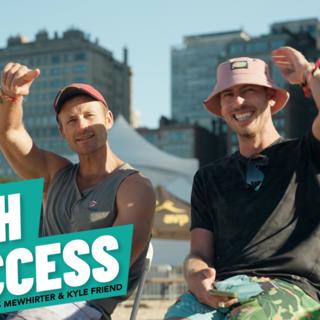


Refs are people too! With John Rodriguez
Nick Lucena winked, and only one person in the stadium could have possibly seen it: head ref John Rodriguez. Lucena had always been known for his fiery demeanor, and though Rodriguez cannot recall the exact year of the wink, he estimates it came at a tournament in Florida, when Lucena and Phil Dalhausser were playing Matt Olson and Kevin Wong, which would date it to the mid-2000s, which also dates it to when Lucena’s temper was nearing its zenith. Or was that temper just theatrics? Something for the crowd to enjoy, an added element to an excellent match between one storied team and the next great one? Perhaps, as it goes sometimes, it’s a bit of both. “Phil [Dalhausser] chucked a set,” recalled Rodriguez, one of the most well-known and well-respected refs on the AVP Tour and p1440. “Which is rare but it happened, and I tweeted it. Nick [Lucena] comes – they were getting killed in the second set against Kevin [Wong] and Matty [Olson] – flying over to my stand.” And here is where the disconnect between crowd and players and refs begins, in that intimate space between ref stand and player, where only two individuals know what’s being said in the conversation. “He goes ‘John, give me a yellow card, I’ve gotta get fired up,’” Rodriguez, said, laughing. “And he’s flailing his arms at me, and I’m like ‘Oh, alright, this isn’t so bad.’ And he says ‘Play along with me’ and I’m pointing at him and he’s pointing at me, and we’re not going overboard with it, but he says ‘Give me one more second and then give me a yellow card.’ So I said ‘Just don’t slam my stand or hit anything because then I have to give you a red card.’ “So he goes around a little bit longer and finally I tweet, give him a yellow card, and the audience goes ‘Booooo!’ And Nick’s pointing back at me and then he winks at me. It was just a fun time.” Ah, yes, few on top of the stand, or maybe even in the entire game, players included, have as much fun as Rodriguez, this week’s guest on SANDCAST: Beach Volleyball with Tri Bourne and Travis Mewhirter. The paths for a male to become a professional beach volleyball player are few and far between, no two the same. The paths for a male to become a professional beach volleyball referee are even more circuitous. “We do not,” Rodriguez said repeatedly, “do this for the money. We do this because we love the game.” Rest assured, Rodriguez does not, or initially did not, get into the game for the money. For the first handful of years in which he was involved in the game, he was a volunteer, a 20-something-year-old ball shagger. “The opportunity as an adult ball shagger, I’m like this older guy amidst all these kids chasing balls next to me and just loving it, loving the game, getting to play afterwards on the pro courts,” Rodriguez said. He shagged balls for so many years, in fact, that the AVP finally shrugged its shoulders and figured why not get the guy involved in a few more capacities? Maybe put him in the information booth, chat with the VIPs? After a few more years of that, the head ref at the time approached him and said “Hey, I know you know the game, and you’re already traveling with the AVP, so I know you could save me a lot of money if I could just use you for one day, maybe two days if we use you as an official,” Rodriguez recalled. “’So I said ‘Yeah, sure, that’ll be cool.’” He worked Thursdays and Fridays as a ref, and when the bigger matches began, the more established refs were called in and Rodriguez, known affectionately as J-Rod among players and fans alike, would return to the information booths or wherever his talents and passion were needed. Soon enough, Rodriguez could no longer be found in information booths or with the VIPs. No, John Rodriguez was a ref, from Qualifier Thursday to Finals Sunday, culminating in his Twitter handle becoming @avpjrod. “I had no idea it would go on this path,” he said. “I’m loving it. And we do this because we love the sport. I think I’ve said that, sorry, but we enjoy what we do, and I think it shows from, all of us, sometimes we’re at the site from 6:30 to 7, whatever it is. It is a long day, but when we look back, and the day closes, we’re like ‘Hey, that was a great day! We had the best seats in the house, or standing, whatever it may be, we saw some amazing volleyball, and it’s all worth it.’ The fatigue seems to go away and you wake up in the morning, get on your horse, and do the same thing again. We really love it.”
10 Loka 20181h 8min
The World Tour-cast with Norway, Canada, Latvia, United States
Martins Plavins requested the mic from Aleksandrs Samoilovs. Had to set some matters straight. “I know,” Plavins said on Saturday night at p1440 San Jose, “that Edgars misses me.” He was joking – maybe, possibly, perhaps – but Sunday’s result, when the Latvians upended the world’s best in Norway’s Christian Sorum and Anders Mol in the finals, proved that there’s likely a bit of truth to the notion that Edgars Tocs, Plavins’ typical partner, may have been missing his defender. Plavins and Tocs, Latvia’s No. 2 team behind Samoilovs and the injured Janis Smedins, were one of the world’s most delightful surprises in the 2018 FIVB season. Entering the year, Tocs, a 29-year-old from Madona, had never eclipsed the five-figure threshold in prize money, with just three main draws to his name in all of 2017. Yet there they were, on podium after podium to begin the year – gold at The Hague in January, silver in Kish Island a month later. By the end of the year they had played in 13 events, nearly as many main draws as Tocs had played in his entire career. By season’s end, they were ranked fifth in the world, three spots behind Samoilovs and Smedins, and a country that is roughly the size of Nebraska in terms of population was suddenly home to two of the world’s beach volleyball powers. Not that Latvia is an upstart. Not by any means. Ten years ago, Samoilovs and Plavins authored arguably the greatest upset in Olympic beach volleyball history when they stunned Phil Dalhausser and Todd Rogers in the first round of pool play. In 2012, Plavins did it again, this time with Smedins, upsetting Jake Gibb and Sean Rosenthal – then the No. 1 team in the world – in the quarterfinals of the 2012 Olympics in London. “We used to play good together,” Samoilovs said. “[Martins] agreed to come to San Jose so I’m very happy he had a chance to join me.” In two years, for the second time in three Olympics, they might very well join each other as teammates on separate teams. While Plavins was winning a bronze medal with Smedins in 2012, Samoilovs took a ninth with Ruslans Sorokins. “Martins is one of the best defenders in the world,” Samoilovs said, which explained why, in San Jose, Samoilovs, typically a split-blocker, stayed at the net. “It doesn’t make sense to go block.” Indeed it seemed they found the right defensive system, as they lost just one set the entire weekend in San Jose, to Austrian Olympian Alexander Huber and Leo Williams in the first round. After that, it was dominant win after dominant win, over Piotr Marciniak and Canadian Olympian Chaim Schalk, Spaniards Adrian Gavira and Pablo Herrera, Americans Miles Evans and Billy Kolinske and the world’s best in Noway’s Mol and Sorum. More important for either than the winning, though, is the fact they have a chance to win anything at all. Samoilovs remembers what it was like post-2016, when the world tour had just eight events big enough for the best to play, when beach volleyball was somewhat of a wasteland. With the advent of the King of the Court series and p1440, as well as the extension of the FIVB season, the sport has become nearly year-round. “This is really great,” Samoilovs said. “I remember after the Rio Olympics, in 2017, it was a disaster. It was only eight World Tour events, so you spend three months preparation just to play eight weeks, two months, so for us players we’re relieved because of these tournaments. Our families live because of these tournaments. It’s important to have more opportunities and more tournaments to earn money and to have a better life.”
3 Loka 201833min
Dane Selznick previews p1440 San Jose
Dane Selznick has seen it all. Seen every last one of beach volleyball’s many evolutions. He was there when players competed for little more than pride and maybe – maybe – a free dinner. He was there when two men named David Wilk and Craig Masuoka formed a promotional company named Event Concepts and began hauling in the Millers and Cuervos of the world and throwing legitimate prize money into tournaments. He was there when the AVP Tour was founded, in 1984, and when it collapsed, and when it formed again, and when it collapsed once more, to be revived in its current iteration under Donald Sun. He’s seen both the golden era, financially, when 10 players once banked more than $100,000 in prize money alone, and he’s seen the most dominant era, when Kerri Walsh-Jennings and Misty May-Treanor once rattled off 112 straight wins and three consecutive gold medals from 2004-2012. And now he is witness once more to the latest permutation in professional beach volleyball, the upstart event series, p1440, founded by Walsh-Jennings and her husband, Casey, and former college teammate Dave Mays. In March, Selznick, who had been a tournament director for the California Beach Volleyball Association (CBVA), founding the Gene Selznick Invitational, an eponymous nod to his father, was hired as p1440’s Director of Competition and Sport. “About a year ago, Kerri approached me and said ‘Dane I have a project I’d love for you to be a part of,’” Selznick said on SANDCAST: Beach Volleyball with Tri Bourne and Travis Mewhirter. “She gave me a little bit of background, I brought it to the head staff at CBVA, got their opinion to see if it would be a good fit, and here we are. Everything’s moved along pretty quickly.” Blindingly fast may be a more apt description. P1440 has announced dates for four events in its inaugural season, one of which will be an Olympic qualifier in Las Vegas, while the other three are partnered with the FIVB as international exhibitions. They’ve announced a lengthy list of sponsors that includes ROKA (eyewear), Alsa Energy (water), RX (protein bars), Brand X (strength and conditioning programs), AcuSpike (volleyball training), NormaTec (recovery), among a host of others. They’ve formed a developmental training program, replete with an armada of the finest coaches in the world, and a partnership with the CBVA, the pipeline from which many of the top players in the country cut their teeth, and where p1440 is now hosting what’s known as “satellite qualifiers,” allowing players to compete locally, weeks prior to the event itself, for a spot in the main draw. “They looked at our [CBVA] schedule extensively, and they were trying to select those certain events that they felt fit the mold to be a qualifying point-getter for the players,” Selznick said. “There are specific tournaments that we have that award you p1440 points. The qualifying satellites are enticing for the players because it gives them something more than playing in a tournament. Now they’re playing for a main draw spot in tournaments that offer high level competition, a lot more prize money – you’re guaranteed more money just getting into the tournament. I think being an alternative tour to what we’ve got going on, as long as it’s not conflicting, I see no problem with it, because it really gives players a lot more opportunities to make money.” More opportunities has been the theme of the past few months. In 2018, the AVP put on eight open events, one of which was partnered with the FIVB in Huntington Beach, before adding invitationals in Hawai’i and Huntington Beach. The upstart King of the Court series hosted another handful, to go along with upwards of 40 FIVBs of varying levels. And now there’s p1440, adding events at the end of September (San Jose), mid-October (Las Vegas), end of November and early December (San Diego) and mid-December (Huntington Beach), with events on the horizon in Texas, Florida and Los Angeles. “It seems like a pretty exciting time right now for the sport in general,” Tri Bourne said. “It’s cool, I think the sport is gaining a lot of momentum right now. There’s a lot of people like yourself and p1440 and AVP and King of the Court and FIVB and CBVA that are all kind of creating opportunities in their own way. I think it’s great. It seems like the sport is gaining some momentum.” That next opportunity begins Thursday, with the San Jose on-site qualifier, and extends through the weekend, in a domestic event that features the top two teams in the world of each gender – Norwegians Anders Mol and Christian Sorum and Brazilians Carolina Salgado and Maria Antonelli – as well as a host of the best talent in the United States – Sean Rosenthal and Chase Budinger, Jeremy Casebeer and Reid Priddy, Billy Allen and Theo Brunner, Chaim Schalk and Piotr Marciniak, Walsh-Jennings, Nicole Branagh and Lauren Fendrick, Kelley Larsen and Emily Stockman, Caitlin Ledoux and Geena Urango. “It’s just great to have more opportunity,” Selznick said. “Bottom line. Every entity should take care of its athletes. It’s like the Olympic Games, the athletes are No. 1.”
26 Syys 20181h 2min
SANDCAST roundtable: 'Play in as many tournaments as you can'
It became a recurring motif, though not exactly a conspicuous one. If you’re a regular listener to SANDCAST: Beach Volleyball with Tri Bourne and Travis Mewhirter, you’ll know that our final question to our guests is some iteration of: “If you had to give an up-and-coming beach volleyball player one piece of advice, what would that piece of advice be?” Some might expect a secret drill, a certain lift in the weight room, that one key to unlocking their potential, the secret formula to why Taylor Crabb always seems to be in the right place, at the right time, all the time (just watch the Manhattan Beach Open final and you’ll understand). The most common bit of advice, however, is as simple: Just play. This week, with Bourne home in Hawai'i and me in Maryland for an emergency trip home, we had to cancel the podcast, so we gathered advice from four of the best in the game -- Taylor Crabb, Rafu Rodriguez, Nicolette Martin, Katie Spieler -- on how, exactly, they became the best in the game. “Be a student of the game,” said Crabb, a likely candidate to win at least one of Most Valuable Player, Most Improved Player and Best Defender on the AVP Tour this season. “Be smarter rather than stronger, faster, bigger. It’s more important than the other things. Learnt he game, learn why things work, learn why things don’t work. The more you play, that’s when you get bigger, faster, stronger, going on the beach, just playing every day, you’ll train those muscles naturally. The gym does help also but the IQ of the game is the most important thing.” This season was, incredibly, only Crabb’s third on the beach. Just as he did in 2017, he enjoyed a career year in 2018, winning a pair of AVPs in Seattle and Chicago as well as claiming King of the Court in Hawai’i. His theory, too, was supported by three other SANDCAST guests – Spieler, Rodriguez, Martin – who all, not so coincidentally, enjoyed career-highs. “Just keep – just play every day,” said Martin, who claimed fifths in Austin and Seattle, narrowly missing her first Sunday. “We were talking about playing too much or whatever, but if you’re up and coming, I think it’s super important to get out to all those CBVAs on the weekend and just be playing as much as you can because it’s such an experience sport for sure. Just as much as you can touch a ball, the contacts, make sure when you’re going to the beach, get [phone] numbers, talk to people, that’s huge.” It has been for Martin, just as it has been for Spieler, a 5-foot-5 dynamo out of Hawai’i who made her first career Sunday in Austin, where her and Karissa Cook finished third. The founder and coach at East Beach Volleyball Academy, Spieler tells her girls to do exactly what she does over the summer: “Get out there and play as much as possible,” she said. “Growing up at East Beach, I would just go down and play with older guys or pickup games all day on the weekends and I think that’s when I really learned that I, a) loved the sport, and b) just a lot of different ways to score. So I don’t think you necessarily need to play for a club, even though that’s great if you have the resources to do so. Just that we are able to go down to the beach, grab a ball, maybe pick up a player and get better is great. So just get out there.” Rodriguez, the final guest on the SANDCAST radio hour of sorts, emphasized tournaments and pickup as well. He’s no stranger to CBVAs and AVP Nexts, despite winning an AVP in San Francisco this season, his first career AVP win. “Just go out and play in as many tournaments as you can,” he said. “Learn the game playing the game, right? Even me, I go out and play in CBVAs and all those one-day tournaments because you got to go out and play. Yeah, you have to train and learn the techniques, but you need to go out and play and play and play and play.” Popular on SANDCAST: SANDCAST: Melissa Humana-Paredes and Sarah Pavan SANDCAST: Taylor Crabb, AVP Seattle champion SANDCAST: Sarah Sponcil, Pac-12 Champ, National Champ, AVP Finalist SANDCAST: Tim Bomgren, the Minnesotan who could SANDCAST: Netherlands’ Brouwer and Meeuwsen go for gold or bust Train like the pros, with the pros, at VolleyCamp Hermosa! Recover the right way with Firefly: Accelerated Athletic Recovery Choose the ball the pros use. Choose Wilson and use our discount code: WILSONSAND FOR 20 PERCENT OFF!
19 Syys 201819min
Karissa Cook: Old fart, hood rat, awesomely effective volleyball
Call it old fart volleyball. Call it hood rat volleyball. Call it dirty or creative or funny or crafty or whimsical or whatever other name you’d like to label Karissa Cook’s decidedly awesome style of scoring points on a volleyball court. But you must, at the very least, call it this: effective. Effective enough that Cook and her partner, Katie Spieler, scored an invite to the AVP’s final event of the year, an invitational in Hawaii, where Spieler and Cook played their college ball. Effective enough to make her first career Sunday, at the AVP’s opening stop in Austin. Effective enough to avoid the qualifiers all year – “I had to do some beautiful mind calculations for New York,” she said, laughing – for the first time of her young career. “If it ain’t broke don’t fix it,” she said of her partnership with Spieler, last week’s guest on SANDCAST: Beach Volleyball with Tri Bourne and Travis Mewhirter. “We’ve just been playing together and the honeymoon phase hasn’t worn off two years later.” And Spieler’s contagious energy continues to rub off on Cook. After Chicago, where they finished seventh, Cook was about ready to shut it down. Time for rest and recovery. Off-season things. But the season wasn’t over. Not yet. There was a NORCECA qualifier to play, and an energetic – always energetic – and enthusiastic – always enthusiastic – partner who wanted to play. “I was like an angry cat,” Cook said, laughing. “We had played so many tournaments but we had so much fun, per usual. I 100 percent always love volleyball as soon as my feet touch the sand. You go and it’s the best decision you’ve ever made.” Seems so. Cook and Spieler breezed through the qualifier, and now they have few events on their 2018 schedule, to go along with the unexpected invite to Hawaii. “Katie was like ‘Let’s do it!’” Cook said laughing. “And I was like ‘Ok, fine.’ I just grom onto her and make her carry me with her wherever we go.” It appears that really isn’t too far from the case. Earlier this year, Spieler made the move from Santa Barbara to Hermosa Beach, cutting down on an obscene amount of drive time, able to get in with the top training groups in the country. Cook recently did the same, leaving her post as a Stanford beach coach, moving from Palo Alto to Manhattan Beach. Of course, some things are a bit different between the two as well. Cook is also moving to be closer with her brother, Brian, the hilarious and viral star of Instagram this season, with whom she’s helping found a start-up, a sort of “Uber for bartenders,” she said. Stanford kids. But mostly, she knows that, while beach volleyball is friendly to the body, she cannot play forever. Her window as an elite athlete is narrowing over the next five to 10 years. Coaching will be there forever. Gromming onto Spieler, qualifying to play events in countries she’d otherwise never visit, is here now. “I could have stayed there and been a padawan forever and been super happy,” Cook said of Stanford. “I adored [coaching] and I loved it and I’ll always be super grateful for it, and I do see myself going back and coaching but I wanted to really go for it for a couple years at least.”
12 Syys 201855min
Katie Spieler: 'Go out on the court and be you'
The beginning of the best year of Katie Spieler’s burgeoning career began at once brutally and spectacularly. The brutal, as it tends to go in sports, preceded the spectacular, setback was succeeded by breakthrough. “One of my worst matches was my first game in Austin,” Spieler said on SANDCAST: Beach Volleyball with Tri Bourne and Travis Mewhirter. “I was super bummed because I felt mentally not on, physically not on. I never call anyone on gamedays, but I called my sister and I was just like ‘I need your advice.’ Her advice was to just ‘Go out and be you. You don’t have to go out and try to be super confident and super aggressive. Just literally be yourself on the court and that’s when you’re going to play your best.’” That initial 13-21, 22-20, 11-15 loss to Jace Pardon and Brittany Tiegs in the rearview, Spieler and partner Karissa Cook won their next four matches. Just like that, Spieler had gone from minor identity crisis to her first career AVP semifinal, blowing well past her previous career-best of seventh, at Chicago of 2016, all the way to the semifinals, her first Sunday. “It felt way different,” Spieler said of the semifinal. “The vibes on a Sunday are totally different from even late on a Saturday. There’s so many fewer teams there and there’s a big crowd, and Austin was super weird because there was a rain delay. I think we’ve learned a lot since then just to take it as another match, but I think it was ‘Oh my gosh! We’re in the semis!’ Playing your game is just how you should approach every match.” And it seems their own game works just fine. In five of the next six tournaments, they’d match or improve upon that previous career-high, finishing seventh or better in the final five events of the year. “It was great learning with Karissa and getting better,” Spieler said. “Each tournament, unless you win, you end on a loss, so there’s always that, and there’s so much I want to work on and get better, but yeah, it was a great season.” It was a season in which Spieler more than doubled her career prize money from the previous four seasons combined. A season in which, for the first time in her career, she didn’t have to play in a single qualifier. A season in which, once again, her and Cook tossed out many of beach volleyball’s norms and won and grinded in their own decidedly unique style. “I don’t think it was one certain thing, but [Karissa] was coaching at Stanford all of last year so our practice was just playing in tournaments,” Spieler said. “That continued thoughout this season but for me this off-season I just worked on myself, and moving down [to Hermosa Beach] was huge. And [Karissa] just worked on herself this off-season and when we got together we were that much better because we had both worked on what we needed to and we got better as the year went on. It wasn’t one certain thing, we just both have a growth mindset and are working to get better individually.” With the AVP regular season over, Spieler is left with perhaps two tournaments remaining on the 2018 calendar: a Norceca qualifier – and potentially the three events for which it would qualify them – and, potentially, an AVP Hawaii wild card. Of the women’s teams vying for the wild card spot, it shouldn’t come as a surprise if the AVP taps Spieler and Cook, both of whom played for Hawaii, both of whom have a significant following on the islands. Wild card or not, Spieler is simply going to continue doing what she does best: find a way to keep on winning. “I don’t really set goals that I need to reach this goal by this date,” she said. “I don’t think I’ve ever been like that. It’s more like, ‘Ok, put my head down, grind it out, have fun, play,’ and then when I surface, it’s like ‘Oh, nice!’ If I did these things, great. My goal is just to keep playing at the highest level I can play for as long as I can play, because I just love playing volleyball.”
5 Syys 20181h
Eric Zaun: The Happy Gilmore of the AVP Tour
The first thing you must know about Eric Zaun is that you cannot call him Eric Zaun. Don’t laugh. He’s serious. Maybe. Sort of. Well, you never can know with Zaun. “I’ve actually been going by Danny Fahrenheit lately,” Zaun said on SANDCAST: Beach Volleyball with Tri Bourne and Travis Mewhirter. “You introduced me as Zaun but I like Danny Fahrenheit. I just don’t like the name Eric.” If you know Zaun, nothing about this is surprising. If you do not know Zaun, the 37 words above are an apt summation of what it’s like to be around Eric Zaun, or Fahrenheit, or whatever it is you’d like to call him. He’ll take anything but Eric at this point. “[Piotr Marciniak] actually calls me Cookie,” Zaun said. “I used to go by Cookie Robinson exclusively on the NVL. Everybody called me that. A lot of my good friends still call me that.” So his current partner calls him Cookie, he occasionally moonlights as Danny Fahrenheit, though he’s also immensely proud of tricking a reporter covering Pottstown that his name was Lamb Rivermore. When the paper ran the next morning, and Zaun was quoted under that alias, he finished the weekend known as Mr. Rivermore, Lamb Rivermore. “They wrote that in the newspaper!” he said, laughing. Just Zaun being Zaun…or Fahrenheit or Cookie or Reebok Hernandez or Lamb Rivermore, whatever you want to call him. But don’t let him fool you, either. There’s more to Zaun than he lets on. Much more. One does not simply earn the AVP Rookie of the Year by chance. Nor does one make a Sunday in his first season on Tour, and in the next, win Waupaca, Seaside and six-man – the biggest non-AVP domestic stops of the year – without putting in the work to do so. Zaun puts in his work. Plenty, actually. This is a season that began with a two-month trek through New Zealand and Australia, in which he and Adam Roberts won a handful of tournaments in New Zealand before claiming fifth in an FIVB in Shepparton, his second career international tournament. “That takes a lot out of your off-season training,” Zaun said. So he just kept going. To Iran, Aguascalientes, China, Austin, Wisconsin, Oregon, Dallas, “Just getting used to the grind,” he said. “I got a lot more FIVB points, compared to zero at this time last year.” The points are nice, yes, but Zaun isn’t much for material things, even if it concerns his career. Ed Ratledge still has his Rookie of the Year plaque. He once took off an FIVB jersey and handed it to a ball girl. An oversized check from Seaside? Gave it to a random kid, just because. The only prize he’s ever kept from volleyball is the money he’s made, which really just funds the next one, and the next one, piling up experience after experience. That’s what he’s after, anyway. Experiences. Stories. Perspective. “It’s really unfortunate that we can go to all these places but we don’t really have any time for fun,” he said. “It’s almost brutal, mentally, these new places I’ve never been before, I have to fly right back for an AVP. But it’s cool because even though you’re going to China or Iran or the middle of nowhere Mexico, it’s not like a total loss because a lot of people never get to see that and see how they live. “You really take for granted how great your life is in America. Even if you didn’t get to do anything in Iran, you still got to see another place in the world. You’re not even allowed to go to Iran! America’s pretty great. You realize that once you travel.” Though the volleyball season will be over after this weekend, Zaun’s travels have just begun. As soon as the final ball hits the sand in Chicago, he’s off to South America, on what promises to be nothing shy of a winding, epic, story-filled “road trip with the boys.” A morale-booster. He’s the first to admit that his second season on tour was “a bit of a sophomore slump,” he said. But he’s learned. He’s dabbling on the right side, expanding his skill set. He’s recognized that his defense is still lacking, that his weight can’t fluctuate as much as it has over the course of his career. “I don’t think I’m that great of a defender,” he said. “Just kind of overall everything – digging hard driven balls, staying balanced. I don’t have a volleyball background. I started playing beach volleyball late so it’s not like I have all those fundamentals drilled into me. I just don’t think I have that many touches or reps or coaching.” So he’s going to get into film. He’s going to get more touches. But first, he’s taking a road trip with the boys. For Danny Fahrenheit to play to the best of his abilities, morale needs to be high.
29 Elo 20181h 15min
Jake Gibb isn't finished playing just yet
There are exactly two indicators in Jake Gibb’s house that there is a professional volleyball living there. One is a panorama of the 1976 Manhattan Beach Open, the year Gibb was born. The other is a panorama of the 2005 Manhattan Beach Open, the first of three occasions in which Gibb would win and cement his name onto the famed Manhattan Pier. “It’s just kind of cool to see what it was when I was born, and you see the crowd just lined up like 30 deep watching, I think it was [Steve] Obradovich and I forget who he was playing with,” Gibb said on SANDCAST: Beach Volleyball with Tri Bourne and Travis Mewhirter. “Then I have my first win, we played actually Nick and Phil, and I played with Stein [Metzger], and it’s a picture that Stein gave me after.” After that? Nothing. Nothing from the guy who has been to three Olympics and once, in 2012, finished ranked No. 1 in the world alongside Sean Rosenthal. “Those,” he said of the Manhattan panoramas, “are the only volleyball pictures I have.” It really shouldn’t be all too surprising coming from Gibb, who has for years been one of beach volleyball’s most humble ambassadors. It’s not uncommon that his fellow AVP veterans liken him to Tim Duncan, the soon-to-be Hall-of-Famer after a brilliant career with the San Antonio Spurs. It’s easy to see the comparison, for the most notable characteristic the two share – aside from being excruciatingly modest, rarely succumb to any theatrics, unanimously respected by their peers – is this: They just get the job done. Since the AVP began hosting full seasons again in Donald Sun’s second year of ownership, in 2013, Gibb has won 16 AVP tournaments and competed in five more finals. He has won in Salt Lake City and Cincinnati, in Shanghai and New York, St. Pete’s and Atlantic City. He has won in the torrential rain, as he did in New Orleans of 2015, and stifling heat (Manhattan Beach, 2016). And, age be damned, at 42 years young, he’s doing it as well as he ever has. In four events this season, his second with Taylor Crabb, Gibb has made at least the semifinals in all four and thrice competed in the finals, beating Dalhausser and Nick Lucena in Seattle. “I feel like age really isn’t in the equation for me,” he said. “It’s how I’m playing and how I feel and my desire to play and I love playing and I feel like I’m playing well and I feel like I can keep increasing my knowledge of this sport so I want to keep doing it.” At the moment, it seems he’ll be doing it for another several years longer. Throughout the year, he and Crabb have only improved, finishing their last three FIVB events in the top 10. They claimed a fourth in a major in Gstaad, losing a thriller against current world leaders Anders Mol and Christian Sorum that would have pushed them into the finals. Two weeks later, at a major in Vienna, they came out of the qualifier to take fifth. Two weeks after that? Manhattan Beach, Gibb’s favorite stop. Again, he was in the finals, and had it not been for a swing that went two inches too long at the score freeze in the second set, he’d have had his fourth plaque on the Manhattan Beach Pier with his fourth partner. “It’s raw right now is where it is,” he said. “I’m going to need some time to let it sit. Like anything, you need time to learn from it, because right now I’m not in that space. Right now, it’s a car ride home by myself with a lot of F bombs and grabbing the wheel.” There’s not much time for reflection. Two days after Manhattan, Gibb began coaching duties for his son’s soccer team. Then a NORCECA qualifier on the day after that, one that begins the Olympic qualification process. Then it’s onto Chicago, the Netherlands, Hawaii, Vegas, maybe China, he isn’t sure yet. What he is sure of is this: He wants to go to Tokyo. And he isn’t ready to retire just yet.
22 Elo 201848min