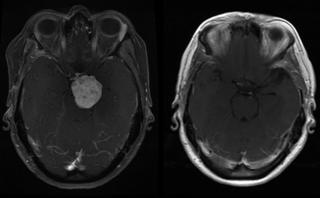
Podcast 582:  Gadolinium - The Contrast of MRI

Podcast 582: Gadolinium - The Contrast of MRI

Contributor: Michael Hunt, MD

Educational Pearls:

  • Contrast agents are commonly used for X-rays and CT's to better characterize disease, but contrast doesn't work with MRI. That's where the element Gadolinium comes into play.
  • Gadolinium, element 64, is ferromagnetic (attracted to iron) below 68 degrees and above that temperature it's paramagnetic which makes it useful in MRI (Magnetic Resonance Imaging).
  • Gadolinium is toxic alone, but when paired with chelators it can be used in humans and allows for better characterization of tumors or abnormal tissue on MRI.
  • It helps identify this abnormal tissue because when MRI causes polarization of our body's cells, the gadolinium, which has the maximum number of unpaired electrons in its orbital shells, alters the rate of decay in abnormal tissue highlighting abnormalities on imaging.
  • Gadolinium can also be used in the treatment of cancers because it collects in the cells of abnormal tissue, allowing for more targeted therapies.
  • In people exposed to gadolinium, the anaphylaxis rate is low, below 1/1000, and in rare cases there are reports of kidney injury and nephrogenic systemic fibrosis which is why it's not recommended in renal failure patients.

References

1)Ibrahim MA, Hazhirkarzar B, Dublin AB. Magnetic Resonance Imaging (MRI) Gadolinium. [Updated 2020 Mar 9]. In: StatPearls [Internet]. Treasure Island (FL): StatPearls Publishing; 2020 Jan-. Available from: https://www.ncbi.nlm.nih.gov/books/NBK482487/

2)Pasquini L, Napolitano A, Visconti E, et al. Gadolinium-Based Contrast Agent-Related Toxicities [published correction appears in CNS Drugs. 2018 May 15;:]. CNS Drugs. 2018;32(3):229-240. doi:10.1007/s40263-018-0500-1

Summarized by Jackson Roos, MS4 | Edited by Erik Verzemnieks, MD

Jaksot(1145)

Podcast #318: Nystagmus

Podcast #318: Nystagmus

Author: Erik Verzemnieks, M.D. Educational Pearls: ● Common causes of nystagmus: Congenital disorders, CNS diseases (MS, CVA), Intoxication ● Drugs associated (ETOH, Ketamine, PCP, SSRI, MDMA, Lit...

13 Huhti 20181min
Podcast #317: Elbow Dislocation

Podcast #317: Elbow Dislocation

Author: John Winkler, M.D. Educational Pearls: ● Lower mechanisms of injury have a lower chance of an associated fracture or major ligament injury ● One major concern is having a fracture fragment i...

11 Huhti 20182min

Podcast #316: Abnormalities in Alcohol Intoxication

Podcast #316: Abnormalities in Alcohol Intoxication

Author: Michael Hunt, M.D. Educational Pearls: 1% of patients presenting to ED with alcohol intoxication end up going to the ICU Most common critical illnesses were acute hypoxic respiratory fail...

9 Huhti 20183min
Podcast #315: Retropharyngeal Infections in Pediatrics

Podcast #315: Retropharyngeal Infections in Pediatrics

Author: Dr. Karen Woolf, MD Educational Pearls: Anatomy : base of skull to posterior mediastinum, anteriorly bounded by middle layer of deep cervical fascia and posteriorly by the deep layer, communi...

6 Huhti 20186min
Podcast #314: Psychogenic nonepileptic seizures (PNES)

Podcast #314: Psychogenic nonepileptic seizures (PNES)

Author: Gretchen Hinson, M.D. Educational Pearls: PNES vs. epilepsy: postictal state is diagnostic of an epileptic seizure (sonorous respirations and/or confusion, lasting typically 20-30 minutes);...

4 Huhti 20185min

Podcast #313: Flu Screening

Podcast #313: Flu Screening

Author: Dr. Peter Bakes Educational Pearls: High risk patients: underlying lung disease, immunocompromised, extremes of age (65), underlying cardiac/renal/neurologic disease, and pregnant women Testi...

2 Huhti 20187min
Podcast #312: SCIWORA

Podcast #312: SCIWORA

Author: Sam Killian, M.D. Educational Pearls: Spinal cord injury without radiographic abnormality (SCIWORA) is a diagnosis defined as traumatic injury to spine with clinical sx of traumatic myelopa...

30 Maalis 20184min
Podcast #311: Recurrence of Seizures in Pediatrics

Podcast #311: Recurrence of Seizures in Pediatrics

Author: Aaron Lessen, M.D. Educational Pearls: Recurrence rate for first time unprovoked seizures - 5% after 48 hours, 14% at 2 weeks , 30% after 4 months. Higher risk for recurrence: age under 3; pa...

28 Maalis 20182min

Suosittua kategoriassa Tiede

tiedekulma-podcast
rss-mita-tulisi-tietaa
rss-poliisin-mieli
rss-duodecim-lehti
docemilia
filocast-filosofian-perusteet
rss-ammamafia
rss-luontopodi-samuel-glassar-tutkii-luonnon-ihmeita
rss-sosiopodi
utelias-mieli
radio-antro
rss-astetta-parempi-elama-podcast
rss-tiedetta-vai-tarinaa