Podcast 582:  Gadolinium - The Contrast of MRI

Podcast 582: Gadolinium - The Contrast of MRI

Contributor: Michael Hunt, MD

Educational Pearls:

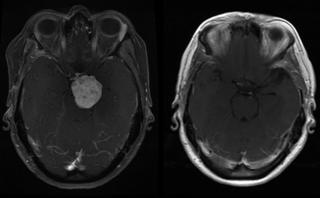
  • Contrast agents are commonly used for X-rays and CT's to better characterize disease, but contrast doesn't work with MRI. That's where the element Gadolinium comes into play.
  • Gadolinium, element 64, is ferromagnetic (attracted to iron) below 68 degrees and above that temperature it's paramagnetic which makes it useful in MRI (Magnetic Resonance Imaging).
  • Gadolinium is toxic alone, but when paired with chelators it can be used in humans and allows for better characterization of tumors or abnormal tissue on MRI.
  • It helps identify this abnormal tissue because when MRI causes polarization of our body's cells, the gadolinium, which has the maximum number of unpaired electrons in its orbital shells, alters the rate of decay in abnormal tissue highlighting abnormalities on imaging.
  • Gadolinium can also be used in the treatment of cancers because it collects in the cells of abnormal tissue, allowing for more targeted therapies.
  • In people exposed to gadolinium, the anaphylaxis rate is low, below 1/1000, and in rare cases there are reports of kidney injury and nephrogenic systemic fibrosis which is why it's not recommended in renal failure patients.

References

1)Ibrahim MA, Hazhirkarzar B, Dublin AB. Magnetic Resonance Imaging (MRI) Gadolinium. [Updated 2020 Mar 9]. In: StatPearls [Internet]. Treasure Island (FL): StatPearls Publishing; 2020 Jan-. Available from: https://www.ncbi.nlm.nih.gov/books/NBK482487/

2)Pasquini L, Napolitano A, Visconti E, et al. Gadolinium-Based Contrast Agent-Related Toxicities [published correction appears in CNS Drugs. 2018 May 15;:]. CNS Drugs. 2018;32(3):229-240. doi:10.1007/s40263-018-0500-1

Summarized by Jackson Roos, MS4 | Edited by Erik Verzemnieks, MD

Jaksot(1146)

Podcast # 423: Blunt Cardiac Injuries

Podcast # 423: Blunt Cardiac Injuries

Author: Mike Hunt, MD Educational Pearls: Blunt cardiac injuries most commonly occur in motor vehicle collisions, auto-pedestrian collisions, and from sports injuries The more anterior right ventri...

14 Tammi 20194min
Podcast # 422: ED Opioid Prescription Trends

Podcast # 422: ED Opioid Prescription Trends

Author: Jared Scott, MD Educational Pearls: From 1996 to 2012, the total quantity of opioids prescribed increased 647% for non-cancer pain Office based prescriptions accounted for 84% of the total ...

11 Tammi 20194min
Podcast # 421: Sweet DKA Pearls

Podcast # 421: Sweet DKA Pearls

Author: Gretchen Hinson, MD Educational Pearls:   Diabetic ketoacidosis patients are subject to electrolyte derangements Potassium should be monitored closely: K 3.3 K > 5.3 = delay potassium repl...

9 Tammi 20194min
Podcast # 420: CT Contrast and the Kidneys

Podcast # 420: CT Contrast and the Kidneys

Author: Don Stader, MD Educational Pearls: Recent meta-analysis has demonstrated that there is no significant risk for kidney injury from CT contrast Most kidney injury seen after contrast CTs wer...

7 Tammi 20192min
Podcast # 419: Etripamil

Podcast # 419: Etripamil

Author: Don Stader, MD Educational Pearls: Etripamil is an intranasal calcium channel blocker in development for use in SVT A recent study showed that etripamil has an SVT conversion rate of arou...

20 Joulu 20183min

Podcast # 418: Vertebral Artery Dissection

Podcast # 418: Vertebral Artery Dissection

Author: Don Stader, MD Educational Pearls: Vertebral artery dissection (VAD) contributes to just 2% of strokes overall but ~25% of strokes for patients VAD is associated with minor trauma (chiroprac...

17 Joulu 20183min
Podcast # 417: Water Balance

Podcast # 417: Water Balance

Author: Katie Sprinkle, MD Educational Pearls: Hyponatremia results when patients over hydrate and dilute their sodium with too much free water Symptoms of hyponatremia can mimic symptoms of dehydrat...

15 Joulu 20183min
Podcast # 416: Wide Complex Tachycardia

Podcast # 416: Wide Complex Tachycardia

Author: Aaron Lessen, MD Educational Pearls: Defined as QRS over 120 ms and rate over 120 Two major rhythms = Vetricular tachycardia (VT) or SVT with aberrancy Safest approach is to assume it is VT S...

12 Joulu 20183min

Suosittua kategoriassa Tiede

tiedekulma-podcast
rss-mita-tulisi-tietaa
rss-poliisin-mieli
docemilia
rss-duodecim-lehti
rss-luontopodi-samuel-glassar-tutkii-luonnon-ihmeita
utelias-mieli
rss-astetta-parempi-elama-podcast
filocast-filosofian-perusteet
rss-lapsuuden-rakentajat-podcast
rss-sosiopodi











