Podcast 785: Pepper Spray

Podcast 785: Pepper Spray

Contributor: Jared Scott, MD

Educational Pearls:

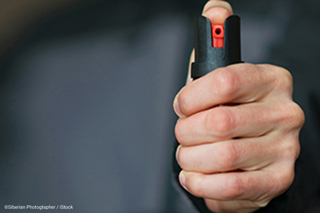
  • Pepper spray is a chemical irritant derived from oleoresin capsicum (OC), an extract from pepper plants. It can be used by police for riot or crowd control, or by individuals for self defense.
  • In the event of an exposure, those affected should immediately disperse from the area, remove contact lenses with clean or gloved hands, and remove contaminated clothing.
  • Pepper spray can spread from patients to providers by contact. When caring for those exposed, providers should use PPE including gloves and should double bag personal belongings.
  • For patient management consider the following:
    • If the eyes are affected, first remove contacts then irrigate with clean water. Use proparacaine drops for relief.
    • Clean exposed skin thoroughly with soap and water.
    • Inhalation and ingestion may cause nausea, vomiting, shortness of breath and generalized anxiety from discomfort. Treatment can include antiemetics and anxiolytics. Symptoms may persist for many days.

References

Schep LJ, Slaughter RJ, McBride DI. Riot control agents: the tear gases CN, CS and OC-a medical review. J R Army Med Corps. 2015;161(2):94-99. doi:10.1136/jramc-2013-000165

Tidwell RD, Wills BK. Tear Gas and Pepper Spray Toxicity. [Updated 2022 Jan 10]. In: StatPearls [Internet]. Treasure Island (FL): StatPearls Publishing; 2022 Jan-. Available from: https://www.ncbi.nlm.nih.gov/books/NBK544263/

Summarized by Kirsten Hughes, MS4 | Edited by John Spartz MS4 & Erik Verzemnieks, MD

The Emergency Medical Minute is excited to announce that we are now offering AMA PRA Category 1 credits™ via online course modules. To access these and for more information, visit our website at https://emergencymedicalminute.org/cme-courses/ and create an account.

Donate to EMM today!

*********************


Jaksot(1145)

Podcast # 438 : tPA for Frostbite

Podcast # 438 : tPA for Frostbite

Author: Aaron Lessen, MD Educational Pearls: Several studies have shown administration of tPA can improve outcomes and reduce need for amputation tPA is considered in grade III and IV frostbite tPA...

22 Helmi 20192min

Podcast # 437 : Myasthenia Gravis

Podcast # 437 : Myasthenia Gravis

Podcast # 437 : Myasthenia Gravis Author: Gretchen Hinson, MD Educational Pearls: Myasthenia gravis (MG) is an antibody mediated autoimmune disorder against the acetylcholine receptors at the neuromu...

20 Helmi 20197min

Podcast # 436 : Epinephrine Autoinjectors

Podcast # 436 : Epinephrine Autoinjectors

Author: Charleen Gnisci, PharmD Educational Pearls: Between 2011 to 2016, Mylan increased EpiPen prices by 400% ($700 for 2 packs) AUVI-Q was recalled in 2012, which left the market share to the Ep...

18 Helmi 20192min

Podcast # 435 : UCL Injury

Podcast # 435 : UCL Injury

Author: Ryan Circh, MD Educational Pearls: Ulnar collateral ligament injury is often called gamekeeper's thumb or skier's thumb Can results from traumatic deviating the thumb radially (abduction) Poo...

15 Helmi 20192min

Podcast # 434 : TIA

Podcast # 434 : TIA

Author: Peter Bakes, MD Educational Pearl: Transient ischemic attack (TIA) is defined as neurologic symptoms that resolve in 24 hours with no new changes on head imaging Mimics include complex migr...

13 Helmi 20195min

Podcast # 433: Geriatric Ketamine

Podcast # 433: Geriatric Ketamine

Author: Michael Hunt, MD Educational Pearls: Recent study compared ketamine to morphine in elderly patient Ketamine (IV dose 0.3 mg /kg) provided equivalent pain control to morphine (IV dose 0.1 mg ...

9 Helmi 20192min
Podcast # 432: Hunting for UTIs

Podcast # 432: Hunting for UTIs

Author: Michael Hunt, MD Educational Pearls: As many as 20% of women in assisted living have asymptomatic bacteriuria This can present a diagnostic conundrum when seeing these patients in the emergen...

7 Helmi 20193min

Podcast # 431: Medication Errors

Podcast # 431: Medication Errors

Author: Rachel Brady, MD Educational Pearls: Medication errors are estimated to be the 3rd leading cause of death A 2016 study estimated 250,000 errors occur per year, with 7000-9000 leading to death...

4 Helmi 20193min

Suosittua kategoriassa Tiede

tiedekulma-podcast
rss-mita-tulisi-tietaa
rss-poliisin-mieli
docemilia
rss-duodecim-lehti
rss-sosiopodi
radio-antro
filocast-filosofian-perusteet
rss-ammamafia
utelias-mieli
mielipaivakirja
rss-bios-podcast
rss-astetta-parempi-elama-podcast
rss-tiedetta-vai-tarinaa
rss-luontopodi-samuel-glassar-tutkii-luonnon-ihmeita