Podcast 912: Narcan (Naloxone)

Podcast 912: Narcan (Naloxone)

Contributor: Taylor Lynch, MD

Educational Pearls:

Opioid Epidemic- quick facts

  • Drug overdoses, primarily driven by opioids, have become the leading cause of accidental death in the U.S. for individuals aged 18-45.

  • In 2021, opioids were involved in nearly 75% of all drug overdose deaths

  • The rise of synthetic opioids like fentanyl, which is much more potent than heroin or prescription opioids, has played a major role in the increase in overdose deaths

What is Narcan AKA Naloxone?

  • Competitive opioid antagonist. It sits on the receptor but doesn't activate it.

When do we give Narcan?

  • Respiratory rate less than 8-10 breaths per minute

Should you check the pupils?

  • An opioid overdose classically presents with pinpoint pupils BUT…

  • Hypercapnia from bradypnea can normalize the pupils

  • Taking other drugs at the same time like cocaine or meth can counteract the pupillary effects

  • Basilar stroke could also cause small pupils, so don't anchor on an opioid overdose

How does Narcan affect the body?

  • Relatively safe even if the patient is not experiencing an opioid overdose. So when in doubt, give the Narcan.

  • What if the patient is opioid naive and overdosing?

    • Use a large dose given that this patient is unlikely to withdraw

    • 0.4-2 mg every 3-5 minutes

  • What if the patient is a chronic opioid user

    • Use a smaller dose such as 0.04-0.4 mg to avoid precipitated withdrawal

How fast does Narcan work?

  • Given intravenously (IV), onset is 1-2 min

  • Given intranasal (IN), onset is 3-4 min

  • Given intramuscularly (IM), onset is ~6 min

  • Duration of action is 60 mins, with a range of 20-90 minutes

How does that compare to the duration of action of common opioids?

  • Heroine lasts 60 min

  • Fentanyl lasts 30-60 min, depending on route

  • Carfentanyl lasts ~5 hrs

  • Methadone lasts 12-24 hrs

  • So we really need to be conscious about redosing

How do you monitor someone treated with Narcan?

  • Pay close attention to the end-tidal CO2 to ensure that are ventilating appropriately

  • Be cautious with giving O2 as it might mask hypoventilation

  • Watch the respiratory rate

  • Give Narcan as needed

  • Observe for at least 2-4 hours after the last Narcan dose

  • Larger the dose, longer the observation period

Who gets a drip?

  • If they have gotten ~3 doses, time to start the drip

  • Start at 2/3rds last effective wake-up dose

Complications

  • Flash pulm edema

    • 0.2-3.6% complication rate

    • Might be from the catecholamine surge from abrupt wake-up

    • Might also be from large inspiratory effort against a partially closed glottis which creates too much negative pressure

    • Treat with BIPAP if awake and intubation if not awake

Should you give Narcan in cardiac arrest?

  • Short answer no. During ACLS you take over breathing for the patient and that is pretty much the only way that Narcan can help

  • Just focus on high quality CPR

References

Summarized by Jeffrey Olson MS2 | Edited by Meg Joyce & Jorge Chalit, OMSII

Jaksot(1144)

Podcast 802: Intranasal Medication Administration for Pediatric Patients

Podcast 802: Intranasal Medication Administration for Pediatric Patients

Contributor: Aaron Lessen, MD Educational Pearls: Intranasal medication administration is a convenient, quick, and relatively painless option for pediatric patients Often used as an initial medicatio...

2 Elo 20223min
Mental Health Monthly #14: Substance-Induced Psychosis (Part II)

Mental Health Monthly #14: Substance-Induced Psychosis (Part II)

In this second episode of a two-part mini-series, we feature Dr. Nadia Haddad, a Colorado psychiatrist, and Dr. Ricky Dhaliwal, an emergency medicine physician, as they discuss the various treatment m...

27 Heinä 202224min
Podcast 801: Push Dose Vasopressors

Podcast 801: Push Dose Vasopressors

Contributor: Aaron Lessen, MD Educational Pearls: There are two common options for push-dose vasopressor: phenylephrine and epinephrine. Both have been studied in the setting of the OR, but are lacki...

26 Heinä 20223min
Podcast 800: Mortality in Fevers

Podcast 800: Mortality in Fevers

Contributor: Aaron Lessen, MD Educational Pearls: A recent study evaluated the association between the degree of fever and mortality rate in patients presenting to a set of Emergency Departments in I...

25 Heinä 20222min
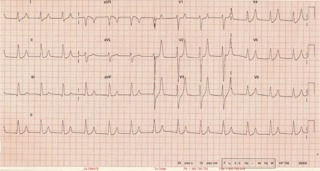
Podcast 799: EKG Abnormalities in Renal Failure

Podcast 799: EKG Abnormalities in Renal Failure

Contributor: Peter Bakes, MD Educational Pearls: Patients in renal failure may have elevated serum potassium levels which can result in EKG changes. EKG changes in the setting of hyperkalemia gener...

19 Heinä 20224min

Podcast 797: Vitamin C in Sepsis

Podcast 797: Vitamin C in Sepsis

Contributor: Aaron Lessen, MD Educational Pearls: Prior, smaller studies showed intravenous Vitamin C given to patients with sepsis significantly improved patient mortality and additional outcomes. ...

12 Heinä 20222min
Podcast 796: Fluid Amounts in Septic Shock

Podcast 796: Fluid Amounts in Septic Shock

Contributor: Aaron Lessen, MD Educational Pearls: Septic shock management has traditionally endorsed rapid fluid resuscitation and the administration of vasopressors Current guidelines are for patien...

11 Heinä 20223min
Podcast 795: Lithium Toxicity

Podcast 795: Lithium Toxicity

Contributor: Peter Bakes, MD Educational Pearls: Lithium remains a commonly used medication for treating bipolar disorder Lithium toxicity can be acute, acute-on-chronic, or chronic Measuring blood ...

5 Heinä 20224min

Suosittua kategoriassa Tiede

rss-mita-tulisi-tietaa
tiedekulma-podcast
rss-poliisin-mieli
docemilia
rss-duodecim-lehti
utelias-mieli
radio-antro
filocast-filosofian-perusteet
rss-laakaripodi
rss-lihavuudesta-podcast
rss-sosiopodi
ihanat-ipanat
sotataidon-ytimessa
mielipaivakirja
rss-radplus
rss-opeklubi