Episode 918: Automated Blood Pressure Cuffs

Episode 918: Automated Blood Pressure Cuffs

Contributor: Aaron Lessen, MD

Educational Pearls:

How does an automated blood pressure cuff work?

  • Automated blood pressure cuffs work differently than taking a manual blood pressure.

  • While taking a manual blood pressure, one typically listens for Korotkoff sounds (turbulent flow) while slowly deflating the cuff.

  • An automatic blood pressure cuff only senses the pressure in the cuff itself and specifically pays attention to oscillations in the pressure caused by when the pressure of the cuff is between the systolic (heart squeezing) and diastolic (heart relaxed) pressures.

  • These oscillations are at a maximum when the pressure in the cuff matches the mean arterial pressure (MAP) and therefore the machines are most accurate at reporting the MAP.

  • The machines then use the MAP and other information about the oscillations to estimate the systolic and diastolic pressures, which are less accurate.

What should you do if you need more accurate systolic and diastolic blood pressures?

  • Take a manual blood pressure.

  • Get an arterial-line (a-line), which provides continuous data for the blood pressure at the end of a catheter.

What happens if the cuff is too big or too small for the patient?

  • If the cuff is too small it will overestimate the pressure.

  • If the cuff is too large it will underestimate the pressure.

What should you do if the cuff cycles a bunch of times before reporting a blood pressure?

  • It probably isn't very accurate so consider another method.

Bonus fact!

  • The MAP is not directly in the middle of the systolic and diastolic pressures but is weighted towards the diastolic pressure. The MAP can be calculated by adding two-thirds of the diastolic pressure to one third of the systolic pressure. For example if the BP is 120/90 the MAP is 100 mmHg.

References

  1. Benmira, A., Perez-Martin, A., Schuster, I., Aichoun, I., Coudray, S., Bereksi-Reguig, F., & Dauzat, M. (2016). From Korotkoff and Marey to automatic non-invasive oscillometric blood pressure measurement: does easiness come with reliability?. Expert review of medical devices, 13(2), 179–189. https://doi.org/10.1586/17434440.2016.1128821

  2. Liu, J., Li, Y., Li, J., Zheng, D., & Liu, C. (2022). Sources of automatic office blood pressure measurement error: a systematic review. Physiological measurement, 43(9), 10.1088/1361-6579/ac890e. https://doi.org/10.1088/1361-6579/ac890e

  3. Vilaplana J. M. (2006). Blood pressure measurement. Journal of renal care, 32(4), 210–213. https://doi.org/10.1111/j.1755-6686.2006.tb00025.x

Summarized by Jeffrey Olson, MS3 | Edited by Meg Joyce, MS1 & Jorge Chalit, OMS3

Donate: https://emergencymedicalminute.org/donate/

Jaksot(1144)

Podcast 809: Achilles Tendon Rupture

Podcast 809: Achilles Tendon Rupture

Contributor: Aaron Lessen, MD Educational Pearls: Achilles tendon rupture usually presents in younger, healthy patients after a sports injury Patients typically present complaining of an abrupt onset...

30 Elo 20224min

Podcast 808: BVM and PEEP Valve

Podcast 808: BVM and PEEP Valve

Contributor: Dylan Luyten, MD Educational Pearls: Positive End Expiratory Pressure (PEEP) is positive pressure within the lungs and maintained throughout the entire respiratory cycle. It is the press...

29 Elo 20224min

Podcast 807: Ring Removal Tricks

Podcast 807: Ring Removal Tricks

Contributor: Jared Scott, MD Educational Pearls: If a patient is in significant pain, a digital block can be helpful. Pain management alone may allow for manual ring removal.  Ring cutters and trauma...

23 Elo 20224min
Podcast 806: Normal ECGs

Podcast 806: Normal ECGs

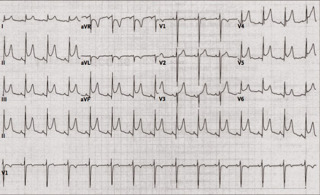
Contributor: Jared Scott, MD Educational Pearls: Physicians are typically advised not to trust computer interpretation of ECGs Retrospective study was done of computer interpreted normal ECGs to eva...

22 Elo 20223min

Podcast 805: Tunneled Peritoneal Catheter

Podcast 805: Tunneled Peritoneal Catheter

Contributor: Aaron Lessen, MD Educational Pearls: Patients with recurrent ascites may need frequent outpatient or emergency department paracentesis which can be time consuming and uncomfortable for p...

16 Elo 20223min

Podcast 804: Brugada Criteria for V Tach

Podcast 804: Brugada Criteria for V Tach

Contributor: Peter Bakes, MD Educational Pearls: Tachycardia describes a heart rate of >120 beats per minute Wide Complex describes a QRS duration of >120 ms or 3 small boxes on a standard EKG The ma...

9 Elo 20226min

Podcast 803:  Sedation During Intubation

Podcast 803: Sedation During Intubation

Contributor: Aaron Lessen, MD Educational Pearls: Awareness with recall of paralysis can occur in intubated and ventilated patients receiving paralytic medications  Patients who suffer from this eff...

8 Elo 20223min

Pediatric Palliative Care Expert Panel

Pediatric Palliative Care Expert Panel

Selected audio from our event, Palliative, hosted on June 27, 2022 in conjunction with Children's Hospital Colorado's Department of Palliative Medicine and The Denver Hospice's Footprints Program. Ke...

3 Elo 20221h 6min

Suosittua kategoriassa Tiede

rss-mita-tulisi-tietaa
tiedekulma-podcast
rss-poliisin-mieli
docemilia
rss-duodecim-lehti
utelias-mieli
filocast-filosofian-perusteet
rss-laakaripodi
rss-opeklubi
rss-lihavuudesta-podcast
rss-sosiopodi
sotataidon-ytimessa
mielipaivakirja
radio-antro
rss-radplus
rss-luontopodi-samuel-glassar-tutkii-luonnon-ihmeita