26d: The Age of Montu - The First Intermediate Period (Part 7, Finale)

26d: The Age of Montu - The First Intermediate Period (Part 7, Finale)

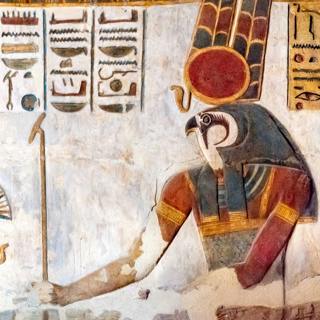
Newly researched and updated in 2024. These violent delights have violent ends. Between 1992 BCE and 1941 BCE, King Montu-Hotep (“Montu is Content”) ruled the southern kingdom. And he led efforts to expand Theban power, and ultimately reunify the Two Lands… Logo image: Montu, in a chapel of Ramesses III at Karnak (Kairoinfo4u). Website: www.egyptianhistorypodcast.com. Support the show via Patreon www.patreon.com/egyptpodcast. Make a one-time donation via PayPal payments. Music and interludes by Keith Zizza www.keithzizza.net. Music and interludes by Luke Chaos www.chaosmusick.com. Montuhotep’s Expansion into Wawat / Nubia and the records of the wars: Darnell, ‘The Route of the Eleventh Dynasty Expansion into Nubia: An Interpretation Based on the Rock Inscriptions of Tjehemau at Abisko’, Zeitschrift für Ägyptische Sprache und Altertumskunde 131 (2004), 23—37. Available on Academia.edu. Darnell, ‘The Eleventh Dynasty Royal Inscription from Deir el-Ballas’, Revue d’Égyptologie 59 (2008), 81—110. Available on Academia.edu. Montuhotep’s Mahat Chapel at Abydos, discovered in 2014: Josef Wegner at Academia.edu and Damarany in Abydos: The Sacred Land (2019), JSTOR. Scholarly debates on the timeline and events of the Reunification: Brovarski, ‘The Hare and Oryx Nomes in the First Intermediate Period and Early Middle Kingdom’, in Egyptian Culture and Society: Studies in Honour of Naguib Kanawati, 1 (2010), 31—85. Available on Academia.edu. This was the study I followed in my reconstruction. Willems, ‘The Nomarchs of the Hare Nome and Early Middle Kingdom History’, Jaarbericht van het Vooraziatisch-Egyptisch Genootschap Ex Oriente Lux 28 (1985), 80—102. Available at Researchgate. Nubia – The Archaeology of Wawat and Kerma: Kerma – Mission archéologique suisse à Kerma (Soudan) C. Bonnet, ‘The Cities of Kerma and Pnubs-Dokki Gel’, in G. Emberling and B. B. Williams (eds), The Oxford Handbook of Ancient Nubia (Oxford, 2021), 201—212. H. Hafsaas, ‘The C-Group People in Lower Nubia: Cattle Pastoralists on the Frontier Between Egypt and Kush’, in B. B. Williams and G. Emberling (eds), The Oxford Handbook of Ancient Nubia (Oxford, 2020), 157—177. G. K. Meurer, ‘Nubians in Egypt from the Early Dynastic Period to the New Kingdom’, in B. B. Williams and G. Emberling (eds), The Oxford Handbook of Ancient Nubia (Oxford, 2020), 289—308. B. B. Williams, ‘Kush in the Wider World During the Kerma Period’, in G. Emberling and B. B. Williams (eds), The Oxford Handbook of Ancient Nubia (Oxford, 2021), 179--200. The Tomb of General Antef, with images of siege towers and naval forces: B. Jaroš-Deckert, Grabung im Asasif. 1963-1970. Band 5: das Grab des Jnj-jtj.f. Die Wandmalereien der 11. Dynastie, 12 (1984). Learn more about your ad choices. Visit megaphone.fm/adchoices

Jaksot(402)

01: The Two Lands

01: The Two Lands

Five thousand years ago, a kingdom emerged on the banks of the Nile. The "Two Lands" of Southern and Northern Egypt slowly unified, and rulers like Narmer established their authority. The origins of the kingdom are murky, but archaeology can uncover secrets. In this episode, we meet the first ruler of the land, get a sense of Egypt and its people, and introduce the podcast as a whole. Welcome! Date: circa 3050 – 3000 BCE. Kings: Narmer, Scorpion (epilogue). The History of Egypt Podcast website. Support the show at www.patreon.com/egyptpodcast. Episode Music by Keith Zizza www.keithzizza.com. Select Bibliography: Kathryn A. Bard, An Introduction to the Archaeology of Ancient Egypt, 2nd edition, 2015. Eugenia D’Atanasio et al., “The Peopling of the Last Green Sahara Revealed by High-Coverage Resequencing of Trans-Saharan Patrilineages,” Genome Biology 19.20 (2018): 1–15. Gunter Dreyer, “Tomb U-j: A Royal Burial of Dynasty 0 at Abydos,” in Emily Teeter (ed.) Before the Pyramids: The Origins of Egyptian Civilization, 2011: 127-36. A.J. Spencer, Early Egypt: The Rise of Civilization in the Nile Valley, 1993. Barry J. Kemp, Ancient Egypt: Anatomy of a Civilization, 3rd edition, 2018. David O’Connor, Abydos: Egypt’s First Pharaohs and the Cult of Osiris, 2011. John Romer, A History of Ancient Egypt from the First Farmers to the Great Pyramid, 2013. Alice Stevenson, “Material Culture of the Predynastic Period,” in Emily Teeter (ed.) Before the Pyramids: The Origins of Egyptian Civilization, 2011: 65-74. David Wengrow, “Landscapes of Knowledge, Idioms of Power: The African Foundations of Ancient Egyptian Civilization Reconsidered,” in David O’Connor and Andrew Reid (eds) Ancient Egypt in Africa, 2003: 121-36. David Wengrow, The Archaeology of Early Egypt: Social Transformations in North-East Africa, 10,000 to 2650 BC, 2006. Robert J. Wenke, The Ancient Egyptian State: The Origins of Egyptian Culture (c. 8000 – 2000 BC), 2009. Toby A.H. Wilkinson, Early Dynastic Egypt, 1999. Bruce B. Williams, “Relations Between Egypt and Nubia in the Predynastic Period,” in Emily Teeter (ed.) Before the Pyramids: The Origins of Egyptian Civilization, 2011: 83-92. Learn more about your ad choices. Visit megaphone.fm/adchoices

1 Tammi 201333min

The History of Egypt, Trailer

The History of Egypt, Trailer

Welcome to the show! If you are wondering whether to start the story, this introduction will give you the gist. Learn more on our website or the Patreon. Hosted on Acast. See acast.com/privacy for more information. Learn more about your ad choices. Visit megaphone.fm/adchoices

31 Loka 20124min

Suosittua kategoriassa Yhteiskunta

olipa-kerran-otsikko
kolme-kaannekohtaa
i-dont-like-mondays
siita-on-vaikea-puhua
sita
aikalisa
poks
antin-palautepalvelu
rss-ootsa-kuullut-tasta
yopuolen-tarinoita-2
mamma-mia
kaksi-aitia
meidan-pitais-puhua
ootsa-kuullut-tasta-2
gogin-ja-janin-maailmanhistoria
rss-murhan-anatomia
murha-joka-tapahtui-2
lahko
terapeuttiville-qa
loukussa