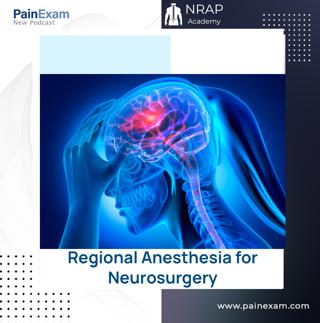
Blocks for Head, Neck, and Spinal Surgeries

Blocks for Head, Neck, and Spinal Surgeries

Neurosurgery and Regional Anesthesia

Claim CME Credit:

The CE experience for this Podcast is powered by CMEfy - click here to reflect and earn credits: https://earnc.me/t3z3kR

In this episode, we will explore the various regional anesthesia techniques used in neurosurgery, specifically focusing on blocks for head, neck, and spinal surgeries.

Segment 1: Blocks used in Head and Neck Surgeries

  1. Scalp Block:
  • The scalp block involves blocking six nerves that provide sensory innervation to the scalp.
  • It is performed by subcutaneous infiltration of local anesthetics (such as bupivacaine, ropivacaine, or levobupivacaine) for each nerve.
  • Ultrasound guidance has improved the precision of block administration.
  • The main indication for a scalp block is awake craniotomy, but it is also used in other procedures like deep brain stimulation and cranioplasty surgery.
  • Scalp block offers advantages such as accurate neurological evaluation, pre-emptive analgesia, and hemodynamic stability during surgery.
  • It also reduces postoperative pain, the need for rescue analgesics, and pain scores in the early postoperative period.
  1. Infraorbital Block (IOB):
  • The infraorbital nerve block targets the infraorbital nerve, which supplies the skin and mucous membrane of the upper lip, lower eyelid, and cheek.
  • The IOB can be performed using the classical landmark technique or ultrasound guidance.
  • Ultrasound guidance provides real-time visualization and accurate needle placement.
  • IOB combined with general anesthesia is beneficial for postoperative pain relief in procedures like endoscopic trans-nasal trans-sphenoidal (TNTS) approach for pituitary tumor excision.
  • Other regional techniques like sphenopalatine ganglion block and maxillary nerve blocks have also been attempted for transsphenoidal surgeries.
  1. Trigeminal Nerve Block:
  • Trigeminal nerve block is used for patients unresponsive to medical management of trigeminal neuralgia.
  • Traditionally performed using the paresthesia technique, ultrasound guidance allows real-time visualization and confirmation of local anesthetic spread.
  • Ultrasound guidance helps locate the Gasserian ganglion and visualize the trigeminal ganglion, providing a safe and radiation-free procedure for pain relief.

Segment 2: Blocks used for Spinal Surgeries

  1. Cervical Plexus Block (CPB):
  • CPB is commonly used in carotid endarterectomy (CEA) and cervical spine surgery.
  • Different levels of CPB can be performed depending on the depth of injection.
  • Superficial CPB involves injecting local anesthetic superficially into the deep cervical fascia.
  • Deep CPB requires depositing local anesthetic deep to the prevertebral fascia.
  • CPB helps in monitoring cerebral blood flow during CEA and provides postoperative pain relief.
  • Ultrasound guidance can be used for superficial CPB, ensuring accurate needle placement and local anesthetic spread.
  1. Erector Spinae Block (ESB):
  • ESB is used for pain control in spinal surgeries.
  • It involves depositing local anesthetic in the plane between the erector spinae muscle and the transverse process.
  • ESB provides effective postoperative analgesia and reduces opioid consumption.

Regional anesthesia techniques play a crucial role in neurosurgery, providing effective pain relief and improving patient outcomes. Blocks like scalp block, infraorbital block, trigeminal nerve block, cervical plexus block, and erector spinae block offer numerous advantages in specific procedures. Ultrasound guidance has enhanced the precision and safety of block administration. These techniques contribute to improved surgical outcomes and patient satisfaction in neurosurgical procedures.

Upcoming Courses and Workshops!

Course Calendar

Practice Management Webinar: The End of the Public Health Emergency. What's Changed and what Opportunities Remain!

Pain Management Board Review/Refresher Course/ Ultrasound Training NYC- June 9-11, 2023

Ultrasound Guided Regional Anesthesia and Pain Medicine NYC- July 19, 2023

Ultrasound Guided Regional Anesthesia and Pain Medicine NYC- August 19th, 2023

Ultrasound Guided Regional Anesthesia and Pain Medicine- Sept 15, 2023, San Juan, PR

For up to date Calendar, Click Here!

References Kaushal A, Haldar R. Regional Anesthesia in Neuroanesthesia Practice. Discoveries (Craiova). 2020 Jun 29;8(2):e111. doi: 10.15190/d.2020.8. PMID: 32637571; PMCID: PMC7332314.

Tämä jakso on lisätty Podme-palveluun avoimen RSS-syötteen kautta eikä se ole Podmen omaa tuotantoa. Siksi jakso saattaa sisältää mainontaa.

Jaksot(98)

Occipital Neuralgia and Compression Fractures for the Boards

Occipital Neuralgia and Compression Fractures for the Boards

PainExam Podcast Show Notes Compression Fractures, Vertebroplasty, Kyphoplasty & Occipital Neuralgia for the ABA Pain Medicine Boards In this episode of the PainExam Podcast, Dr. David Rosenblum revie...

29 Touko 14min
CRPS & Intrathecal Pain Pumps for the Anesthesia Boards

CRPS & Intrathecal Pain Pumps for the Anesthesia Boards

🎙️ PainExam Podcast Show Notes CRPS & Intrathecal Pain Pumps — High-Yield ABA Pain Board Review 🔥 Episode Overview In this episode of the PainExam Podcast, David Rosenblum reviews two essential ABA...

12 Touko 12min
Corticosteroids and Contrast for Pain Procedures: Anesthesia Board Prep Pearls!

Corticosteroids and Contrast for Pain Procedures: Anesthesia Board Prep Pearls!

🎙️ PainExam Podcast Show Notes Corticosteroids & Contrast Agents in Pain Management + Evidence-Based Steroid Selection 🔥 Episode Overview In this high-yield episode of the PainExam Podcast, David ...

29 Huhti 16min
Facet Mediated Pain for the Anesthesia Boards

Facet Mediated Pain for the Anesthesia Boards

🎙️ AnesthesiaExam Podcast & Video Show Notes Spine Pain, Facet Syndromes, and Interventional Concepts for the Anesthesia Boards 🔥 Episode Overview In this episode of the AnesthesiaExam Podcast, Dav...

16 Huhti 8min
Phantom Limb Pain and SI Joint Dysfunction for the Anesthesia & Pain Boards

Phantom Limb Pain and SI Joint Dysfunction for the Anesthesia & Pain Boards

🎙️ PainExam Podcast Show Notes Phantom Limb Pain & Sacroiliac Joint Dysfunction — High-Yield Pain Board Review 🔥 Episode Overview In this episode of the PainExam Podcast, David Rosenblum delivers ...

25 Maalis 8min

What is Red Light Therapy?

What is Red Light Therapy?

PainExam Podcast Show Notes Red Light Therapy (Photobiomodulation) for Pain Evidence, Mechanisms, and Clinical Applications Host: Dr. David Rosenblum Red light therapy, also known as photobiomodulatio...

4 Maalis 11min

What you need to know about Regenerative Pain Medicine- ASIPP Regenerative Med Talk

What you need to know about Regenerative Pain Medicine- ASIPP Regenerative Med Talk

Dr. Rosenblum from NRAP Academy presented a webinar on the integration of regenerative medicine into pain practices, highlighting its benefits and applications. He discussed the evolution of treating ...

12 Helmi 17min

Meralgia Paresethetica for the Anesthesia Boards- NRAPpain.org

Meralgia Paresethetica for the Anesthesia Boards- NRAPpain.org

Meralgia Paresthetica Education and the Anesthesiology Boards This podcast episode from the NRAP Academy features Dr. David Rosenblum discussing Meralgia Paresthetica, a mononeuropathy affecting the l...

14 Tammi 7min

Suosittua kategoriassa Koulutus

rss-murhan-anatomia
psykopodiaa-podcast
voi-hyvin-meditaatiot-2
rss-narsisti
kesken
ihminen-tavattavissa-tommy-hellsten-instituutti
rss-hereilla
rss-niinku-asia-on
rss-liian-kuuma-peruna
rss-valo-minussa-2
rss-suomen-aa-podcast
adhd-podi
rss-rahamania
dear-ladies
psykologia
rss-duodecim-lehti
rss-opiskelemaan
rss-monarch-talk-with-alexandra-alexis
rss-tietoinen-yhteys-podcast-2
rss-koira-haudattuna