211. Troubled times: India, Press Harlots, and Winston Churchill

211. Troubled times: India, Press Harlots, and Winston Churchill

This episode looks at the impact in Britain of continuing trouble in India. There Gandhi had launched his salt march, walking to the sea to make salt, in breach of the British monopoly and the heavy tax on salt inflicted by the colonial authorities. That had led to his being gaoled.

In Britain, the report of the Simon Commission recommended limited reform in India, but not the granting of Dominion Status. That was in spite of the view of one of the Commission’s co-chairs, Labour’s Clement Attlee, who had been convinced of the need for that status following his travels with the Commission around India.

The Prime Minister called a Round Table conference in London which had representation from many Indian groups, unlike the Simon Commission which had had none. Unfortunately, the gaoled Gandhi’s organisation, the Indian National naturally didn’t attend, and it was the most significant in the sub-Continent. That rather underlines how silly it is to label an opponent as criminal and then proclaim that you don’t talk to criminals – it makes negotiations meaningless.

Fortunately, the Viceroy of India Lord Irwin (later Lord Halifax) released Gandhi and agreed the Gandhi-Irwin pact with him, which included his attendance at a second Round Table.

Winston Churchill was furious that any moves were being made towards Indian self-rule at all, and that his party leader Stanley Baldwin backed them. Baldwin was also under pressure from a campaign by press barons to make him adopt a policy backing tariffs on imports. Baldwin saw off that pressure, denouncing the newspaper proprietors for pursing power without responsibility, ‘the prerogative of the harlot throughout the ages’.

Even so, he began to soften his own opposition to tariffs, further adding to Churchill’s disquiet. By January 1931, he’d had enough and resigned from Baldwin’s leadership team. That, for him, was the start of what he would later call his ‘wilderness years’.


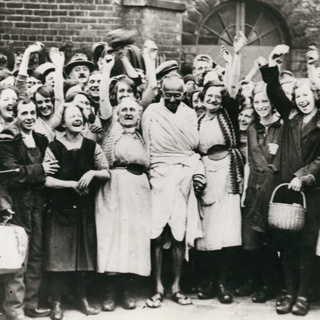
Illustration: Gandhi, for Churchill a seditious, half-naked fakir, visiting millworkers in Lancashire while in England for the Second Round Table conference. Photo by Keystone Press Agency Ltd. National Portrait Gallery x137614.

Music: Bach Partita #2c by J Bu licensed under an Attribution-NonCommercial-No Derivatives (aka Music Sharing) 3.0 International License


Jaksot(275)

50. Preparing for next time

50. Preparing for next time

In the uneasy peace between the War of Austrian Succession and the Seven Years' War, Britain set about securing its growing imperial power. Central to it was its position in North America, as many vis...

30 Heinä 202112min

49. Oh no! Not more Stuarts...

49. Oh no! Not more Stuarts...

While the British army was on the European continent, putting up a pretty useless fight against the French in the Austrian Netherlands, Charles Edward Stuart launched a new uprising - or possibly rebe...

23 Heinä 202113min

48. The Austrian Throne

48. The Austrian Throne

There was no real problem with a woman inheriting the Austrian throne. But it could be a useful pretext for war by nations keen on advancing their own interests militarily. Frederick II of Prussia was...

16 Heinä 202114min

47. Time for another war

47. Time for another war

Ah, those were the days. When Britain went to war over a sea captain who'd had an ear cut off. And taught the Spanish a thing or two. Except, of course, that Britain didn't go to war for that reason. ...

9 Heinä 202114min

46. Freedom

46. Freedom

Britain, its idealists claimed, was launching an Empire of Freedom. The reality, sadly, was rather different. Europeans, with Brits in the forefront, had developed a love of tobacco, and above all a s...

3 Heinä 202114min

45. Robinocracy

45. Robinocracy

'Robin', or Robert Walpole, Britain's first and longest-serving Prime Minister, came to be known as 'Cock Robin'. Possibly because people around him felt his success had made him cocky. The regime ove...

27 Kesä 202110min

44. The Prime Minister

44. The Prime Minister

The title 'Prime Minister' used to be a term of abuse. To be honest, depending on the holder of the office, plenty of people would maintain it still is. The first person of whom it was used as a real...

22 Kesä 202111min

43. Bubble

43. Bubble

Not all bubbles are all that bubbly. The South Sea Bubble made some people a lot of money - such as Isaac Newton, the physicist but also skilful financier - or a colossal amount of money - such as Tho...

17 Kesä 202110min

Suosittua kategoriassa Historia

olipa-kerran-otsikko
gogin-ja-janin-maailmanhistoria
mayday-fi
huijarit
mystista
rss-ikiuni
konginkangas
tsunami
totuus-vai-salaliitto
rouva-diktaattori
sotaa-ja-historiaa-podi
rss-subjektiivinen-todistaja
rss-kirkon-ihmeellisimmat-tarinat
rss-i-dont-like-mondays-2
rss-peter-peter
rss-sattuu-sita-suomessakin
historiaa-suomeksi
apinan-vuosi
maailmanpuu
tiedetta-ja-sirkushuveja-vanhojen-aikojen-podcast