
211. Troubled times: India, Press Harlots, and Winston Churchill

211. Troubled times: India, Press Harlots, and Winston Churchill

This episode looks at the impact in Britain of continuing trouble in India. There Gandhi had launched his salt march, walking to the sea to make salt, in breach of the British monopoly and the heavy tax on salt inflicted by the colonial authorities. That had led to his being gaoled.

In Britain, the report of the Simon Commission recommended limited reform in India, but not the granting of Dominion Status. That was in spite of the view of one of the Commission’s co-chairs, Labour’s Clement Attlee, who had been convinced of the need for that status following his travels with the Commission around India.

The Prime Minister called a Round Table conference in London which had representation from many Indian groups, unlike the Simon Commission which had had none. Unfortunately, the gaoled Gandhi’s organisation, the Indian National naturally didn’t attend, and it was the most significant in the sub-Continent. That rather underlines how silly it is to label an opponent as criminal and then proclaim that you don’t talk to criminals – it makes negotiations meaningless.

Fortunately, the Viceroy of India Lord Irwin (later Lord Halifax) released Gandhi and agreed the Gandhi-Irwin pact with him, which included his attendance at a second Round Table.

Winston Churchill was furious that any moves were being made towards Indian self-rule at all, and that his party leader Stanley Baldwin backed them. Baldwin was also under pressure from a campaign by press barons to make him adopt a policy backing tariffs on imports. Baldwin saw off that pressure, denouncing the newspaper proprietors for pursing power without responsibility, ‘the prerogative of the harlot throughout the ages’.

Even so, he began to soften his own opposition to tariffs, further adding to Churchill’s disquiet. By January 1931, he’d had enough and resigned from Baldwin’s leadership team. That, for him, was the start of what he would later call his ‘wilderness years’.


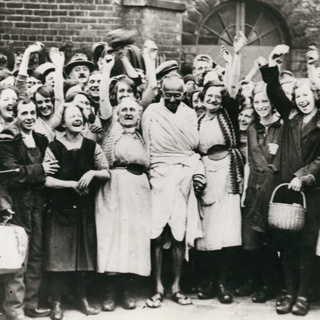
Illustration: Gandhi, for Churchill a seditious, half-naked fakir, visiting millworkers in Lancashire while in England for the Second Round Table conference. Photo by Keystone Press Agency Ltd. National Portrait Gallery x137614.

Music: Bach Partita #2c by J Bu licensed under an Attribution-NonCommercial-No Derivatives (aka Music Sharing) 3.0 International License


Jaksot(274)

17. Things fall apart

17. Things fall apart

Charles I, like his father, proved extremely good at not being at all good at getting on with people he really needed to be really good at getting on side. Just like with his Dad, that mainly meant Pa...

7 Helmi 202110min

16. Slippery Slope

16. Slippery Slope

Charles I started his reign in just the way he'd go on with it, and in just the way his father James I/VI had ended his: by getting right up the noses of most of his subjects in Scotland as well as En...

2 Helmi 20218min

15. Bad to Worse

15. Bad to Worse

The end of James Stuart's reign over Scotland and England was no more impressive than the earlier part. One of the wonderful, crazy and ultimately futile episodes was the 'Spanish Match', involving th...

28 Tammi 20218min

14. Reckless Romanticism, a Touch of Gayness, and Bonfires

14. Reckless Romanticism, a Touch of Gayness, and Bonfires

The marriage of James VI of Scotland, later James I of England, to Anne of Denmark started off with some romanticism, including a dangerous sea crossing to fetch her home, and it certainly produced a ...

23 Tammi 20219min

13. Wise Fool

13. Wise Fool

James I of England (VI of Scotland) had clear ideas of what kingship meant. It meant he'd been chosen by God to run the show and Parliament wasn't going to get in his way. The trouble was, Parliament ...

18 Tammi 20219min

12. Hunting and Hanging

12. Hunting and Hanging

Boy, did it take a long time for James VI of Scotland to get from his proclamation as King of England, down to London to take the throne as James I. Partly that was because he had other things to do o...

13 Tammi 20217min

11. Transition

11. Transition

With no children of her own, what had Elizabeth I done to guarantee a smooth succession after her death? The answer is precious little. Which meant there had to be some clever footwork by her Chief Mi...

8 Tammi 20218min

10. Here today, no heir tomorrow

10. Here today, no heir tomorrow

Elizabeth was the virgin queen. And indeed she had no children, which would be a bit of a problem for when she finally popped her clogs and the survivors had to try to find a way to make the successio...

3 Tammi 20217min

Suosittua kategoriassa Historia

olipa-kerran-otsikko
gogin-ja-janin-maailmanhistoria
mayday-fi
huijarit
mystista
rss-ikiuni
tsunami
konginkangas
totuus-vai-salaliitto
rouva-diktaattori
rss-kirkon-ihmeellisimmat-tarinat
rss-i-dont-like-mondays-2
rss-sattuu-sita-suomessakin
sotaa-ja-historiaa-podi
apinan-vuosi
rss-peter-peter
historiaa-suomeksi
tiedetta-ja-sirkushuveja-vanhojen-aikojen-podcast
rss-subjektiivinen-todistaja
matakuu