211. Troubled times: India, Press Harlots, and Winston Churchill

211. Troubled times: India, Press Harlots, and Winston Churchill

This episode looks at the impact in Britain of continuing trouble in India. There Gandhi had launched his salt march, walking to the sea to make salt, in breach of the British monopoly and the heavy tax on salt inflicted by the colonial authorities. That had led to his being gaoled.

In Britain, the report of the Simon Commission recommended limited reform in India, but not the granting of Dominion Status. That was in spite of the view of one of the Commission’s co-chairs, Labour’s Clement Attlee, who had been convinced of the need for that status following his travels with the Commission around India.

The Prime Minister called a Round Table conference in London which had representation from many Indian groups, unlike the Simon Commission which had had none. Unfortunately, the gaoled Gandhi’s organisation, the Indian National naturally didn’t attend, and it was the most significant in the sub-Continent. That rather underlines how silly it is to label an opponent as criminal and then proclaim that you don’t talk to criminals – it makes negotiations meaningless.

Fortunately, the Viceroy of India Lord Irwin (later Lord Halifax) released Gandhi and agreed the Gandhi-Irwin pact with him, which included his attendance at a second Round Table.

Winston Churchill was furious that any moves were being made towards Indian self-rule at all, and that his party leader Stanley Baldwin backed them. Baldwin was also under pressure from a campaign by press barons to make him adopt a policy backing tariffs on imports. Baldwin saw off that pressure, denouncing the newspaper proprietors for pursing power without responsibility, ‘the prerogative of the harlot throughout the ages’.

Even so, he began to soften his own opposition to tariffs, further adding to Churchill’s disquiet. By January 1931, he’d had enough and resigned from Baldwin’s leadership team. That, for him, was the start of what he would later call his ‘wilderness years’.


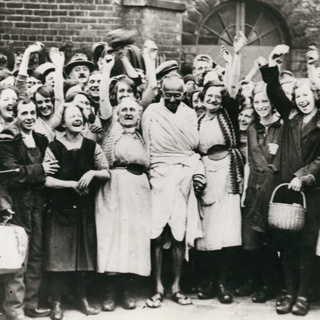
Illustration: Gandhi, for Churchill a seditious, half-naked fakir, visiting millworkers in Lancashire while in England for the Second Round Table conference. Photo by Keystone Press Agency Ltd. National Portrait Gallery x137614.

Music: Bach Partita #2c by J Bu licensed under an Attribution-NonCommercial-No Derivatives (aka Music Sharing) 3.0 International License


Jaksot(274)

233. Shocks and surprises at the war’s end

233. Shocks and surprises at the war’s end

Following the German surrender in May 1945, the ‘Big Three’ – the United States, the Soviet Union and Britain – met for the third and last time in conference. And this time, appropriately, they met on...

2 Maalis 202514min
232. Bickering allies win in Europe

232. Bickering allies win in Europe

At the Yalta conference, between the US, the Soviet Union and Britain, the tensions between the Allies became increasingly obvious. Representing Britain, Churchill wanted the Allies’ war effort to be ...

23 Helmi 202514min
231. Nazis facing defeat

231. Nazis facing defeat

By the time of the Yalta conference in February 1945, between the USA, Soviet Union and Britain, the latter still being treated as a great power though its decline was already clear, there could be li...

16 Helmi 202514min
230. From Husky to Overlord, Sicily to the D-Day beaches

230. From Husky to Overlord, Sicily to the D-Day beaches

In 1943, Britain didn’t feel the Western Allies were ready yet for an invasion of France, and with its influence at the highest point it ever reached, it was able to persuade the Americans reluctantly...

9 Helmi 202514min
229. The tide turns

229. The tide turns

The tide turned against the Axis and in favour of the Allies in the course of 1943. Victories at Stalingrad in Russia, in the Battle of the Atlantic, and in North Africa, came on top of American advan...

2 Helmi 202514min
228. Turning points: 1943

228. Turning points: 1943

This is an episode for turning points. The year’s 1943. The Battle of Stalingrad, where the unstoppable German offensive into Russia was finally stopped and turned around, with Soviet forces essentia...

26 Tammi 202514min
227. Tough times: 1941 and 1942

227. Tough times: 1941 and 1942

The years 1941 and 1942 were tough ones… Things were going badly in the Battle of the Atlantic, with Germany threatening to strangle Britain by sinking more merchant ships than the British could bear ...

19 Tammi 202514min

226. Britain rescued by its enemies

226. Britain rescued by its enemies

Hitler, feeling himself obliged to help out his inept ally Mussolini, was dragged into two wars the Italian dictator had started but lacked the resources to prosecute to victory: in North Africa and i...

12 Tammi 202514min

Suosittua kategoriassa Historia

olipa-kerran-otsikko
gogin-ja-janin-maailmanhistoria
mayday-fi
huijarit
mystista
rss-ikiuni
tsunami
konginkangas
totuus-vai-salaliitto
rouva-diktaattori
rss-kirkon-ihmeellisimmat-tarinat
rss-i-dont-like-mondays-2
rss-sattuu-sita-suomessakin
sotaa-ja-historiaa-podi
apinan-vuosi
rss-peter-peter
historiaa-suomeksi
tiedetta-ja-sirkushuveja-vanhojen-aikojen-podcast
rss-subjektiivinen-todistaja
matakuu