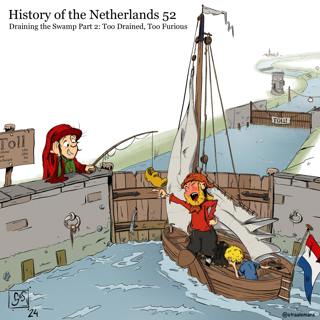
52 - Draining the Swamp Part 2: Too Drained, Too Furious

52 - Draining the Swamp Part 2: Too Drained, Too Furious

Between the years 1000 and 1500 CE the soggy, sphagnum filled bog lands of the western Low Countries were terraformed to support human habitation and, as such, the seeds of future prosperity and hardships were simultaneously, albeit unknowingly, sown. Draining the swamp meant that land was created for agriculture, farming and settlement. This land was crisscrossed by waterways over which products both domestic and foreign could be moved on boats from the sea to the rivers and vice versa. Draining the swamp also meant that those lands sank, due to oxygen seeping into the pierced mass of moss and rotting the previously petrified peat within. People had to invent things like pumping mills to move water out of the swamp and stave off that waterlogged sinking feeling they had been experiencing. By the start of the 16th century, towns in the Low Countries had become important hubs of commercial shipping, with boats sailing from Northern Germany and beyond to the Baltic Sea, preferring to use the relatively calm and peaceful waters “inside the dunes” of Holland to reach markets in Flanders, as opposed to risking the open waters of the North Sea. Although water management required cooperation between the peoples of different towns, all of this economic activity also naturally created competition and rivalry between these towns, particularly in Holland, as they literally fought over their rights to do things like dig new canals, build new locks and charge tolls. It’s Draining the Swamp Part II: Too Drained, Too Furious. With thanks to Fredrik, Kelly Magee, Laura Isräels, Kevin Bertram and Lars for their Patreon support. SHOW NOTES: https://www.republicofamsterdamradio.com/episodes/historyofthenetherlands/episode-52-draining-the-swamp-part-2-too-drained-too-furious PATREON: https://www.patreon.com/historyofthenetherlands TWITTER: https://www.twitter.com/historyofNL Learn more about your ad choices. Visit podcastchoices.com/adchoices

Jaksot(100)

31 - A Luckless Legate in Liège

31 - A Luckless Legate in Liège

At the beginning of 1468, after having crushed a second uprising in Liège in the space of two years, Charles the Bold set about the all-important task of figuring out to whom he was going to marry. At...

5 Loka 202059min

BONUS: A Notable Little Podcast of Cookery in the Low Countries

BONUS: A Notable Little Podcast of Cookery in the Low Countries

When it comes to food, Flanders and the Netherlands are not two peas in a pod. What is the influence of religion on our cuisine? Why do Belgians love eating out at restaurants? Which recipes can be fo...

24 Syys 202045min

BONUS: Rembrandt and the Revolting Batavians

BONUS: Rembrandt and the Revolting Batavians

To tide you over in our absence during the summer break, we decided to reboot an episode of our previous podcast entitled 'Rembrandt and the Revolting Batavians'. We'll be back with regular programmin...

19 Elo 20201h 29min

30 - A Rebuke of the New Duke

30 - A Rebuke of the New Duke

Upon becoming the Duke of Burgundy, along with all the titles that came with it, Charles the Bold inherited the complex series of social revolts that were either simmering or boiling over in places li...

3 Elo 20201h 4min

29 - Dinant, Was...

29 - Dinant, Was...

Charles, the Count of Charolais, began to take a more dominant role in the Burgundian court after the forced reconciliation with his father, Philip the Good, in January 1464. By midway through the nex...

20 Heinä 20201h 7min

BONUS: A Pint-Sized History of Beer and Brewing in the Low Countries

BONUS: A Pint-Sized History of Beer and Brewing in the Low Countries

Why did the Dutch drink almost four times as much beer in the fifteenth century as they do today? Why would the Beer Drinking War be a better name for The Eighty Years' War? And why is the longest-sta...

6 Heinä 202056min

28 - The Strained Reins of a Waning Reign

28 - The Strained Reins of a Waning Reign

In the final decade of his reign, Philip the Good was obsessed with the idea of a crusade against the Ottoman Turks. The complexities of the diverse state that he had built, however, would never allow...

22 Kesä 202044min

27 - Picking Bishops and Familial Fissures

27 - Picking Bishops and Familial Fissures

When Philip the good went to the Imperial Diet in Regensburg in 1454 it gave his son and heir, Charles, the count of Charolais, a chance to get some practice at ruling in his stead, giving subjects in...

8 Kesä 202058min

Suosittua kategoriassa Yhteiskunta

olipa-kerran-otsikko
sita
siita-on-vaikea-puhua
kaksi-aitia
gogin-ja-janin-maailmanhistoria
i-dont-like-mondays
uutiscast
poks
antin-palautepalvelu
rss-nikotellen
kolme-kaannekohtaa
mamma-mia
yopuolen-tarinoita-2
aikalisa
rss-murhan-anatomia
meidan-pitais-puhua
rss-haudattu
rss-palmujen-varjoissa
isani-on-terapeuttiville
taskula-trishin