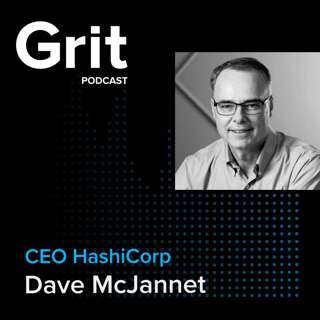
#143 CEO HashiCorp, Dave McJannet: Phase Shifts
Grit19 Kesä 2023

#143 CEO HashiCorp, Dave McJannet: Phase Shifts

Guest: Dave McJannet, CEO of HashiCorp

To scale a company effectively, says HashiCorp CEO Dave McJannet, you will have to make something like 10 decisions every single day. “There’s generally one that really needs to be right, but there are eight that if you get them wrong, you will cause real damage to yourself,” he says. “It won’t be fatal, and a lot of times, it’s cultural damage.” Sometimes, he adds, these decisions can seem innocuous, like deciding how to run internal town halls with workers. But even small choices can create a “cultural crater” that you’ll have to dig yourself out of three months later.

In this episode, Dave and Joubin discuss returning to the office, the sales data flow, unstructured problem-solving, why companies grow like trees, anonymous town halls entrepreneurs-in-residence, go to market vs. product, committing to the job, the executive “CPU tax,” and the 30-to-100 phase shift.

In this episode, we cover:

  • In-person vs. remote collaboration (00:43)
  • How to build any kind of business (05:26)
  • The value of being in the sales motion (07:30)
  • Thinking like a venture capitalist (11:51)
  • Commiserating with other CEOs (13:28)
  • Systems-based thinking (17:37)
  • Administrators vs. builders (20:25)
  • The daily 10 decisions (22:29)
  • Staving off decision fatigue (24:17)
  • Dave’s past jobs and the path to CEO (26:01)
  • The reluctant CEO (28:46)
  • Rapid change vs. high-profile maintenance (32:20)
  • The pressure of being at the top (35:12)
  • The state of HashiCorp when Dave arrived (37:39)
  • How he got the CEO job (40:38)
  • Product-building POV (45:50)
  • The first “oh shit” moment (48:48)
  • Being motivated by competition (50:47)
  • Laddered time horizons (53:47)
  • Paul Moritz and empathy (55:17)
  • Misconceptions about CEOs (57:10)
  • Deciding to go public (59:45)
  • Time and energy management (01:03:10)
  • Anticipating phase shifts (01:06:12)
  • Fierce independence (01:08:12)
  • Getting the right feedback (01:09:13)
  • Who HashiCorp is hiring and what “grit” means to Dave (01:12:30)

Links:

Jaksot(276)

#107 Founding CRO at Flexport, Ben Braverman: The Power of Genuine Curiosity

#107 Founding CRO at Flexport, Ben Braverman: The Power of Genuine Curiosity

“Everyone excellent at their craft starts from a place of deep insecurity,” says Flexport’s founding CRO Ben Braverman. People are “slow-burning fireworks,” he explains, and we need time to learn how to do anything well. If you lie to yourself, you won’t ever improve; but if you admit the truth and approach people who know more with genuine curiosity and enthusiasm, Ben says,  you’ll be able to level up faster and do things you never could before.In this episode, Ben and Joubin discuss giving speeches without prep, soliciting negative feedback, genuine curiosity, dropping out of college, valuing your experience, embracing Buddhism, outside dogs vs. inside dogs, hiring with enthusiasm, “Goldilocks companies,” the secondary sales paradox, the value of exercise, building an outbound sales machine, “natural” sellers vs. fast learners, and the warning signs that 2021 venture funding was “off.”In this episode, we cover:Being yourself and the pressure to be someone else in business (08:23)What Flexport does and how it cracked a low-tech industry (15:36)The advice Ben would give to his younger self: Enjoy the ride (21:09)How he became the founding CRO of Flexport (26:43)Turning on sales and hiring Justin Schafer (31:25)Growing from thousands in revenue to $3.3 billion (36:59)The trade-offs of always being on the road (40:41)Personal growth in the face of exponential product growth (45:30)Product-led growth and the magic of list construction (50:36)The unique way Flexport sales managers earn equity (53:29)How to spot the next Ben Braverman (57:26)The connection between excellence and insecurity (01:03:00)Going from operating to investing and the long window of venture (01:05:43)How and why both Ben and Flexport’s founding CEO Ryan Petersen stepped aside and passed the baton (01:12:08)Links:Connect with BenTwitterLinkedInConnect with JoubinTwitterLinkedInEmail: grit@kleinerperkins.com Learn more about Kleiner PerkinsThis episode was edited by Eric Johnson from LightningPod.fm

10 Loka 20221h 18min

#106 Co-founder & CEO Sweetgreen, Jonathan Neman: The Restaurant Company of the Future

#106 Co-founder & CEO Sweetgreen, Jonathan Neman: The Restaurant Company of the Future

When Sweetgreen CEO Jonathan Neman and his co-founders opened their second-ever store, it was a “complete mess.” Located in Washington D.C.’s Dupont Circle and opening in the middle of the Great Recession, it was clearing less than $1000 per day at first. But Neman & co turned that crisis into opportunity the only way three 23-year-olds knew how: They bought a big speaker, started blasting music in the park, and turned their sleepy storefront into a party. That desperate play underscored one of Sweetgreen’s core values that they still work towards today: Healthy living can be fun.In this episode, Jonathan and Joubin discuss Sweetgreen’s new office, its new tofu, avocado volatility, frozen yogurt, Persian families, the power of capitalism, the “House of Equilibrium,” the problem with franchising, healthy music festivals, scalable brands, people-driven companies, giving workers equity, “Behind the Greens,” overachievers, building a better McDonalds, and “conscious achievers.”In this episode, we cover:Where the name Sweetgreen came from (05:42)Online ordering and the “second line” (08:34)Jonathan’s family and post-COVID attitudes about work (11:30)Returning to the office (17:20)Jonathan’s brief detour to Bain & Company, and the difference between entrepreneurs and consultants (20:58)The unusual way Sweetgreen raised its first several rounds, and scaling sustainably (27:00)Turning crisis into opportunity, and the Sweetlife Festival (33:10)Winning your category vs. becoming a lifestyle brand (37:40)Why Sweetgreen calls the general managers of its stores “head coaches,” and gives them equity (44:20)The health journeys of Sweetgreen’s staff, and the importance of the fundamentals (47:24)Shifting Sweetgreen’s strategic focus to build the restaurant company of the future (53:09)COVID-19 and “getting your ass kicked” (55:05)Letting go as a founder (59:51)Links:Connect with JonathanLinkedInConnect with JoubinTwitterLinkedInEmail: grit@kleinerperkins.com Learn more about Kleiner PerkinsThis episode was edited by Eric Johnson from LightningPod.fm

3 Loka 20221h 6min

#105 AOL Founder & CEO Revolution, Steve Case: The Rise of the Rest

#105 AOL Founder & CEO Revolution, Steve Case: The Rise of the Rest

For more than 10 years, AOL co-founder and Revolution Chairman Steve Case has been investing in startups in all corners of the US — and urging others to do the same. His new book about this movement, The Rise of the Rest, explains why: The next wave of the tech industry, he argues, is not going to be anchored to physical offices in Silicon Valley alone. “The pandemic has created more attention on that,” he says. “That dispersion that started a decade ago accelerated over the last couple years ... people will be intrigued by the level of innovation happening in these cities.”In this episode, Steve and Joubin discuss changing attitudes toward young CEOs, the future of entrepreneurship across the US, the benefits of not being headquartered in Silicon Valley, investing in startups around the world, integrating technology into other systems, revolutions as evolutions, delegating paranoia, shifting one’s mindset as CEO, the missing killer app for blockchain, the commercialization of the internet, the 50th anniversary of communism in China, “the worst merger of all time,” and how AOL almost bought eBay.In this episode, we cover:Why Steve got demoted as CEO of AOL before it went public (04:55)His new book, The Rise of the Rest, and his previous book, The Third Wave (11:08)Democratizing capital for startups across America — and flying on Air Force One (18:43)America’s entrepreneurial success “didn’t happen by accident” (22:36)AOL’s early market motions and the resurgence of the “business person” in tech (25:16)The earliest days of online computer services pre-AOL (29:13)Steve’s entrepreneurial origins and believing in the potential of the internet (35:20)A short-lived Apple partnership in the 1980s, and the invention of “America Online” (39:49)Being a shock absorber for the rest of the company (44:28)The difficulty of scaling AOL and betting big on community over content (48:54)AOL and Time Warner’s notorious merger, and Steve’s tactical decision to step down as CEO (56:08)The aftermath of his resignation: “It was frustrating to go from leading to watching” (01:03:25)Managing a family in tandem with a fast-scaling startup (01:07:54)Links:Connect with SteveTwitterLinkedInBuy The Rise of the RestConnect with JoubinTwitterLinkedInEmail: grit@kleinerperkins.com Learn more about Kleiner PerkinsThis episode was edited by Eric Johnson from LightningPod.fm

26 Syys 20221h 12min

#104 Co-founder of Intuit, Scott Cook: The Power of Paradigms

#104 Co-founder of Intuit, Scott Cook: The Power of Paradigms

Intuit co-founder Scott Cook still remembers the first line of an email he received in 1994 from billg@microsoft.com: “This really is Bill Gates.” Intuit’s personal finance product Quicken had survived being crushed by Microsoft Money, and its new accounting software Quickbooks was thriving as well; instead of competing, Gates wanted to buy Intuit for $1.5 billion and take it worldwide. A deal was struck, hands were shook, but there was just one problem: The U.S. Department of Justice.In this episode, Scott and Joubin discuss finding happiness in your career, who Scott aspired to emulate when he was a young CEO, recruiting for excellence, the radical decision to make Quicken easy to use, the power of paradigms, pulling out of the death spiral, the “oncoming train” of Microsoft, United States v. Microsoft Corp., stepping back from a leadership role, what Scott learned from his successor Bill Campbell, and investing in Snapchat.In this episode, we cover:Allocating your time for both family and work (07:05)Working with Meg Whitman, Steve Ballmer, and other future stars (11:11)How Scott recruited his co-founder Tom Proulx, and other key figures at Intuit (15:32)Why more than two dozen venture capital firms refused to invest in Intuit (24:03)How Wells Fargo kept Intuit alive at its most desperate hour (33:00)The impact of Intuit’s struggle on Scott’s personal life, and going direct to consumers (37:45)Scott’s history with Kleiner Perkins chairman John Doerr (42:34)Quicken vs. Microsoft Money in an era when Microsoft crushed every competitor (45:31)Microsoft’s attempt to buy Intuit, and the antitrust lawsuit that sunk it all (54:32)Stepping down as CEO of Intuit and recruiting the “trillion-dollar coach,” Bill Campbell (01:02:00)How Scott met Snapchat founder Evan Spiegel and became one of his first investors (01:12:30)Links:Connect with JoubinTwitterLinkedInEmail: grit@kleinerperkins.com Learn more about Kleiner PerkinsThis episode was edited by Eric Johnson from LightningPod.fm

19 Syys 20221h 18min

#103 Founder & CEO Productboard, Hubert Palan w/ Ilya Fushman: Chasing Perfection

#103 Founder & CEO Productboard, Hubert Palan w/ Ilya Fushman: Chasing Perfection

Productboard founder and CEO Hubert Palan has made a point of studying the communication style of other leaders, from Martin Luther King Jr. to Elon Musk. But as the boss of a hot and growing tech startup, he’s realizing just how exceptional those people are. “You’re interviewing some of the top execs from companies are the Silicon Valley darling brands,” he says. “You leave the interview like, ‘This person has no idea what they’re doing. They just happen to be in the right spot at the right time.’” But that’s the necessary price, he explains, of doing something innovative instead of iterating on old ideas.In this episode, Hubert and Joubin are joined by Kleiner Perkins partner and Productboard investor Ilya Fushman to discuss Christmas carp, entrepreneurial soft skills, extreme frugality, VCs-as-bosses, the unique reason Hubert went vegetarian, studying famous speeches, being self-critical, the truth about “killing it” in tech, mis-hiring, selling outside your target customer segment, and why Hubert schedules everything.In this episode, we cover:How Hubert and Ilya conducted due diligence on each other (08:49)How Productboard drives revenue generation for modern companies (14:12)The wild fluctuations of the “founder mood meter” (20:00)The value of knowing how hard being a founder will be (28:25)Tough quarters and being transparent with your board (34:35)Holding oneself accountable vs. “showing what’s possible” (38:30)The risk of losing the mission as companies scale (43:15)Going upmarket is like running a new business (51:08)Hubert’s economic survey of Productboard’s board (57:39)Making time for your personal life (59:29)Links:Connect with HubertTwitterLinkedInConnect with IlyaTwitterLinkedInConnect with JoubinTwitterLinkedInEmail: grit@kleinerperkins.com Learn more about Kleiner PerkinsThis episode was edited by Eric Johnson from LightningPod.fm

12 Syys 20221h 6min
#102 CEO Qualcomm, Cristiano Amon: We’re In a Hurry to Get to the Future

#102 CEO Qualcomm, Cristiano Amon: We’re In a Hurry to Get to the Future

Qualcomm CEO Cristiano Amon believes his company is perfectly positioned for the world economy of the future, connecting everything from phones to exercise bikes to cars. And he predicts we’re about to see AI-assisted cars  deployed at a “mass scale.” Fully autonomous vehicles, he concedes, will take longer — perhaps 5 or 10 years — but he says it’s in everyone’s interest to make an intermediate level of assisted driving available in every vehicle on the highway, not just premium cars like Teslas.In this episode, Cristiano and Joubin discuss Cristiano’s brief diversion away from Qualcomm in venture capital, connecting smart devices, endurance and reinvention, growing up in Brazil, work-life balance, self-driving cars and vintage sports cars, making the “Star Wars hologram” real, digital twins, and introversion vs. extroversion.In this episode, we cover:The semiconductor supply chain, and manufacturing chips in the US & EU (10:00)Why Qualcomm is in the “gladiator business” (14:30)Making time for your family and your health (18:57)Measuring Qualcomm in two-year and ten-year cycles (21:28)The incremental steps from today’s assisted driving to fully autonomous cars (24:41)Virtual reality, augmented reality, smart glasses, and the metaverse (30:31)Cristiano’s time demands and the difference between impatience and being in a hurry (36:41)Loving your job and making space for everything else (40:38)Links:Connect with CristianoTwitterLinkedInConnect with JoubinTwitterLinkedInEmail: grit@kleinerperkins.com Learn more about Kleiner PerkinsThis episode was edited by Eric Johnson from LightningPod.fm

5 Syys 202246min

#101 CEO Google Cloud, Thomas Kurian: Competitor-Aware and Customer-Obsessed

#101 CEO Google Cloud, Thomas Kurian: Competitor-Aware and Customer-Obsessed

“When I grew up in Bangalore, I’d never seen a computer,” says Thomas Kurian. The former president of Oracle, now the CEO of Google Cloud, remembers learning how to write while sitting outside his childhood home, and doing homework by candlelight during power blackouts. He credits his “trailblazer” mother, who instilled curiosity and discipline in all her children, with helping them understand the value of education beyond doing well on the next test. Something must have stuck, because Thomas is not the only Kurian in a major leadership position in Silicon Valley; his twin brother, George, is the CEO of NetApp. In this episode, Thomas and Joubin discuss how he accidentally got into computer programming, giving children the freedom to be curious, how to order a sandwich, leading 60 software acquisitions, knowing your own value-add, innovation through experimentation, investing in the future, and being competitor-aware and customer-obsessed.In this episode, we cover:Thomas’ childhood in India (03:45)His twin brother George — the CEO of NetApp — and their trailblazing mother (07:40)Nostalgia for simpler times without responsibilities (14:03)Working up the ranks at Oracle, from product manager to president (21:40)The Google Cloud opportunity (30:12)How to succeed inside a huge organization (32:38)The big difference between Oracle and Google Cloud in 2019 (39:35)The “mother of God” opportunity of the cloud (42:35)The advice Thomas gives to other CEOs (48:25)Links:Connect with ThomasTwitterLinkedInConnect with JoubinTwitterLinkedInEmail: grit@kleinerperkins.com Learn more about Kleiner PerkinsThis episode was edited by Eric Johnson from LightningPod.fm

29 Elo 202251min

#100 Chairman of Kleiner Perkins, John Doerr: Getting Into Trouble with Disruptors

#100 Chairman of Kleiner Perkins, John Doerr: Getting Into Trouble with Disruptors

After Kleiner Perkins chairman John Doerr first invested in Google — $12.8 million for 13 percent of the company — he told co-founders Larry Page and Sergey Brin that they needed to hire a CEO to help them build the business. After they took meetings with a variety of successful tech execs, they came back to Doerr and told him “We’ve got some good news and some bad news.” The good news was that they agreed on the need for a CEO; the bad news, Doerr recalls, is that they believed there was only one person qualified for the role: The then-CEO of Pixar and interim CEO of Apple, Steve Jobs. In the 100th episode of Grit, John and Joubin discuss the urgent need to act on the climate crisis, getting turned down by Kleiner Perkins, CEOs as sales leaders, the microprocessor revolution, balancing between work and family, the opportunity of AI and sustainability, what makes Jeff Bezos special, Bing Gordon and the invention of Amazon Prime, the Google CEO search, how the iPhone nearly killed Apple, Steve Jobs’ greatest gift, Bill Gates’ philanthropy, and how Doerr divides his time.In this episode, we cover:John’s two books — Measure What Matters and Speed & Scale — and applying OKRs to the climate crisis (02:45)How John got to Silicon Valley and what he learned from his entrepreneurial father, Lou (09:00)“I didn’t want to be in venture capital” (16:28)Joining Kleiner Perkins at the dawn of personal computing (20:05)The internet, cloud computing, smartphones, and the next big tech wave: AI (24:53)How John met Amazon founder Jeff Bezos (29:48)Google co-founders Larry Page and Sergey Brin, and teaming up with Mike Moritz from Sequoia (38:29)John’s friendship with Steve Jobs and the creation of the $100 million iFund for iPhone apps (45:20)“Family first” and setting personal OKRs (50:14)Working with Bill Gates outside of Kleiner Perkins (52:53)Brian Roberts, Comcast, and hustling to make at-home broadband nationwide (59:30)Links:Connect with JohnTwitterLinkedInConnect with JoubinTwitterLinkedInEmail: grit@kleinerperkins.com Learn more about Kleiner PerkinsThis episode was edited by Eric Johnson from LightningPod.fm

22 Elo 20221h 6min

Suosittua kategoriassa Liike-elämä ja talous

sijotuskasti
psykopodiaa-podcast
rss-rahapodi
ostan-asuntoja-podcast
mimmit-sijoittaa
pomojen-suusta
rss-bisnesta-bebeja
rss-sisalto-kuntoon
rss-seuraava-potilas
taloudellinen-mielenrauha
rss-porssipuhetta
rss-lahtijat
rss-startup-ministerio
rss-paasipodi
pari-sanaa-lastensuojelusta
bakkari-tarinoita-tapahtumien-takahuoneista
rss-markkinointiradio
rss-karon-grilli
rss-podcast-podcasteista
rss-yritys-ja-erehdys