#184 Former CEO & Co-Founder Sun, Scott McNealy: In the Piñata
Grit1 Huhti 2024

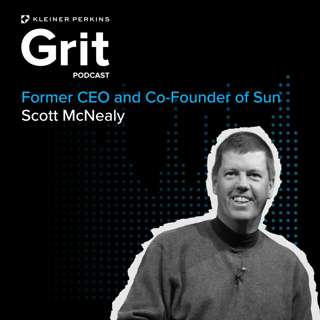
#184 Former CEO & Co-Founder Sun, Scott McNealy: In the Piñata

Guest: Scott McNealy, former CEO and co-founder of Sun Microsystems & co-founder of Curriki

Scott McNealy never wanted to be CEO of Sun, and in his 22-year tenure before selling to Oracle, he knows there were times he failed to execute, or to rein in the once-iconic Silicon Valley firm’s worst impulses. But like his pro golfer son, Maverick, Scott doesn’t like to look back: “Golfers will always look back and blame the wind, a divot that wasn't repaired, a bad rake job, a mower cut that wasn't done properly, a gust of wind,” he explains. “If you blame yourself for all of the mistakes you make. You will hate yourself ... I look forward.”

In this episode, Scott and Joubin discuss Scott Cook, Maverick McNealy, why big companies are riskier than startups, Al Gore, Marc Andreessen, Mark Zuckerberg, Kodak, Dick Kleinhans, Harvard University, “bozo invasions,” Myers-Briggs, making an example, Motorola car phones, the Moscone Center, Elon Musk, Jeff Bezos, NVIDIA’s valuation, farewell letters, “you have no privacy,” open-source education, and toothpaste.com.

In this episode, we cover:

  • (01:00) - John Doerr
  • (02:47) - Fathers, sons, and sports
  • (07:29) - Living in the piñata
  • (10:48) - Why Scott left Sun
  • (13:49) - The heyday of Sun Microsystems
  • (18:24) - Vinod Khosla and founding Sun
  • (21:24) - How Scott became CEO
  • (27:21) - Profitable in three months
  • (30:02) - Inferiority complex
  • (32:20) - Executive exits and fun at work
  • (35:49) - Managers and recognition
  • (38:18) - “HR hero” Crawford Beveridge
  • (40:35) - How Carol Bartz became VP of marketing
  • (43:07) - Sharing in success
  • (45:25) - Scott’s love life & meeting Susan
  • (50:54) - The dotcom boom and crash
  • (53:45) - Unicorn CEOs and IBM’s offer
  • (55:49) - Competitors and hindsight
  • (58:20) - “The planet system”
  • (01:00:13) - Too many employees
  • (01:04:06) - Larry Ellison and selling to Oracle
  • (01:07:01) - Blaming yourself and looking forward
  • (01:10:11) - Curriki
  • (01:12:12) - The AI boom
  • (01:14:42) - “Grit” and insecurity


Links:

Jaksot(276)

Co-Founder & COO Okta, Frederic Kerrest: Zero to IPO

Co-Founder & COO Okta, Frederic Kerrest: Zero to IPO

In the early days of Okta, co-founder Frederic Kerrest was courting a 3,000-person company in Louisiana, which was considering Okta and one other vendor. When he learned who he was up against, he said, “We love competing with them ‘cause we beat them every time.” That arrogant boast lost him the deal, and taught him a humbling lesson: Your confidence is not superior to your customer’s needs.In this episode, Frederic and Joubin discuss literally walking down memory lane in San Francisco, who his new book “Zero to IPO” is for, the value of time, the happiest nations on Earth, why Frederic prioritizes  writing personal thank-you notes, why it’s better to be lucky than good, pivoting to an upmarket strategy, the letdown of being at the top, the problem with “product-led growth” in enterprise, “sharpening the contradictions,” and staying present.In this episode, we cover:Why Frederic wrote “Zero to IPO,” and why he leads it with a story about failure (08:23)Entrepreneurship is a pie-eating contest (13:07)Frederic’s direct communication style and the dichotomy between time and money (15:19)His passion for hockey, and why he used to park his car around the corner (24:35)Getting thrown out of two Okta board meetings in a row (29:03)Surviving awful quarters and service outages (36:10)How Frederic’s arrogance lost him a huge early deal (42:20)Would he build a company from scratch all over again? (45:39)Why Frederic doesn’t take phone calls on the weekends and the “oxygen mask rule” (54:06)“Nothing happens until somebody sells something” (57:20)Is Frederic personally affected by Okta’s stock price? (01:02:09) The key players who receive a “ball bearing award” at Okta (01:07:22)How taking on additional projects and working with a professional coach has extended Frederic’s time at Okta (01:11:48)Links:Connect with FredericTwitterLinkedInConnect with JoubinTwitterLinkedInEmail: grit@kleinerperkins.com Learn more about Kleiner PerkinsThis episode was edited by Eric Johnson from LightningPod.fm

20 Kesä 20221h 19min

Founder & CEO Flock Safety, Garrett Langley: Tech That Makes Everyone Safer

Founder & CEO Flock Safety, Garrett Langley: Tech That Makes Everyone Safer

In April, a young girl was kidnapped and sexually assaulted in Yakima, Wash., and later told police she was picked up by a stranger in a car. The case might have gone cold there, if Yakima hadn’t just installed Flock Safety cameras: The cameras were able to pinpoint a car matching the girl’s description, and picked up the alleged abductor outside an elementary school campus, says Flock CEO Garrett Langley, who says stories like this have validated his company’s mission of stopping crime in our communities.In this episode, Garrett and Joubin discuss a “huge life hack” that Garrett recommends to every CEO with young kids, quarter-life crises and how to rediscover your purpose, the biggest problem in public safety, how Flock Safety is solving thousands of crimes every year, the politics of surveillance camera placement, how Flock cameras became a feature of political campaigns, and how the company almost went out of business before its Series B.In this episode, we cover:Why Garrett’s executive assistant is his mother (02:06)“I had no idea that people started companies” (13:07)Garrett’s quarter-life crisis after two great startup exits (16:59)How Flock Safety helps law enforcement make communities safer (23:49)Solving a child abduction in Washington state (27:27)Why Garrett and his co-founders started Flock (31:22)The impact of Flock cameras on communities that don’t trust the police (36:35)Political controversies and community engagement (39:18)Making cities safer and talent drain from local police departments (47:11)The challenges of fundraising for a police-tech startup in Atlanta (53:42)“Protect the whole community” (01:00:12)The public markets downturn (01:03:33)Links:Connect with GarrettTwitterLinkedInConnect with JoubinTwitterLinkedInEmail: grit@kleinerperkins.com Learn more about Kleiner PerkinsThis episode was edited by Eric Johnson from LightningPod.fm

13 Kesä 20221h 9min

COO Ironclad, Leyla Seka: More Equal Is Always Better

COO Ironclad, Leyla Seka: More Equal Is Always Better

Leyla Seka has a clear idea of “what makes me great” as the COO of Ironclad: She’s incredibly direct with her team. Although many people are not comfortable with getting direct feedback, she says, “I can’t do my job if I can’t tell you what I’m seeing.” And in the end, she sees her job as one of seeking out the truth, to make her business better.In this episode, Leyla and Joubin discuss developing peccadilloes as you get older, why a former boss told her “if you’re in a bad mood, don’t come to work,” what a COO actually does for her team, working through the first dotcom bust, why Leyla doesn’t think she’s better than anyone else, the long battle for equal pay, the “victim mindset” in the tech industry, empowering others who don’t have confidence in themselves, and why you can’t outwork every problem.In this episode, we cover:Maintaining a positive attitude, and dealing with low-energy days (07:57)“The culture of the company is why you stay” (12:02)Overthinking things, good communication and letting go of anxieties (17:50)Leyla’s previous jobs and her parents’ unusual careers  (24:55)Keeping ego out of it and focusing on the “next best action” (31:10)Fighting for equal pay for women at Salesforce (39:19)The double-edged sword of innovation at Salesforce (49:19)How Leyla makes stars out of the underestimated people on her teams (55:40)Leaving Salesforce and starting Operator Collective (59:55)How she started working at Ironclad, and what the company does for customers (01:04:19)The biggest challenge Leyla has faced in her first six months at Ironclad (01:08:36)Links:Connect with LeylaTwitterLinkedInConnect with JoubinTwitterLinkedInEmail: grit@kleinerperkins.com Learn more about Kleiner PerkinsThis episode was edited by Eric Johnson from LightningPod.fm

6 Kesä 20221h 12min

Chief Freemium Business Officer at Spotify, Alex Norstrom: The Power of Setting Impossible Goals

Chief Freemium Business Officer at Spotify, Alex Norstrom: The Power of Setting Impossible Goals

When Alex Norstrom started working at Spotify in 2011, CEO Daniel Ek told him there were three goals: Growth, growth, and growth. But Alex — now the Chief Freemium Business Officer — argued that his team would be better motivated by an “impossible goal,” something like reaching 100 million users. To which Daniel replied: “Let’s do it. Your goal is to get us to 100 million users. Please begin.”In this episode, Alex and Joubin convene at Spotify’s brand-new Stockholm studio to discuss his first job, the “shadow” mentorship program Alex runs, how Facebook changed everything for the gaming company King, thinking about the “bigger picture,” the tremendous effort happening behind the scenes before Spotify launched in each new country, “optimizing for surprises,” Joubin’s embarrassing Spotify playlists, why we’re still in the early innings of podcasting, Alex’s lowest point at Spotify, partnering with FC Barcelona, and culture as currency.In this episode, we cover:The surprising lack of media coverage of Alex despite his prominence at Spotify (05:56) Working at his mother’s Chinese restaurant and his relationship with food (12:21)The early “fiascos” in Alex’s career, and how he came to work at Candy Crush Saga creator King (18:01)How Spotify CEO Daniel Ek convinced Alex to work for him (25:38)Why Alex has tried to set “impossible goals” since his first day at Spotify (28:40)Why the freemium business model works (34:21)Spotify’s hardest and biggest market: The USA (38:39)Pivoting to a mobile-first strategy and the pricing trick that turned conversion numbers around (42:59)The invention of Discover Weekly, and Spotify’s deep bench of other features (51:21)How Spotify got interested in podcasts, and the decision to put them in the same app with music (57:50)The odd but crucial lesson Alex learned early in his career: Stay near the laughter (01:06:46)Being ubiquitous on many platforms, and the art of pitching big & partnering smart (01:09:05)The end of free growth on the internet, and the power of Spotify Wrapped (01:15:07)Links:Connect with AlexTwitterLinkedInConnect with JoubinTwitterLinkedInEmail: grit@kleinerperkins.com Learn more about Kleiner PerkinsThis episode was edited by Eric Johnson from LightningPod.fm

30 Touko 20221h 23min

#87 Founder & CEO Thrive, Arianna Huffington: Life Is About More Than Money and Power

#87 Founder & CEO Thrive, Arianna Huffington: Life Is About More Than Money and Power

Thrive CEO Arianna Huffington is best known for the pioneering online publication she founded, the Huffington Post, which she left in 2016. The experience of running the site awakened her to the most important problem she would tackle in her career: The intersecting crises of stress, burnout, poor sleep, and lack of focus, which Thrive teaches businesses how to manage.In this episode, Arianna and Joubin discuss how she went from a poor family in Greece to president of the elite Cambridge Union debate society; what she learned from both her parents, and the big lessons she has tried to impart to her own daughters; the hardships she faced professionally and personally before starting the Huffington Post; how she fell in love with online media, and how running the Huffington Post awakened her to the burnout epidemic; how Thrive is changing the conversation around stress; and the need for resilience-plus and the “obnoxious roommate in your head.”In this episode, we cover:Being present in every interaction is “one of the greatest gifts we can give each other” (02:23) Arianna’s parents, and abundance as a function of your attitude to life (08:08)How she became the first foreign-born president of the Cambridge Union, which led to her first book (18:00)An “incredible gift”: Discovering at a young age that money and fame aren’t always fulfilling (25:12)Running in the California recall election against Arnold Schwarzenegger, and a digital media epiphany (31:10)Burning out en route to Huffington Post’s $300 million acquisition by AOL (36:53)Why Arianna launched a second startup in her 60s, and the mainstreaming of stress relief (41:35)The meaning of her 2022 word of the year, “resilience-plus” (48:22)How she has constantly re-invented herself, and metabolizing new experiences (55:04)Links:Connect with AriannaTwitterLinkedInEmail Thrive’s head of recruiting, Keith Pescosolido: keith@thriveglobal.comConnect with JoubinTwitterLinkedInEmail: grit@kleinerperkins.com Learn more about Kleiner PerkinsThis episode was edited by Eric Johnson from LightningPod.fm

23 Touko 20221h 1min

CMO Airtable, Archana Agrawal: Success Is Not a Formula

CMO Airtable, Archana Agrawal: Success Is Not a Formula

Archana Agrawal started her job as CMO of Airtable on March 18, 2020 — the same week that the US began to “shelter in place” as cases of the novel coronavirus rapidly rose. With kids who would be staying home from school and Airtable’s San Francisco office closed, everything was changing at once, so she switched into what she calls “problem-solving mode.” And, crucially, she discovered how to use family time to de-stress.In this episode, Archana and Joubin discuss how she made her way from Africa to Asia to America; operating without a full night’s sleep; why her former coworkers made a game of trying to stump her; the secret power under the hood of Airtable; starting her current job right as “shelter in place” kicked in; whether she would stay at Airtable if the founder was no longer CEO; and how she views her responsibility on the boards of MongoDB and Zendesk.In this episode, we cover:Staying in place & doubling down vs. moving on to bigger things (03:03)Moving from Liberia to India to escape civil war (07:13)Archana’s unusual grad school roommate: Her father (11:33)The value of breadth over depth, and following your passions (17:35)Cold-emailing her way into a job at Atlassian and the ridiculous job title Archana almost received (21:38)Understanding a team’s strengths and weaknesses — and her own (27:05)Her lowest point at Atlassian, the sale of HipChat and exit from the messaging business (34:33)Why it matters that Airtable looks like a spreadsheet, but is powered by a relational database (37:52)Going into “problem-solving mode,” and the most important outlet for escaping from stress (42:42)Working for founder-led companies (49:53)Being heard as a quiet person on advisory boards full of louder people (55:27)Links:Connect with ArchanaLinkedInEmail: archana@airtable.comConnect with JoubinTwitterLinkedInEmail: grit@kleinerperkins.com Learn more about Kleiner PerkinsThis episode was edited by Eric Johnson from LightningPod.fm

16 Touko 20221h 3min

CMO Square, Lauren Weinberg: Self-made boss

CMO Square, Lauren Weinberg: Self-made boss

As the CMO for Square, Lauren Weinberg spends a lot of her time talking to new and inexperienced small business owners — and she knows that each of them has wisdom that the others could benefit from. So, Lauren and her former colleague Jackie Reses wrote a book pooling all that wisdom into one place, Self-Made Boss: Advice, Hacks, and Lessons From Small Business OwnersIn this episode, Lauren and Joubin discuss why Lauren never leaves home without sneakers post-9/11; how she maintains discipline in her schedule, and how her priorities have changed over the years; how Lauren overcame three back-to-back challenges in her personal life; why she took a job at Square — after initially turning them down; and the importance of competition for any business.In this episode, we cover:Weekend date nights and the best restaurants in New York City (10:04)How Lauren creates her own time and recharges (15:15)Moving to California to work at Yahoo, and finding a new community (19:32)“The worst year of my life” and going into “survival mode” (22:52)The difference between Square and its newly re-christened parent company, Block (30:22)Why our culture is galvanized by small business stories (36:05)What inspired Lauren and Jackie to write “Self-Made Boss,” and the surprising parts of publishing a book (39:52)Why Lauren includes sad or funny personal stories in every marketing email (42:26)Square’s secret superpower in the company’s early days (49:27)The planning “manifesto” Lauren sent to Square’s executive team shortly after joining (53:31)How Square “earns the right” to show up for social causes (56:50)Links:Connect with LaurenTwitterLinkedInConnect with JoubinTwitterLinkedInEmail: grit@kleinerperkins.com Learn more about Kleiner PerkinsThis episode was edited by Eric Johnson from LightningPod.fm

9 Touko 20221h

Co-Founder & CEO Handshake, Garrett Lord: The Billion-Dollar Question That Changed College Recruiting

Co-Founder & CEO Handshake, Garrett Lord: The Billion-Dollar Question That Changed College Recruiting

Handshake CEO and co-founder Garrett Lord was amazed when he first learned that Silicon Valley firms like Google recruited on college campuses ... just not his, Michigan Technical University. But after excelling in the competitive Palantir internship program, he started asking himself, “How come they can’t reach us?” That question led him to found the job placement platform Handshake, which has raised $434 million in funding and is used by 100 percent of the Fortune 500.In this episode, Garrett and Joubin discuss growing up in an “achievement-focused household”; how Garrett went from struggling to be noticed by Palantir’s recruiters to Handshake CEO; how his $1 billion-plus-valued company started with a broken-down Jeep; working without a safety net; why Garrett has changed his mind about hustle culture; “fortune favors the bold” and “no shave til you raise”; the relief of raising VC funding; how money condenses or extends time; and transitioning from scrappy to scaled CEO.In this episode, we cover:The impostor syndrome — and crucial epiphany — that Garrett had while interning at Palantir (05:46)Starting the IT Oxygen club, and Trojan Horsing other college recruiters in Michigan (11:34)Does having a chip on your shoulder make you more powerful? (17:08)Living in the car, sleeping in McDonald’s parking lots, and showering at university pools (22:25)Hard work and the importance of luck to Handshake’s success (27:08)The difficult VC fundraising process, and finding a crucial ally: Former assistant dean of the Stanford GSB Andy Chan (30:55)Handshake’s first office: A Palo Alto mansion owned by one of LinkedIn’s co-founders (37:55)Growing fast and hiring a COO, Jonathan Stull (41:45)Is Handshake the next LinkedIn? “Why not LinkedIn plus Indeed?” (47:16)Links:Connect with GarrettTwitterLinkedInEmail: garrett@joinhandshake.comConnect with JoubinTwitterLinkedInEmail: grit@kleinerperkins.com Learn more about Kleiner PerkinsThis episode was edited by Eric Johnson from LightningPod.fm

2 Touko 202252min

Suosittua kategoriassa Liike-elämä ja talous

sijotuskasti
psykopodiaa-podcast
rss-rahapodi
ostan-asuntoja-podcast
mimmit-sijoittaa
pomojen-suusta
rss-bisnesta-bebeja
rss-sisalto-kuntoon
rss-seuraava-potilas
taloudellinen-mielenrauha
rss-porssipuhetta
rss-lahtijat
rss-startup-ministerio
rss-paasipodi
pari-sanaa-lastensuojelusta
bakkari-tarinoita-tapahtumien-takahuoneista
rss-markkinointiradio
rss-karon-grilli
rss-podcast-podcasteista
rss-yritys-ja-erehdys