Present Imperfect Episode 6: Josiah Kaplan on the rights of children on the move

Present Imperfect Episode 6: Josiah Kaplan on the rights of children on the move

UNICEF Innocenti presents Present Imperfect, a podcast series exploring the evolution of child rights over the past three decades - and the decades to come, 35 years after the approval of the Convention on the Rights of the Child, or CRC, by the United Nations General Assembly in 1989. According to the Department of Economic and Social Affairs of the United Nations, 281 million people lived outside their country of origin in 2020, representing about 3.6% of the world's population. Freedom of movement is a human right, recognized under article 13 of the Universal Declaration of Human Rights and there's no internationally agreed definition of migrants. It varies by context and purpose. In 2020, 36 million out of 281 international migrants, were children. Children on the move include refugees, internally displaced persons, children who migrate alone or with their families in the hope of a better life, or children who are forced by social, cultural, economic, and natural factors. In Episode 6 Josiah Kaplan, child protection specialist at UNICEF Innocenti and an expert in international aids and child protection, will guide us to understand the complex phenomenon of children who migrate: who they are, why they decide to move, the routes and the challenges they encounter during the journey, as well as the major violation of their rights in the countries of origin, transit, and destination, including exposure to violence, exploitation and abuse, including trafficking. Children on the move are not a homogeneous group, but a child is a child first, regardless of their migratory status or what a state determines to be their legal status because of migration and, as such, they are fully entitled to their rights as children. Josiah reflects also on the main drivers for children on the move and points out to the global mega-trends which shape childhood today, including climate change, urbanization, conflict or technological integration. He also underlines the fact most migration is not international, rather from a rural community to a larger urban center in one's own country. He also talks about the decision-making process and the role of families, communities, and peers, as well as on some successful strategies or programs implemented to protect children on the move and on what governments should do to protect migrant and refugee children. Reports and resources mentioned in this episode: • UNICEF Innocenti migration and displacement page: https://www.unicef.org/innocenti/projects/children-migration-and-displacement • IDAC: https://data.unicef.org/resources/international-data-alliance-for-children-on-the-move/

Tämä jakso on lisätty Podme-palveluun avoimen RSS-syötteen kautta eikä se ole Podmen omaa tuotantoa. Siksi jakso saattaa sisältää mainontaa.

Jaksot(55)

Present Imperfect Episode 2: Professor Cecile Aptel on Children and Justice

Present Imperfect Episode 2: Professor Cecile Aptel on Children and Justice

UNICEF Innocenti presents Present Imperfect, a podcast series exploring the evolution of child rights over the past three decades - and the decades to come, 35 years after the approval of the Conventi...

13 Helmi 202551min
Episode 5: Alessandra Guedes & Shanaaz Mathews on violence against children & violence against women

Episode 5: Alessandra Guedes & Shanaaz Mathews on violence against children & violence against women

UNICEF Innocenti presents Present Imperfect, a podcast series exploring the evolution of child rights over the past three decades - and the decades to come, 35 years after the approval of the Conventi...

23 Loka 20241h 4min
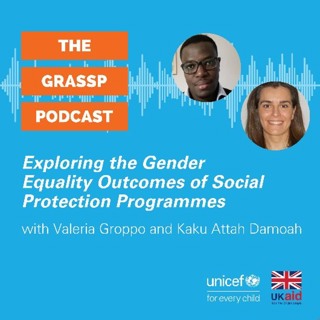
The GRASSP Podcast - Exploring the Gender Equality Outcomes of Social Protection Programmes

The GRASSP Podcast - Exploring the Gender Equality Outcomes of Social Protection Programmes

Episode 3 of the GRASSP podcast explores social protection case studies from Angola, Burkina Faso, Mali and Tanzania. Discover how how social protection interventions can be adapted to focus on women ...

15 Loka 202446min
Present Imperfect: Episode 4 - Gavin Wood on The Rights of Children With Disabilities

Present Imperfect: Episode 4 - Gavin Wood on The Rights of Children With Disabilities

UNICEF Innocenti presents Present Imperfect, a podcast series exploring the evolution of child rights over the past three decades - and the decades to come, 35 years after the approval of the Conventi...

26 Syys 202440min
Present Imperfect Episode 3: Camila Teixeira on the right to peaceful protest

Present Imperfect Episode 3: Camila Teixeira on the right to peaceful protest

UNICEF Innocenti presents Present Imperfect, a podcast series exploring the evolution of child rights over the past three decades - and the decades to come, 35 years after the approval of the Conventi...

14 Elo 20241h 1min
Present Imperfect Episode 1: Professor Ann Skelton on The Committee on the Rights of the Child

Present Imperfect Episode 1: Professor Ann Skelton on The Committee on the Rights of the Child

UNICEF Innocenti presents Present Imperfect, a podcast series exploring the evolution of child rights over the past three decades - and the decades to come, 35 years after the approval of the Conventi...

20 Kesä 202445min

Democracy and youth

Democracy and youth

In the first of a new series of podcasts, Camila Teixeira of UNICEF Innocenti speaks with Nahjae Nunes and Abril Perazzini, both UNICEF Youth Foresight Fellows, on the future of democracy - as seen th...

18 Kesä 202448min

Suosittua kategoriassa Politiikka ja uutiset

uutiscast
aikalisa
politiikan-puskaradio
ootsa-kuullut-tasta-2
rss-ootsa-kuullut-tasta
otetaan-yhdet
rss-vaalirankkurit-podcast
rss-podme-livebox
rss-voi-venaja
rss-seksicast
rss-girls-finish-f1rst
tervo-halme
rss-asiastudio
rss-kaikki-uusiksi
rss-pinnalla
linda-maria
rss-raha-talous-ja-politiikka
rss-kovin-paikka
nakokulma-oikealta-jussi-halla-ahon-blogin-kommentaarit
rss-mina-ukkola