218. Surprised by the man of no suprises
A History of England17 Marras 2024

218. Surprised by the man of no suprises

We start this week with Hitler announcing that there would be no more surprises, though we immediately question whether his word could always be wholly trusted.

We go on to look at the way Hitler was building a regime which didn’t just want war, above all against what he saw as a Jewish-Bolshevik menace, but actually needed it as the only way to obtain basic products for the German population, and raw materials that the military machine itself had to have.

Meanwhile, British foreign policy was under new management, with Anthony Eden as Foreign Secretary in place of the disgraced Samuel Hoare. The Prime Minister, Stanley Baldwin, told him he wanted better relations with Germany and when Eden asked how he was to obtain them, he told him that it was Eden’s job to work that out. But then Baldwin stood down, and his successor, Neville Chamberlain, had a different approach. He wanted to run foreign affairs himself, and he was intent on going flat out for appeasement.

That finally brought the Prime Minister and his Foreign Secretary into a head-on clash, over concessions to Italy, in the hope of securing Mussolini’s assistance. Chamberlain was prepared to recognise that Italy had the right to invade and occupy Abyssinia (Ethiopia today), even though that was a breach of international law. Eden was in favour of appeasement, but not at the cost of unreasonable concessions, and this one he decided really wasn’t reasonable. Eden went. His replacement was Lord Halifax. He’d recently been on a hunting trip to Germany as the guest of Hermann Goering, and came back convinced that the Nazi leaders were reasonable men with whom a sensible set of arrangements could be negotiated.

Then Hitler showed that the age of surprises really wasn’t over. He sent troops over the border into neighbouring Austria, to absorb it into the German Reich. There was no resistance in the country, and none from outside either, including from Britain.

European great powers didn’t greatly rate the rights of Africa’s native peoples. Writing off the rights of the Abyssinians therefore was no great shock. But this was Austria, a European country, and Hitler invaded and annexed it without the slightest attempt to stop him from abroad.

It seemed that appeasers were prepared to step across some red lines in their bid to buy peace through concessions to dictators.


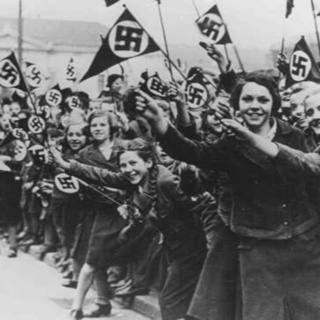
Illustration: Members of the Nazi organisation, the League of German Girls, celebrating the arrival of German troops in Vienna. Dokumentationsarchiv des Oesterreichischen Widerstandes

Music: Bach Partita #2c by J Bu licensed under an Attribution-NonCommercial-No Derivatives (aka Music Sharing) 3.0 International License


Jaksot(274)

25. Protectorate

25. Protectorate

In the 1650s, power concentrated in England into fewer and fewer hands, until in the end a Lord Protector was appointed and - surprise, surprise, since he dominated the Army Council which appointed hi...

19 Maalis 202113min

24. Republic

24. Republic

Who could imagine that England could ever be a republic? And yet for eleven years it became one. Still, it would be a serious mistake to confuse 'republic' with 'democracy'. It swiftly became clear, a...

14 Maalis 20219min

23. An uncertain throne and an oak tree

23. An uncertain throne and an oak tree

We start with Charles I's son mounting a throne in Scotland as Charles II, and end with him hiding up an oak tree, throneless once more. In between, lots of exciting battles, all rather boringly won b...

9 Maalis 20218min

22. A desert called peace

22. A desert called peace

This is the chapter where we reach the Third English Civil War. We've seen that though their concerns may have been mainly English, the civil wars were by no means limited to England. They were, indee...

4 Maalis 20218min

21. Round 2 and a deluded king’s fine death

21. Round 2 and a deluded king’s fine death

When the Scots began to worry about the increasing power of the New Model Army, and even whether it might be a bigger threat to them than the king, they decided to open negotiations with him. The resu...

27 Helmi 202111min

20. Interlude

20. Interlude

The First Civil War had ended. King Charles I had lost, which wasn't just a military or political problem, but a religious one too: after all, if God had made him king, and God also determined who won...

22 Helmi 202114min

19. First Civil War: Parliament gets serious

19. First Civil War: Parliament gets serious

Parliament getting serious about the Civil War, getting its act together on military matters - above all by launching its New Model Army - and starting to win some key battles. Against that context, a...

17 Helmi 20219min

18. First Civil War: the fight gets going

18. First Civil War: the fight gets going

Oh dear, oh dear. Charles I pushed and pushed. Eventually, the other side pushed back. First it was the Scots, who turned out to be a lot better at fighting than Charles had imagined, and gave him a c...

12 Helmi 202113min

Suosittua kategoriassa Historia

olipa-kerran-otsikko
gogin-ja-janin-maailmanhistoria
mayday-fi
huijarit
mystista
rss-ikiuni
tsunami
konginkangas
totuus-vai-salaliitto
rouva-diktaattori
rss-subjektiivinen-todistaja
rss-i-dont-like-mondays-2
rss-peter-peter
rss-sattuu-sita-suomessakin
sotaa-ja-historiaa-podi
historiaa-suomeksi
rss-kirkon-ihmeellisimmat-tarinat
maailmanpuu
apinan-vuosi
tiedetta-ja-sirkushuveja-vanhojen-aikojen-podcast