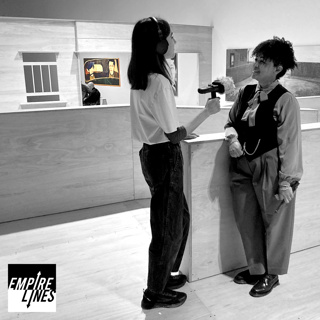

It Will End in Tears, Pamela Phatsimo Sunstrum (2024) (EMPIRE LINES x Barbican)
EMPIRE LINES21 Marras 2024

It Will End in Tears, Pamela Phatsimo Sunstrum (2024) (EMPIRE LINES x Barbican)

Contemporary artist Pamela Phatsimo Sunstrum, and curator Diego Chocano, slip between places and times, reconstructing the landscape of Botswana in the centre of the city of London, through their filmic installation, It Will End in Tears (2024).

Pamela Phatsimo Sunstrum’s practice spans landscapes and media, encompassing painting, installation, and animation. Their drawings take the form of narrative landscapes, that seem simultaneously futuristic and ancient, playing with conventions of linear time. Pamela often draws from literature, theatre, and science fiction - with references from Octavia Butler’s Parable of the Sower, to Guillermo del Toro‘s Pan’s Labyrinth - particularly in their slippery representations of people and places.
Born in Botswana, and practicing in the US, Canada, South Africa, and the Netherlands, Pamela describes how their work has been shaped by these different contexts. They detail their transformative residency with Arturo Lindsay in the rainforest in Panama, a coastal Central American and Caribbean country, which has shaped their representations of volcanic, subterranean, and cosmological environments. Seeing the landscape as ‘another character’ in their their works, Pamela challenges the binary of landscape and figurative painting, and Western/European art historical conventions. Though It Will End in Tears (2024) is Pamela’s first major UK solo exhibition, it is not their first in the city of London; we discuss their relationship with spaces across the capital, and its colonial histories.


Curator Diego Chocano highlights how Pamela has both challenged and embraced conventions of Western/European art history. We discuss the artist’s academic approach, and ‘research’ approach to art, which has inspired interdisciplinary collaborations in the field of science, with theoretical physicist Dr. James Sylvester Gates. He details the artist’s interest in performance and artifice, drawing on film noir, wooden theatre sets, and the figure of the femme fatale for this body of work. We discuss how Pamela’s self-constructed alter ego, Asme, enables the artist more freedom of creative expression, and the ability to resist categorisation by identity, biography, or subjectivity.


Pamela Phatsimo Sunstrum: It Will End in Tears runs at the Barbican in London until 5 January 2025.


For more, you can read my article, in gowithYamo: gowithyamo.com/blog/pamela-phatsimo-sunstrum-barbican

Find out more about Leo Robinson, and Édouard Glissant’s ideas of ‘trembling’, at the London Mithraeum Bloomberg SPACE: instagram.com/p/DAtbDyUIHzl/?next=%2F&img_index=3


Hear Barbican curator Florence Ostende on Carrie Mae Weems’ series, From Here I Saw What Happened and I Cried (1995–1996): pod.link/1533637675/episode/b4e1a077367a0636c47dee51bcbbd3da


And curator Alice Wilke on Carrie Mae Weems’ Africa Series (1993), at the Kunstmuseum Basel: pod.link/1533637675/episode/d63af25b239253878ec68180cd8e5880


For more from the Curve, hear Barbican curator Eleanor Nairne on Julianknxx’s Chorus in Rememory of Flight (2023), on EMPIRE LINES: pod.link/1533637675/episode/1792f53fa27b8e2ece289b53dd62b2b7


And find out more about ancient Adinkra symbology and geometric structures in the episode about El Anatsui’s Scottish Mission Book Depot Keta (2024) at Talbot Rice Gallery in Edinburgh: pod.link/1533637675/episode/2e464e75c847d9d19cfa4dc46ea33338


PRODUCER: Jelena Sofronijevic.


Follow EMPIRE LINES on Instagram: ⁠instagram.com/empirelinespodcast⁠

And Twitter: ⁠twitter.com/jelsofron/status/1306563558063271936⁠

Support EMPIRE LINES on Patreon: ⁠patreon.com/empirelines

Jaksot(166)

The Tribes of Israel (Jacob and his Twelve Sons), Francisco de Zurbarán (1640s)

The Tribes of Israel (Jacob and his Twelve Sons), Francisco de Zurbarán (1640s)

Akemi Luisa Herráez Vossbrink depicts relations between imperial Spain and the Americas, through Francisco de Zurbarán’s paintings, The Tribes of Israel. From Seville’s most acclaimed religious artist...

10 Joulu 202014min

Bengali Colcha with Triumphal Arch of the Flemish (Mid 17th Century)

Bengali Colcha with Triumphal Arch of the Flemish (Mid 17th Century)

Dr. Laura Fernández-González explores the circulation of visual trends between imperial Lisbon and India, through the design for the Bengali Colcha with Triumphal Arch of the Flemish. Numerous Indian ...

26 Marras 202015min

Electra House, London (1902)

Electra House, London (1902)

Dr. Alex Bremner navigates London as the powerhouse of British technological imperialism, by looking at Electra House. Home to the Eastern Telegraph Company, London’s Electra House became the centre o...

12 Marras 202012min

La Haine, Mathieu Kassovitz (1995)

La Haine, Mathieu Kassovitz (1995)

Dr. Emile Chabal navigates the contemporary echoes – and explosions – of French colonialism, through Mathieu Kassovitz’s 1995 film La Haine. Through the dangerous escapades of the young Vinz, Hubert a...

29 Loka 202014min

John Bull’s Other Island, George Bernard Shaw (1904)

John Bull’s Other Island, George Bernard Shaw (1904)

Journalist Megan Kenyon explores imperial relations between Britain and Ireland, through George Bernard Shaw’s 1904 play, John Bull’s Other Island. Ireland was England’s first colony, and the first co...

15 Loka 202014min

The Great Mosque(s) of Djenné, Mali

The Great Mosque(s) of Djenné, Mali

Dr. Peter Clericuzio observes complex imperial hierarchies between Mali and France, through the Great Mosque(s) of Djenné. Population 32,000, Djenné is a small city in Mali, itself one of Africa's le...

1 Loka 202013min

Suosittua kategoriassa Yhteiskunta

sita
olipa-kerran-otsikko
kaksi-aitia
hupiklubi
i-dont-like-mondays
siita-on-vaikea-puhua
ihme-ja-kumma
uutiscast
poks
gogin-ja-janin-maailmanhistoria
antin-palautepalvelu
kolme-kaannekohtaa
rss-murhan-anatomia
mamma-mia
aikalisa
yopuolen-tarinoita-2
meidan-pitais-puhua
rss-palmujen-varjoissa
mystista
terapeuttiville-qa