

936: Realtime LED Wall With React + Websockets (I Let Strangers Control It)
Scott, Wes, and CJ dive into Wes’s Hackweek project: a real-time, web-controlled LED grid. They break down the hardware build, custom 3D-printed diffuser, ESP32 microcontroller, and Cloudflare durable objects powering live pixel art, GitHub activity displays, and interactive web drawings. Show Notes 00:00 Welcome to Syntax! 02:03 Wes’ Hackweek project: a web-controlled LED grid 03:52 The hardware: LED panels, soldering, and power WS2812 LED panels 06:38 ESP32 microcontroller and WLED firmware explained ESP32 Microcontroller 10:57 Power supply challenges and injection fixes 15:05 Debugging and testing a DIY LED matrix 15:56 Shorts, blown circuits, and melted wires 17:58 Designing and 3D-printing the diffuser for crisp pixels 21:29 The software: Cloudflare Durable Objects + Party Server Cloudflare Durable Objects Party.server 22:18 Real-time sync and state management across clients Party Client 28:43 Connecting the server to the LED hardware 41:51 Open access fun: scripts, NSFW images, and moderation Cloudflare tunnel 44:10 Live demos 45:34 Future plans: stats, rooms, and making it always-on Hit us up on Socials! Syntax: X Instagram Tiktok LinkedIn Threads Wes: X Instagram Tiktok LinkedIn Threads Scott: X Instagram Tiktok LinkedIn Threads Randy: X Instagram YouTube Threads
10 Syys 202547min

935: CJ Made A Sega Game In 2025
CJ takes us behind the scenes of Hackweek to share how he built a custom Sega Genesis game from scratch, complete with assembly code, level loading, and retro hardware tricks. From SGDK to parallax faking, this episode is a deep dive into old-school game dev with a modern twist. Show Notes 00:00 Welcome to Syntax! 00:44 Why a Sega game? Sega Genesis. Sega Master System. MKBHD Retro Tech: Sega. 06:55 What is it running on? 07:49 Working with assembly code. 10:11 Sega Genesis Development Kit. Stephane-D GitHub. 10:54 Awesome Megadrive. 12:02 Booting on an emulator. 13:07 Gens and KMod. 15:54 Compiling stage. 17:44 Genesis Code VS Code Extension. 18:22 Images and Assets. 19:46 Loading images with bitmap. 23:50 Megacat Studios. 25:21 Z index? Faking Parallax. 27:34 Specific code examples. 27:51 Platformer Engine. 30:01 Platformer Sample Game. 30:44 LDTK (Level Designer Toolkit). 33:13 Tiled Collision mapping. 37:42 What about debugging? 39:37 Loading in levels. RetroGameMechanicsExplained. Sega Mega-CD Development Unit. 43:56 Challenges with graphics. 49:56 Adding music. Super Cartridge. Flahskit Programmer MD. Flashkit Cart MD. Hit us up on Socials! Syntax: X Instagram Tiktok LinkedIn Threads Wes: X Instagram Tiktok LinkedIn Threads Scott: X Instagram Tiktok LinkedIn Threads Randy: X Instagram YouTube Threads
8 Syys 202552min
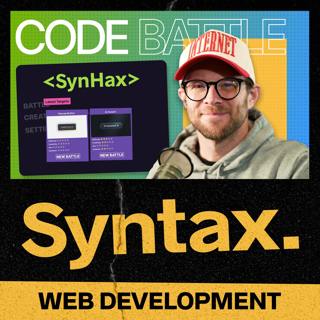
934: We Built a Real-Time, Local-Data, Competitive Coding Game
Scott, Wes, and CJ dive into SynHax, Scott’s Hackweek project for code battles. They discuss live coding duels, referee controls, and the surprisingly simple tech stack that delivers instant updates and audience engagement. Show Notes 00:00 Welcome to Syntax! 01:50 Brought to you by Sentry.io 02:30 What is SynHax? This Button Broke Our Brains (CSS Challenge) 04:21 The Stack SvelteKit Postgres Drizzle Zero Sync Better Auth Syntax 931: How to make good choices when starting a coding project 07:39 How it works 15:03 The battle experience 28:28 Fun details 34:12 Creating new battles & the admin dashboard Hit us up on Socials! Syntax: X Instagram Tiktok LinkedIn Threads Wes: X Instagram Tiktok LinkedIn Threads Scott: X Instagram Tiktok LinkedIn Threads Randy: X Instagram YouTube Threads
3 Syys 202537min
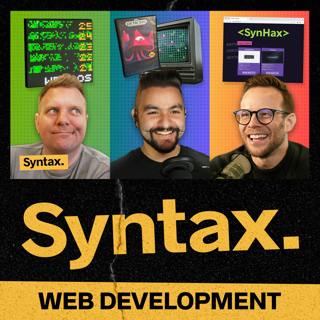
933: Hackweek Overview - What Is It, What Did We Build
It’s Hackweek at Syntax! Scott, Wes, and CJ break down what Hackweek is all about - how they picked their projects, what came out of them, and why it’s the best excuse to experiment, build, and have fun before the deep-dive episodes roll in. Show Notes 00:00 Welcome to Syntax! 00:04 What is Hackweek? 01:05 Hackweek projects spark motivation. 04:05 Choosing our projects. 04:34 What we chose. 05:11 CJ’s Hackweek Project. 05:51 Using SGDK C language toolkit. 07:02 Writing to an Everdrive. 08:09 What game engine did you use? Platformer Engine. LDtk. 12:11 What was the end result? 14:09 Wes’ Hackweek Project. 16:15 Why hardware projects? Watch the Video Here. 19:09 Scott’s Hackweek Project. Watch the Video Here. 21:42 Early considerations. 25:42 AI usage. Hit us up on Socials! Syntax: X Instagram Tiktok LinkedIn Threads Wes: X Instagram Tiktok LinkedIn Threads Scott: X Instagram Tiktok LinkedIn Threads Randy: X Instagram YouTube Threads
1 Syys 202532min
932: Vibe Coding’s Huge Problem
Wes and Scott talk about the dangers of vibe coding when it comes to authentication and access control. They share real-world examples of security fails, discuss how to avoid client-side-only checks, and offer practical tips for protecting sensitive user data in your apps. Show Notes 00:00 Welcome to Syntax! We build the world’s most painful CAPTCHAs (Kitboga scammers) 02:08 Brought to you by Sentry.io 02:33 Wes’ vibe coding experience Wes’ app 04:38 The Tea app disaster Tea app 07:45 Don’t vibe code access control Better Auth with Better Auth 09:38 Let in, don’t lock down 11:23 Server vs. client-side code 13:46 Visualize access control 15:30 Automate tests 17:00 Sick Picks + Shameless Plugs Sick Picks Scott: A City on Mars Wes: Hotel Collection Essential Oils Shameless Plugs Syntax YouTube Channel Hit us up on Socials! Syntax: X Instagram Tiktok LinkedIn Threads Wes: X Instagram Tiktok LinkedIn Threads Scott: X Instagram Tiktok LinkedIn Threads Randy: X Instagram YouTube Threads
27 Elo 202522min
931: Project Init - How to Make Good Choices When Starting a New Coding Project
Scott and Wes dive into the fundamentals of project initialization and planning, from outlining ideas and choosing the right tools to making smart technology decisions. They also chat about leveraging AI and collaboration to shape better projects before rolling up your sleeves and getting to work. Show Notes 00:00 Welcome to Syntax! 02:12 Brought to you by Sentry.io. 04:03 Make a plan. 04:06 Start with an outline and let it evolve. 05:59 Mind-Mapping software vs plain text. 08:49 Utilizing LLMs for alternative perspectives. 09:58 Utilizing humans for alternative perspectives. 11:17 Making technology choices. 13:24 Assessing the project’s actual needs. 13:30 Is this a long-term project? 15:43 Is this project Open Source? 16:09 Are you working in a team? 18:12 Are you prioritizing learning? 19:48 Pick technologies with proven compatibility. 20:17 Implementing AI. 20:44 Steering docs. 26:24 Get to work and break stuff. Hit us up on Socials! Syntax: X Instagram Tiktok LinkedIn Threads Wes: X Instagram Tiktok LinkedIn Threads Scott: X Instagram Tiktok LinkedIn Threads Randy: X Instagram YouTube Threads
25 Elo 202530min
930: Text Editor Keybindings, WASM Replacing Docker, LLM apathy and hosting mini apps
In this potluck episode of Syntax, Wes and Scott answer your questions about VS Code vs Cursor, navigating promotions and job titles, database fundamentals, avoiding decision paralysis, how AI is shaping frameworks, and more! Show Notes 00:00 Welcome to Syntax! 00:56 Brought to you by Sentry.io 06:24 Moving from VS Code to Cursor without losing your shortcuts 12:13 Should you bring up a senior promotion at a new job? 16:32 Relying on LLMs vs. learning database fundamentals 20:42 Overcoming decision paralysis in programming 25:00 What to do when your code gets too messy 27:39 Could Wasm replace Docker and Kubernetes? 32:14 Organizing mini-apps in Express: monorepo, micro frontends, or something else? 38:49 Will AI lock us into React and make new frameworks irrelevant? 46:57 Sick Picks + Shameless Plugs Sick Picks Wes and Scott: Niimbot Shameless Plugs Subscribe to Syntax on YouTube Hit us up on Socials! Syntax: X Instagram Tiktok LinkedIn Threads Wes: X Instagram Tiktok LinkedIn Threads Scott: X Instagram Tiktok LinkedIn Threads Randy: X Instagram YouTube Threads
20 Elo 202555min
929: Cloudflare Blocks AI Crawlers × Debugging Local Data × Raising Kids with Healthy Digital Habits and More
Scott and Wes tackle listener questions on everything from local-first databases and AI-built CRMs to protecting APIs and raising kids with healthy digital habits. They also weigh in on Cloudflare’s AI crawler ban, portfolio critiques, and more hot takes from the dev world. Show Notes 00:00 Welcome to Syntax! 00:49 Dreaming about web components. 02:55 Local-First Apps for Customer Support. Brought to you by Sentry.io 08:17 AI-Built CRM: Portfolio or Problem? Ben Vinegar’s Engineering Interview Strategy. 18:55 InstantDB vs. Other Local-First Databases. 21:46 Raising Kids with Healthy Digital Habits. Porta Potty Prince on TikTok. 32:55 Cloudflare Blocks AI Crawlers. Good for Creators? Cloudflare Pay Per Crawl. Cloudflare No AI Crawl Without Compensation. Chris Coyier’s Blog Response. 41:46 Protecting APIs and Obfuscating Source Code. 44:49 Will Portfolio Critiques Return? 46:45 Sick Picks + Shameless Plugs. Sick Picks Scott: Wifi 7 Eero. Wes: Plastic Welder Shameless Plugs Scott: Syntax on YouTube Hit us up on Socials! Syntax: X Instagram Tiktok LinkedIn Threads Wes: X Instagram Tiktok LinkedIn Threads Scott: X Instagram Tiktok LinkedIn Threads Randy: X Instagram YouTube Threads
18 Elo 202553min