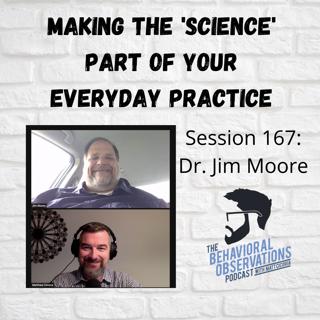
Making the 'Science' Part of Your Everyday Practice: Session 167 with Jim Moore

Making the 'Science' Part of Your Everyday Practice: Session 167 with Jim Moore

Dr. Jim Moore returns to Behavioral Observations in this session. And I'm so thankful he had the time to chat, because this episode is jam-packed with great information for practitioners at all experience levels.

We spent a few minutes catching the audience up on some of the changes in Jim's life since his last appearance on the show. In particular, we discuss his new job as Chief Clinical Officer of Apollo Behavior and his move to the Atlanta area.

Afterwards, we managed to touch on several important issues in clinical practice, including the following:

  • Our differing (initially) views on what it means to engage in scientific behavior... i.e., who is and is not a scientist.
  • How identifying research questions differs in academia and practice.
  • Solving behavior problems by examining overly strict rule adherence (and what to do about it).
  • What to pay attention to when interviewing caregivers about problem behavior.
  • How to trouble shoot stalled learner progress.
  • Using Socratic questioning during clinical supervision (if you listen to any part of this episode, listen to this one!).
  • A preview of what sounds like an incredibly interesting talk at the upcoming Stone Soup Conference (and if you're interested in attending this incredibly affordable and informative event, use the code PODCAST to save even more at checkout).
  • Jim's point of view on the varying functional analysis practices that are being discussed in the literature.

We also recorded about 20 or so minutes of bonus content, which is available to Patreon subscribers (check out this link to learn more). In this segment of the show, Jim went into some detail regarding his ups and downs with his health and fitness, and how he's trying to get back on track, what it's like to be a Saints fan in the Atlanta Metro area, the parallels between good coaching and good leadership, and lots more.

Lastly, Jim was too gracious to shamelessly plug his practice group, but if the type of practice he describes interests you, hit him up on LinkedIn, or elsewhere on social media, as he's pretty easy to find.

Here are links to some resources we discussed:

Quote #1:

The differences between applied and basic research are not differences between that which "discovers" and that which merely "applies." Both endeavors ask what controls the behavior under study

Baer, Wolf, & Risley (1968)

Quote #2:

An applied behavior analysis will make obvious the importance of the behavior changed, its quantitative characteristics, the experimental manipulations which analyze with clarity what was responsible for the change, the technologically exact description of all procedures contributing to that change, the effectiveness of those procedures in making sufficient change for value, and generality of that change

Baer, Wolf, & Risley (1968)

Quote #3:

Applied research is designed to solve practical problems of the modern world, rather than to acquire knowledge for knowledge's sake. One might say that the goal of the applied scientist is to improve the human condition.

Lawrence Berkley National Laboratory

This episode is brought to you by:

  • The aforementioned Stone Soup Conference, again, use the promo code PODCAST to save, and hear talks from folks like Drs. Linda LeBlanc, Adithyan Rajaraman, Jordan Belile, and more!
  • Behavior University. (who incidentally is sponsoring the Stone Soup Conference!) Their mission is to provide university quality professional development for the busy Behavior Analyst. Learn about their CEU offerings, including their brand new 8-hour Supervision Course, as well as their RBT offerings over at behavioruniversity.com/observations.
  • Consider joining the BOP Patreon. Patreon members get early access to podcasts, bonus podcast material, discounts on CEU events from FTF and other continuing ed purveyors, occasional Zoom hangouts, and more!
  • The Professional Crisis Management Association, or PCMA for short. Later on in the show, you'll hear from one of the most popular podcast guests, Dr. Merrill Winston, where he'll talk about how PCMA helps agencies support individuals who exhibit dangerous behaviors. For more info on them, go to PCMA.com.

Jaksot(329)

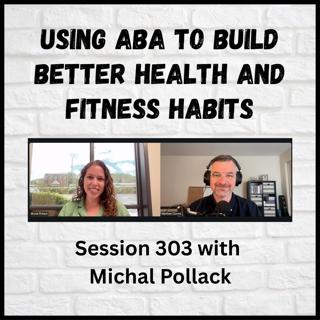
Using ABA to Build Better Health and Fitness Habits: Session 303 with Michal Pollack

Using ABA to Build Better Health and Fitness Habits: Session 303 with Michal Pollack

Michal Pollack joined me to discuss how she uses her training in Behavior Analysis to help her with her personal health and fitness goals. Michal is a Clinical Director at Apollo Behavior. In this epi...

24 Kesä 20251h
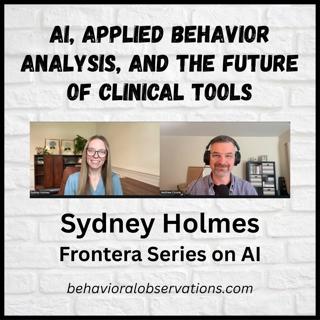
AI, Applied Behavior Analysis, and the Future of Clinical Tools: Frontera Series on AI with Sydney Holmes

AI, Applied Behavior Analysis, and the Future of Clinical Tools: Frontera Series on AI with Sydney Holmes

Behavior Analysis Meets Artificial Intelligence In the second installment of Behavioral Observations' Frontera Series on AI, I had the pleasure of speaking with Sydney Holmes, a Board Certified Beha...

12 Kesä 202542min
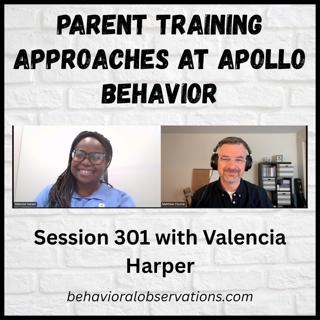
Supporting Parents in ABA Services with Valencia Harper from Apollo Behavior: Session 301

Supporting Parents in ABA Services with Valencia Harper from Apollo Behavior: Session 301

When it comes to Applied Behavior Analysis (ABA), much of the focus is often placed on data collection, program goals, and measurable outcomes for the child. But what about the parents? Supporting car...

29 Touko 202550min
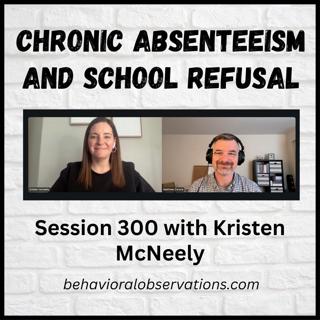
Chronic Absenteeism and School Refusal: Session 300 with Kristen McNeely

Chronic Absenteeism and School Refusal: Session 300 with Kristen McNeely

Kristen McNeely joins me for an informative discussion about the challenging topic of School Refusal and Chronic Absenteeism. If you are in any way connected to a school community, you've probably hea...

14 Touko 20251h 16min
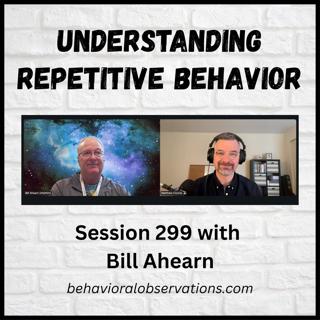
Understanding Repetitive Behavior: Session 299 with Bill Ahearn

Understanding Repetitive Behavior: Session 299 with Bill Ahearn

Dr. Bill Ahearn joins me in Session 299 of Behavioral Observation. I met Bill a few times at conferences and I'm so glad we finally had a chance to sit down and record a podcast together. Bill is the ...

5 Touko 20251h 34min
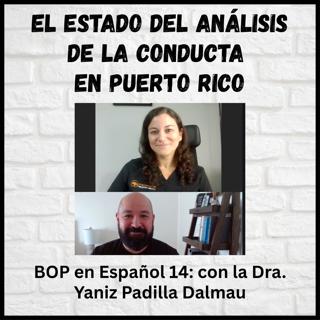
El Estado del Análisis de la Conducta en Puerto Rico con la Dra. Yaniz Padilla Dalmau: BOP en Español 14

El Estado del Análisis de la Conducta en Puerto Rico con la Dra. Yaniz Padilla Dalmau: BOP en Español 14

El Estado del Análisis de la Conducta en Puerto Rico con la Dra. Yaniz Padilla Dalmau En este episodio, tuve el honor de conversar con la Dra. Yaniz Padilla Dalmau, una de las voces más comprometidas ...

28 Huhti 20251h 23min
Altering the Relative Efficiencies of Responses for Behavioral Improvement: Session 297 with Steve Ward

Altering the Relative Efficiencies of Responses for Behavioral Improvement: Session 297 with Steve Ward

Steve Ward returns to the podcast to talk about a paper he recently published with co-author Teresa Grimes, titled, "50 Practical Ways to Alter the Relative Efficiencies of Behaviors." In this convers...

16 Huhti 202556min
Improving Access to Medical Care for Individuals with Intellectual Disabilities: Session 296 with Brandon Franklin

Improving Access to Medical Care for Individuals with Intellectual Disabilities: Session 296 with Brandon Franklin

Brandon Franklin returns to the podcast after a very long hiatus. You'll have to go back to Session 36 to hear his first appearance as a matter of fact. It turns out that he's been doing a lot of inno...

7 Huhti 20251h 5min

Suosittua kategoriassa Tiede

tiedekulma-podcast
rss-mita-tulisi-tietaa
rss-poliisin-mieli
rss-metsantuntijat-podcast
filocast-filosofian-perusteet
rss-duodecim-lehti
mielipaivakirja
rss-astetta-parempi-elama-podcast
rss-tiedetta-vai-tarinaa
rss-luontopodi-samuel-glassar-tutkii-luonnon-ihmeita
university-of-eastern-finland
utelias-mieli
docemilia
menologeja-tutkimusmatka-vaihdevuosiin
rss-bios-podcast
rss-ranskaa-raakana
rss-ylistys-elaimille
rss-lapsuuden-rakentajat-podcast
rss-lihavuudesta-podcast
rss-sosiopodi