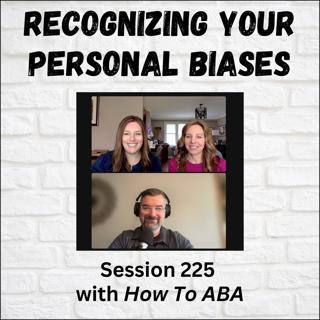

Recognizing Your Personal Biases: Session 225 with How To ABA

Recognizing Your Personal Biases: Session 225 with How To ABA

In Session 225, Shira Karpel and Shayna Gaunt from How To ABA return to the show to discuss a recent webinar that they provided for their online community (note: see here for their first appearance on the podcast).

Their talk discussed code element 1.10, from the Behavior Analysis Certification Board's Ethics Codes for Behavior Analysts. For a quick recap, it reads as follows:

1.10 Awareness of Personal Biases and Challenges

• Behavior analysts maintain awareness that their personal biases or challenges (e.g., mental or physical health conditions; legal, financial, marital/relationship challenges) may interfere with the effectiveness of their professional work.

• Behavior analysts take appropriate steps to resolve interference, ensure that their professional work is not compromised, and document all actions taken in this circumstance and the eventual outcomes.

In the spirit of this code element, Shira and Shayna discuss how they define these biases, and how they can potentially occur in practice. More importantly, they discuss steps for detecting and responding to such biases when they do surface.

This podcast will be available for BACB Continuing Education (1.0 Ethics Credits). To learn more about how to obtain, click here. If you want to learn more about the great community that Shira and Shayna are leading, click here. In the meantime, be sure to check out their blog, free resources, and podcast. If you decide to join their community, use the promo code, BOP, when signing up to save on your membership!

Jaksot(327)

23: Mark Dixon Discusses his PEAK Curriculum

23: Mark Dixon Discusses his PEAK Curriculum

In Session 23 of The Behavioral Observations Podcast, Mark Dixon visits with us again to discuss the PEAK assessment and curriculum. Specifically, he tells us about how he first got into working with ...

27 Maalis 201755min
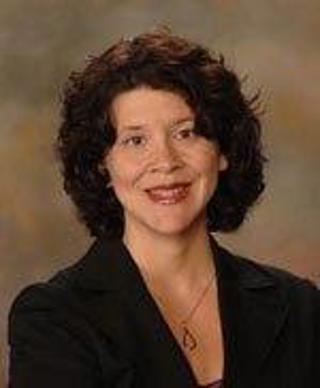
22: Dr. Linda LeBlanc discusses OBM, Behavioral Gerontology, and More!

22: Dr. Linda LeBlanc discusses OBM, Behavioral Gerontology, and More!

Dr. Linda LeBlanc joins me today to provide a primer of sorts on behavioral approaches to supporting the elderly, using solid behavioral principles to run organizations, and embedding ethics into ever...

17 Maalis 20171h 18min

21: Gina Green on APBA and Licensure

21: Gina Green on APBA and Licensure

I am honored to be joined by Dr. Gina Green in Session 21 of The Behavioral Observations Podcast. In this show we talk about some current events in the practice of ABA, including the role of professio...

9 Helmi 20171h 43min

20: Greg Hanley Answers YOUR Questions!

20: Greg Hanley Answers YOUR Questions!

In Session 20, Greg Hanley returns to The Behavioral Observations Podcast for an unprecedented third time! The first two podcast episodes with Greg (Session 1 and Session 7) were so popular that they ...

12 Tammi 20171h 35min

Beyond Bourbon St, or Fun Reasons to Attend APBA!

Beyond Bourbon St, or Fun Reasons to Attend APBA!

Several weeks ago Dr. Gina Green posted an impassioned request to support the Association for Professional Behavior Analysts on Facebook, noting, among other things, that the organization is uniquely ...

28 Joulu 20161h 7min
18: The authors of OBM Applied!

18: The authors of OBM Applied!

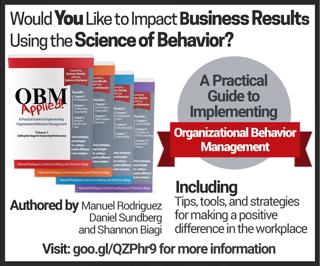
In Session 18, Manny Rodriguez, Shannon Biagi, and Dan Sundberg join me to discuss their OBM Applied! book series. In this episode we cover the following topics: Why they wrote OBM Applied! Who the i...

19 Joulu 20161h 5min
Session 17: Derek Reed on Behavioral Economics

Session 17: Derek Reed on Behavioral Economics

What does risky sex, drug use, and even indoor tanning have in common? Fortunately Dr. Derek Reed, BCBA-D, joins me in Session 17 to provide a tutorial of sorts on behavioral economics, which helps to...

8 Joulu 20161h 11min

Sesson 16: Pat Friman is Back!

Sesson 16: Pat Friman is Back!

Pat Friman returns to The Behavioral Observations Podcast in Session 16. In this episode, we talk about things that we as Behavior Analysts typically avoid, namely things like depression, anxiety, and...

23 Marras 20161h 7min

Suosittua kategoriassa Tiede

rss-mita-tulisi-tietaa
rss-poliisin-mieli
utelias-mieli
tiedekulma-podcast
docemilia
rss-duodecim-lehti
rss-luontopodi-samuel-glassar-tutkii-luonnon-ihmeita
filocast-filosofian-perusteet
rss-tervetta-skeptisyytta