
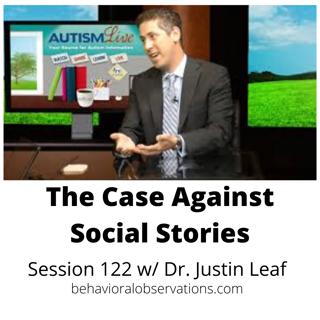
The Case Against Social Stories: Session 122 with Justin Leaf
"Does anyone have a social story for [insert challenging situation here]?" Chances are if you're like me, you've seen this question on the various ABA Facebook groups. Very often, the responses to questions like these generate some controversy, or at the very least, arguing over the empirical support for the use of Social Stories and other story-based narrative interventions. One of these types of Facebook threads popped up a month or two ago, and in response to it, I saw a post from Dr. Justin Leaf from the Autism Partnership Foundation. In it, he described his own research in this area, which casts doubt on the utility of these types of interventions. To be up front with my own biases, I've often been skeptical of Social Story based interventions as well, and thought it would be interesting to discuss this further with Justin. We recorded this podcast episode a while back at the height of the quarantine, so you'll likely hear various background noises from both of our households, though I don't think they detract from the overall sound quality. Our conversation will no doubt generate some controversy, so please feel free to add your thoughts or commentary at Facebook.com/behavioralobservations or right in the comments section of the show notes. Here are the links to the resources we discussed: Justin's appearance on ABA Inside Track. The Facebook post that started this conversation off. Leaf, et al. (2019). A Critical Review of Social Narratives. The Autism Partnership Foundation's free RBT course. Google Scholar results for the Teaching Interaction Procedure. Clinical Judgement, the book Justin co-authored with Ronald Leaf and John McEachin. This session of Behavioral Observations is brought to you by: The ABA Marketing Minute with Rich Brooks. Digital marketing guru and two-time guest Rich Brooks and I have teamed up to provide listeners with 60-second micro-lessons in digital marketing. You'll hear the first installment later in this broadcast, so I won't spoil it here, but let's just say the message should parallel a lot of what we should strive for in our clinical practice. If you're interested in marketing your practice on social media or Google, or if you want to give your website a makeover, I highly recommend working with Rich and his awesome team over at Flyte New Media. The Behavioral Observation Podcast's own Continuing Education offerings. As of this writing, there are over 20 podcasts that are available for continuing education. With discounts available for multiple event purchases and the ability to learn while driving, walking the dog, and so on, there's never been a better time to get caught up with your continuing education. And while I'm promoting the stuff on my website, I'd be remiss if I didn't mention the membership program. Think of it as a DIY Patreon… Members get access to a private FB group in which they are able to get nearly instantaneous access to the videos of these podcast interviews. For example, this interview has been available to members for two months. Members get the raw feed. That means no ads, and none of these introductory comments. You just get right to the interview. Another cool thing we do is hold Zoom Hangouts with former guests so where you can interact with them directly. For more information, check out behavioralobservations.com/membership.
25 Kesä 20201h 17min
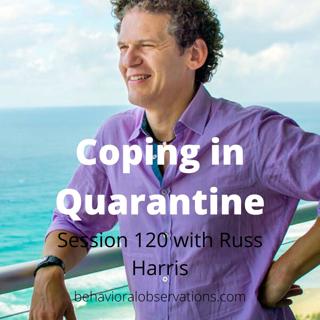
Coping in Quarantine: Session 121 with Russ Harris
Russ Harris and I recorded this episode about three or four weeks ago, when the world's troubles centered around the challenges with Covid-19 related stay-at-home measures. It's amazing how fast things have changed since then! In light of the social upheaval as people in the United States and beyond come to grips with tragic examples of racism and injustice, getting irritated by one's family members pales in comparison in terms of personal suffering. I had briefly thought to shelve this episode in light of this contrast, but the more I thought about it, I believe that the suggestions and thoughts that Russ shared on this episode will be helpful nonetheless. Please check out behavioralobservations.com for this episode's shownotes!
18 Kesä 202050min
Listening to Perspectives That Matter: Session 120
Since the killing of George Floyd, I've had colleagues approach me with suggestions on how to address the issue of police brutality and racism on Behavioral Observations. To be honest, none of the suggestions were entirely satisfying. As a white guy living in one of the whitest states in America - someone who has not had any mistreatment based on his skin color - other than condemn the actions of those police officers, sharing my thoughts on this event (as well as the broader topic of racism and police brutality) would not only ring hollow, but not be appropriate for the moment. In other words, I realized that I lacked personal perspective with this issue, and while I may have some thoughts on the matter, those thoughts are more or less academic in nature. So after wracking my brain for a few days on what I could do to leverage the BOP platform for good, I came upon the idea for this show: For Session 120, I want to take myself out of the podcast altogether, and turn it over to a panel of African American men who are also our colleagues in Behavior Analysis. The goal of the show would be for both me and the BOP audience to simply listen rather than talk. I reached out to Dr. Antonio Harrison to see if he would be interested in facilitating this discussion, and thankfully he agreed. We then recruited Shawn Capell, Pierre Louis, Larry West III, and Kirk Kirby to participate in the panel. From there, I stepped out of the rest of the production process. As of this writing, I haven't even listened to the final product yet because I want to experience this conversation as an audience member would. As such, I'm ready to learn more about the experience of African American men in our country and I hope you are too. If you find value in this episode, please share it with as many friends and colleagues as possible. I'm hoping this episode is also disseminated beyond the field of Behavior Analysis as well. Lastly, if you have the means to do so, please consider donating to the group, Black Applied Behavior Analysts, (in case you're wondering, I have and will continue to put my money where my mouth is). Thanks for listening!
3 Kesä 20201h 52min
Feedback F-Ups and How to Avoid Them: Session 119 with Natalie Parks
Providing feedback to staff members is essential for delivering quality services, but doing it effectively is easier said than done. That's why I'm excited to share this conversation I had with Dr. Natalie Parks from BehaviorLeader.com. Natalie, along with co-authors Adam Ventura, Erica Crowley, and Dennis Uriarte, just published "Feedback F!@# Ups and How to Avoid Them," and in Session 119, we really dive deep into this topic. Natalie describes some best practices for providing feedback, including how to do so in the current digital-meeting age. We also talk about how to provide feedback to the "difficult" staff member, as well as how to incorporate the feedback process in staff on-boarding procedures. If you find this topic interesting, I suggest heading over to BehaviorLeader.com and click on the Featured Products button, and order a copy for yourself. There's also a 5-Day "Fix Your Feedback" Challenge on their website as well, which sounds like a lot of fun! If you find this episode helpful and would like to get a supervision CEU for it, click here to get more info. You'll also find CEU's on many more topics there, and bulk-purchase discounts are available if you're a procrastinator like me ;-) Lastly, I'd like to mention that I've been running a membership program for the podcast for a few years now; think of it as a DIY Patreon… It costs the princely sum of $9/month. Members get access to a private FB group in which they are able to get nearly instantaneous access to the videos of these podcast interviews, often weeks or months before they are published. The best part is that members get the raw conversation itself. That means no ads, and none of the introductory comments, and sometimes, some bloopers, re-takes, and do-overs. Another cool thing we do is hold Zoom Hangouts with former guests. We do this about 6 times a year, and it works like this: we schedule a Zoom call, a former guest comes on and joins us, and the members have the opportunity to ask them questions directly. So if you'd like to learn more, head to BehavioralObservations.com/membership.
27 Touko 202057min

Cannabis, Condoms, and Psilocybin: Session 118 with Matt Johnson
You may recall that a few months back, I interviewed Dr. David Cox (@davidjcox_). In our discussion, we spent a fair amount of time talking about the literature on the use of psychedelics for the treatment of a variety of behavioral and mental health challenges. I recently got the opportunity to extend this conversation with Dr. Matthew Johnson (@Drug_Researcher). Matt Johnson is a Professor of Psychiatry and Behavioral Sciences at John Hopkins University, and he's been a leading figure in this area of research for over 15 years. His expertise in this area is so well regarded that he's been sought out by media outlets such as (takes deep breath): The New York Times, Washington Post, Wall Street Journal, Globe and Mail, Daily Mail, USA Today, Chicago Tribune, San Francisco Chronicle, Denver Post, Baltimore Sun, CNN, CBS News, NBC News, The Atlantic, Newsweek, Vanity Fair, Marie Claire, Vogue, Whole Living, The Washingtonian, Scientific American, Nature, Vice, Insider, Inverse, Healthline, Psychology Today (pause to inhale...) 60 Minutes, CNN's Wolf Blitzer Situation Room, Fox Business News' Kennedy, the Dr. Oz Show, PBS' Retro Report, Labyrint (television show in the Netherlands), Spectrum News NY1, the BBC World Service, NPR's Morning Edition, NPR's Kojo Nnamdi Show, New Zealand Radio, and Newstalk Radio Ireland... just to name a few. Matt has also been featured in a special episode of The Tim Ferriss Show on this very topic. As such, I'm a little more than humbled to chat with him on Behavioral Observations! In our chat, we did a quick overview of Delay Discounting, talked about decision making with condom usage, and the behavioral economics of cannabis. As an aside, we've done quite a few shows on Behavioral Economics. Here's a quick list of them if you want to get really up to speed: Session 17, A Behavioral Economics Primer, Derek Reed. Session 114, The Behavioral Economics of Toilet Paper, Derek Reed. The aforementioned David Cox episode. Session 11: Obesity, Food Insecurity, Behavioral Economics, and Mindful Eating, Erin Rasmussen. Session 2: Science and Pseudoscience, Steve Lawyer. Back to this show, Matt and I spent a large part of our chat discussing his groundbreaking work in the area of psychedelics. We really get into the weeds, as it were, of how these studies are done, and discuss everything from recruiting participants, the timing of these trips, how participants are supported through their experiences, bad trips, transformative experiences, hypothesized mechanisms of action, what these treatments will look like in five years, and much, much more. And before I forget, here are some links to additional readings that we referenced: MacCorquodale and Meehl (1948). Article on Hypothetical Constructs. Rasmussen and Newland (2009). Quantification of the Anti-Punishment Effect in Humans Using the Generalized Matching Equation. Hopkinspsychedelic.org, a clearing house of all the cool research that's being done at JHU. We close with a fun discussion of the concept of impulsivity. In Matt's view, as a psychological construct, the term isn't very useful, and we get into how he came to that conclusion. This episode is brought to you by: HRIC Recruiting. Barb Voss has been placing BCBAs in permanent positions throughout the US for just about a decade, and has been in the business more generally for 30 years. Like Batman, she works alone, which means that when you work with HRIC, you work directly with Barb and get highly personalized service. So if you're about to graduate, you're looking for a change of pace, or you just want to know if the grass really is greener on the other side, head over to HRIColorado.com to schedule a confidential chat right away. Behavior University. Their mission is to provide university quality professional development for the busy Behavior Analyst. Learn about their CEU offerings and podcast-specific discounts over at behavioruniversity.com/observations. Lastly, I'd like to mention something I don't bring up all that frequently. I have a membership program for the podcast; think of it as a DIY Patreon… It's been running for a few years now, and it costs the princely sum of $9/month. Members get access to a private FB group in which they are able to get nearly instantaneous access to the videos of these podcast interviews. The best part is that members get the raw feed. That means no ads, and none of the introductory comments. You just get right to the interview. Another cool thing we do is hold Zoom Hangouts with former guests. We do this about 6 times a year, and it works like this: we schedule a Zoom call, a former guest comes on and joins us, and the members have the opportunity to ask them questions directly.
18 Touko 20201h 47min
Verbal Behavior Conference 2020 Speakers' Panel: Session 117
You may recall that in Session 112 I chatted with Kelle Rich about, among other things, the upcoming Verbal Behavior Conference. In these pre-pandemic times, the event was supposed to be held in Austin, Texas. However, in anticipation of the stay-at-home orders, quarantines, and so forth, Kelle wisely shifted this event to the online space. So VBC 2020 became a virtual conference, and was executed as scheduled on April 2nd and 3rd. I had the pleasure of moderating the speakers' panel, and I thought it would be fun to share it with you here. This was indeed an august group, and featured Drs. Barbara Esch, Anna Petursdottir, Caio Miguel, Pat McGreevy, David Palmer, and Mark Sundberg. VBC 2020 VIRTUAL PANEL During the panel, we made some references to the speakers' earlier presentations. But don't worry, there's enough context in the Q and A, so I don't think you'll have a problem understanding what we're talking about. The one exception to this is that in Dr. Barbara Esch's presentation, she talked extensively about the book, Enjoy Old Age: A Practical Guide, by Skinner and Vaughn, and I asked her some questions about it, so if you hear a reference to "the book," that's what we were talking about. I should also note that due to the video conferencing software, the audio - though listenable - is far from podcast quality. I apologize in advance for that, and encourage you to give the show a listen nonetheless, as there are a lot of fun exchanges, anecdotes, and lessons from all the panelists. Lastly, I'd like to thank Kelle Rich and her team at the Central Texas Autism Center for asking me to be a part of this fun event! This podcast is brought to you with support from The Essential for Living curriculum. If you are looking for a curricular alternative for children and adults with limited repertoires, especially those without an effective, efficient method of speaking, seriously consider Essential for Living. From now until May 31, you can use the coupon code 'efl420' to receive $20 off the regular price of the Essential for Living handbook. Since we're on the subject of marketing, I also want to let you know about the Behavioral Observations Podcast Membership Program. Think of this as a DIY Patreon program where members get access to ad-free videos of podcast interviews, oftentimes weeks (months in some cases) before they're publicly released. We also hold occasional special events in which I will bring previous guests from the show into a Zoom hangout, and members can have some direct Q & A. For more information about this, click here.
11 Touko 20201h 1min

Telemedicine and ABA, an Episode That was Ahead of its Time: Session 116 with Wendy Machalicek
This episode of the Behavioral Observations Podcast is brought to you by Behavior University and GoLotus. Behavior University's mission is to provide you with university quality continuing education. If you're in quarantine like I am, take this time to brush up on your skills, or push yourself to learn something new. For great deals for podcast listeners, head over to behavioruniversity.com/observations to learn more. GoLotus recognizes that ABA providers are facing their most difficult challenges right now. So in light of recent events, Go Lotus has decided to open up its data trackers and scheduling systems for nearly 90% off to help everyone make it through these challenging times. Normally $40/seat, Go Lotus will offer these service for just $5/seat for all new customers until the crisis ends. Trust me when I say that they are not looking at the pandemic opportunistically. GoLotus was founded by a mother of a child with Autism, and she wants to make sure providers have the tools necessary to serve their clients, even in the face of economic hardships. For more information, please check out GoLotus.com and request a demo today. OK, today's episode is a re-play of a podcast session that was apparently ahead of its time. Back Session 26, I interviewed Dr. Wendy Machalicek about using telemedicine in the context of ABA service delivery. At the time, she was one of a few Behavior Analysts conducting research in this area. Once this current pandemic went into full swing, I gave the episode a re-listen and found that many of the lessons Wendy imparted are still quite relevant today, so rather than reinvent the wheel, I decided to re-publish the show. I'm happy to produce more content in this area, so if this is something you're interested in, please leave a comment in the shownotes for this episode, or on Facebook, Twitter, or LinkedIn. At the same time, I know other ABA podcasters, CEU providers, and the like have created many offerings in the realm of telemedicine, so I'm just as happy to continue pursuing other topics of interest. Long story short, let me know your thoughts either way. Lastly, I'd like to draw your attention to the recent issue of The Journal of Behavioral Education, which put out a special issue on telemedicine. Behavior Analysis and Practice has also published many articles related to service delivery in the midst of this pandemic.
29 Huhti 202053min
Inside JABA Series #3, Session 115: Accumulated versus Distributed Reinforcement with Iser DeLeon
You've more than likely heard the saying, "A bird in the hand is worth two in the bush." In the third installment of the Inside JABA Series, Dr. Iser DeLeon, along with Inside JABA regulars Drs. Tiger and St. Peter we do a deep-dive into the topic of accumulated versus distributed reinforcement arrangements to see if this adage is true in the context of skill acquisition and problem behavior. I'm excited to have Dr. DeLeon, better knowns as Willie to friends and colleagues, on the show. Willie's contributions to the field are too lengthy to list here but to summarize, he is a Professor of Psychology at The University of Florida, and he has done great work in the area of translating concepts derived from the Experimental Analysis of Behavior for use in the applied realm. I'll read you a bit from his bio: "[Willie's] work is notable for its use of concepts derived from behavioral economics, behavioral momentum, and other conceptual models as they apply to behavior analytic interventions. In addition to his impressive research and scholarly contributions, Dr. DeLeon has served on the editorial boards of a number of behavior analysis journals, including as associate editor of the Journal of Applied Behavior Analysis and editor of translational research for the Journal of the Experimental Analysis of Behavior." So as you can see, Willie, along with my other Inside JABA co-hosts, are eminently qualified to talk about this subject. In this episode we reference three different papers on distributed versus accumulated reinforcement. For the purposes of short-hand, I referred to them in the conversation as "Willie's paper," "Claire's paper," and so on. Allow me a minute to give full and proper recognition to all of the authors. The papers we discussed include the following: DeLeon, Chase, Frank-Crawford, Carreau-Webster, Triggs, Bullock, and Jennett (2014). Distributed and accumulated reinforcement arrangements: evaluations of efficacy and preference. Fulton, Tiger, Meitzen, and Effertz (2019). A comparison of accumulated and distributed reinforcement periods with children exhibiting escape-maintained problem behavior. Robinson and St-Peter (2019). Accumulated reinforcers increase academic responding and suppress problem behavior for students with Attention-Deficit Hyperactivity Disorder. During our chat, a number of other papers came up, and my colleagues on the podcast were nice enough to go back and track down those references as well. Hackenberg and Pietras (2000). Video access as a reinforcer in a self-control paradigm: A method and some data. Fienup, Ahlers, and Pace (2011). Preference for fluent versus disfluent work schedules. Frank-Crawford, Borrero, Newcomb, Chen, Schmidt (2018). Preference for and Efficacy of Accumulated and Distributed Response–Reinforcer Arrangements During Skill Acquisition. We also promised to excerpt Figure 1 from DeLeon, et al., (2014): As with previous Inside JABA Series podcasts, there are no ads during these shows, but the content is eligible for continuing education credit. Half of the proceeds from these sales go towards supporting the Society for the Experimental Analysis of Behavior. So to support what we're doing here, please go to behavioralobservations.com/get-ceus. Once there, you'll also be able to see other podcasts that are eligible for continuing ed, and discounts are available for bulk purchases. If you're interested in getting CEU's for this event and want to learn more, here is the abstract, followed by the specific learning objectives: The delivery of reinforcement in intervention programs is often delivered in small increments (e.g., 30 s) on a dense schedule (e.g., FR 1). An alternative to this distributed delivery of reinforcement is to arrange conditions in which reinforcement can accumulate following multiple target responses before then being consumed. This episode's discussion highlights three studies that compared task engagement among individuals with intellectual and developmental disabilities (DeLeon et al., 2014) including those identified with escape-maintained problem behavior (Fulton et al., 2020) and adolescents with attention deficit/hyperactivity disorder (Robinson & St. Peter, 2019) under accumulating and distributed reinforcement arrangements. Across each study, engagement was increased and problem behavior reduced during accumulated reinforcement conditions. Further, these studies each included preference assessments in which participants were provided with the opportunity to choose between accumulated and distributed reinforcement arrangements. There was some variability across participants, but many individuals preferred to engage in extended work periods for the opportunity to accumulate reinforcement prior to consumption. Learning Objectives: Describe the difference between distributed and accumulated reinforcement arrangements. Describe why reinforcement efficacy may be increased through accumulation of reinforcers? Describe why a preference for accumulated reinforcement may be counterintuitive. OK, if that doesn't get you excited to learn, I'm not sure what will, so go head, and click here to pick up that CE!
8 Huhti 20201h 19min