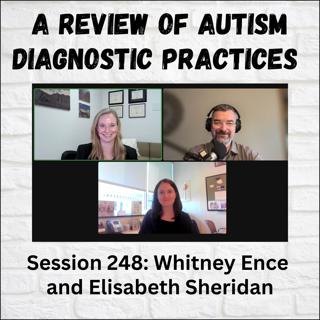
A Review of Autism Diagnostic Practices: Session 248: Whitney Ence and Elisabeth Sheridan

A Review of Autism Diagnostic Practices: Session 248: Whitney Ence and Elisabeth Sheridan

Drs. Whitney Ence and Elisabeth Sheridan joined me to talk about the diagnosis of Autism. You might be thinking that this sounds like an impossibly broad topic... and you're right.

But in this show, we tried to narrow it down a bit to discuss the various routes in which people can acquire an Autism diagnosis, which of these routes represent best practice, the critical diagnostic features of Autism, severity levels in Autism (and the extent to which these terms are useful), the role of intense interests, specific assessment instruments and techniques, and the importance of working with interdisciplinary teams.

We also talk about how the diagnosis has changed over the years, including the retirement of terms such as Pervasive Developmental Disorder and Asperger's Syndrome. During this part of the conversation, we also discussed self-diagnosis of Autism, and how clinics sometimes triage screening for individuals seeking diagnoses.

Towards the end of the podcast, we did touch on a few terms and topics that are relatively new to the Autism discourse.

Specifically, we discussed the term Neurodiversity, the social model of disability, "Severe Autism" as a separate diagnosis, and Pathological Demand Avoidance. It's important to note that his part of the podcast should not be construed as a deep exploration of these topics, as I really wanted to initially focus on what the current state of the science has to say about the diagnosis of Autism as a condition requiring medically-necessary treatment.

I also want to draw your attention to what could be considered a companion podcast about the diagnostic characteristics of Autism. I'm in the middle of listening to a long episode from the Huberman Lab Podcast, in which Dr. Andrew Huberman interviews Dr. Karen Parker from Stanford University about the causes of, and treatments for Autism. This is from a more neuro-biological perspective, and thus far, quite interesting.

Here are links to the topics we discussed:

If you'd like to support the show or its sponsors, check out the following:

  • To receive Behavioral Observations episodes ad and commentary-free, that is, just the interviews themselves, consider supporting the show with a Patreon subscription.
  • Consider Behavioral Observations as a source for your continuing education. I have almost 50 events that span a variety of topics, all from your favorite podcast guests. So if you want catch up on your professional development while walking the dog, commuting to work, making dinner, or whatever else you do while listening to podcasts, go to behavioralobservations.com/get-ceus to learn more.
  • The Verbal Behavior Conference is right around the corner. If you haven't heard me talk about it before, the VBC is a 2 day event that is available both virtually and in-person in Austin, Texas. It's happening on February 29th and 30th, and will feature speakers like Drs. Pat McGreevy, Alice Shillingsburg, Barbara Esch, and more. There's even a full-day pre conference workshop by Dr. Lina Slim. This is a really fun event that provides many opportunities for individual interactions with the speakers, and there's even a panel discussion moderated by yours truly. To learn more, go to behaviorlive.com/vbc, or simply hit the shownotes for this episode to learn more.
  • The University of Cincinnati Online. UC Online designed a Master of Education in Behavior Analysis program that is 100% online and asynchronous, meaning you log on when it works for you. Want to learn more? Go to online.uc.edu and click the "request info" button.

Jaksot(326)

22: Dr. Linda LeBlanc discusses OBM, Behavioral Gerontology, and More!

22: Dr. Linda LeBlanc discusses OBM, Behavioral Gerontology, and More!

Dr. Linda LeBlanc joins me today to provide a primer of sorts on behavioral approaches to supporting the elderly, using solid behavioral principles to run organizations, and embedding ethics into ever...

17 Maalis 20171h 18min
21: Gina Green on APBA and Licensure

21: Gina Green on APBA and Licensure

I am honored to be joined by Dr. Gina Green in Session 21 of The Behavioral Observations Podcast. In this show we talk about some current events in the practice of ABA, including the role of professio...

9 Helmi 20171h 43min
20: Greg Hanley Answers YOUR Questions!

20: Greg Hanley Answers YOUR Questions!

In Session 20, Greg Hanley returns to The Behavioral Observations Podcast for an unprecedented third time! The first two podcast episodes with Greg (Session 1 and Session 7) were so popular that they ...

12 Tammi 20171h 35min

Beyond Bourbon St, or Fun Reasons to Attend APBA!

Beyond Bourbon St, or Fun Reasons to Attend APBA!

Several weeks ago Dr. Gina Green posted an impassioned request to support the Association for Professional Behavior Analysts on Facebook, noting, among other things, that the organization is uniquely ...

28 Joulu 20161h 7min
18: The authors of OBM Applied!

18: The authors of OBM Applied!

In Session 18, Manny Rodriguez, Shannon Biagi, and Dan Sundberg join me to discuss their OBM Applied! book series. In this episode we cover the following topics: Why they wrote OBM Applied! Who the i...

19 Joulu 20161h 5min
Session 17: Derek Reed on Behavioral Economics

Session 17: Derek Reed on Behavioral Economics

What does risky sex, drug use, and even indoor tanning have in common? Fortunately Dr. Derek Reed, BCBA-D, joins me in Session 17 to provide a tutorial of sorts on behavioral economics, which helps to...

8 Joulu 20161h 11min
Sesson 16: Pat Friman is Back!

Sesson 16: Pat Friman is Back!

Pat Friman returns to The Behavioral Observations Podcast in Session 16. In this episode, we talk about things that we as Behavior Analysts typically avoid, namely things like depression, anxiety, and...

23 Marras 20161h 7min

Session 15: Rich Brooks on Website and Marketing Strategies

Session 15: Rich Brooks on Website and Marketing Strategies

Rich Brooks has the distinctive honor of being the first non-Behavior Analyst to come on the show. Don't let that temper your enthusiasm for this episode though. In Session 15, Rich and I talk about t...

18 Marras 201649min

Suosittua kategoriassa Tiede

rss-mita-tulisi-tietaa
tiedekulma-podcast
rss-poliisin-mieli
docemilia
rss-duodecim-lehti
utelias-mieli
radio-antro
filocast-filosofian-perusteet
rss-laakaripodi
rss-lihavuudesta-podcast
rss-sosiopodi
ihanat-ipanat
sotataidon-ytimessa
mielipaivakirja
rss-radplus
rss-opeklubi