Shostakovich Symphony No. 8

Shostakovich Symphony No. 8

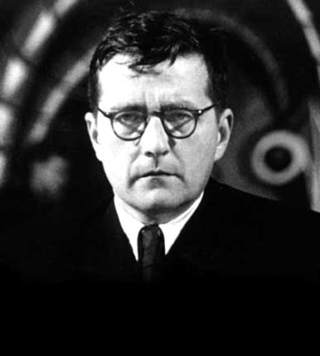
Here are two statements by Dmitri Shostakovich about the same piece, the 8th symphony that we are talking about today:

Statement No. 1, Shostakovich's published comments about the symphony when it was first performed in 1943: The 8th Symphony reflects my…elevated creative mood, influenced by the joyful news of the Red Army's victories….
"The Eighth Symphony contains tragic and dramatic inner conflicts. But on the whole it is optimistic and life-asserting. The first movement is a long adagio, with a dramatically tense climax. The second movement is a march, with scherzo elements, and the third is a dynamic march. The fourth movement, in spite of its march form, is sad in mood. The fifth and final movement is bright and gay, like a pastoral, with dance elements and folk motifs.
"The philosophical conception of my new work can be summed up in these words: life is beautiful. All that is dark and evil rots away, and beauty triumphs."

Statement No. 2, from the disputed book Testimony, published in the 1970s: 'And then the war came and the sorrow became a common one. We could talk about it, we could cry openly, cry for our lost ones. People stopped fearing tears. Before the war there probably wasn't a single family who hadn't lost someone, a father, a brother, or if not a relative, then a close friend. Everyone had someone to cry over, but you had to cry silently, under the blanket, so no one would see. Everyone feared everyone else, and the sorrow oppressed and suffocated us. It suffocated me too. I had to write about it. I had to write a Requiem for all those who died, who had suffered. I had to describe the horrible extermination machine and express protest against it. The Seventh and Eighth Symphonies are my Requiems.

I don't know of a more profound example of Shostakovich's doublespeak, or of his ability to make diametrically opposing statements about the meaning behind his music. Shostakovich's 8th symphony premiered at the height of World War II, and it was not a hit, unlike his 7th symphony which had swept the world with its seeming patriotic fervor and its devastating condemnation of the Nazis. Shostakovich's 8th is a very different piece, darker, edgier, less catchy, less simple, and certainly less optimistic. It was panned in the Soviet Union by the official critics and was effectively banned from performance in teh Soviet Union from 1948 until the late 1950s. It was also not particularly popular outside of the Soviet Union, as the 7th's popularity and accessibility dwarfed the 8th, though this equation has now flipped, with the 8th symphony now probably becoming slightly more often played than the 7th. As always with Shostakovich, he mixes tradition with his own Shostakovich-ian innovations. The symphony has a Sonata Form first movement, but that movement is longer than the following three movements combined. It has a darkness to light theme from C Minor to C Major, like in Beethoven's 5th and Mahler's 2nd, but whether the ending is optimistic is subject to furious debate. It has not 1 but 2 scherzos, but they are among the least funny scherzos ever written, and it has a slow movement that is surprisingly un-emotional. The requiem Shostakovich speaks of seems to happen slowly over the course of this 1 hour symphony. It is perhaps Shostakovich's most ambiguous mature symphony, and it is also thought of as one of his greatest masterpieces. Today on this Patreon Sponsored episode, we'll dive into this remarkable work, trying to create a framework to understand this huge and demanding symphony. Join us!

Tämä jakso on lisätty Podme-palveluun avoimen RSS-syötteen kautta eikä se ole Podmen omaa tuotantoa. Siksi jakso saattaa sisältää mainontaa.

Jaksot(291)

Arthur Honneger, Symphony No. 3, "Liturgique"

Arthur Honneger, Symphony No. 3, "Liturgique"

In the aftermath of World War II, the Swiss composer Arthur Honegger, who had been living in occupied Paris throughout the war, wrote a new symphony entitled "Liturgical." He wrote an extended comment...

25 Kesä 53min
Dvorak Piano Quintet, Op. 81

Dvorak Piano Quintet, Op. 81

In 1872, at the age of 31, Dvořák wrote a Piano Quintet designated as Opus 5. Dvořák was not a prodigy like some other famous composers; instead, his development as a composer was slow and steady. Lat...

11 Kesä 49min
Mozart String Quartet, K. 465, "Dissonance"

Mozart String Quartet, K. 465, "Dissonance"

You might be wondering: why on earth would I choose a piece that is literally called "Dissonance" when I was looking for something a bit simpler or cleaner to talk about on the show today? Actually, M...

28 Touko 49min

Bonus Episode: Beethoven 5 en français!

Bonus Episode: Beethoven 5 en français!

Bienvenue dans cette édition spéciale du podcast Sticky Notes en français ! Aujourd'hui, nous parlons de la symphonie la plus célèbre du monde, et de la symphonie que nous allons interpréter à Lille l...

15 Touko 42min

Liszt Faust Symphony

Liszt Faust Symphony

Thank you to Jerry for sponsoring today's episode on Patreon! Goethe's Faust is considered to be the greatest work of German literature. This sprawling, 2-part play occupied Goethe's life for nearly 6...

14 Touko 1h 3min

Schubert: Die Schöne Mullerin Mini-Episode No. 1 (Free Preview)

Schubert: Die Schöne Mullerin Mini-Episode No. 1 (Free Preview)

This is a free preview of my new series of mini-episodes over on Patreon all about Schubert's Die Schöne Mullerin, one of the great masterpieces of the 19th century. Each week we'll explore one song f...

8 Touko 6min

Wagner: Prelude and Liebestod from Tristan and Isolde w/Case Scaglione

Wagner: Prelude and Liebestod from Tristan and Isolde w/Case Scaglione

This is a continuation of my new series where I learn about a new piece from a great friend/musician. This week I'm thrilled to welcome Case Scaglione, the Music Director of the Orchestre National D'I...

1 Touko 50min

Lili Boulanger: Psalm 130

Lili Boulanger: Psalm 130

The story of Lili Boulanger's life is one of the most fascinating and tragic in all of musical history. A remarkably precocious talent, Boulanger learned to read sheet music before the alphabet, playe...

16 Huhti 46min

Suosittua kategoriassa Viihde

tuplakaak
anni-jaajo
seitseman
grekovit
hei-baby-3
ellen-jari-tamakin-viela
trippileiri
antin-palautepalvelu
hupiklubi
terveisia-perheesta
dear-shirly
bella-table
the-harlin-show
antin-elokuvakerho
everypodi
nonsensepodi
dear-shirly-ja-arttu
verhon-takaa
tahtitehdas
get-jassud