TSE 1156: Why The Winners-Never-Quit Fallacy Is Preventing Your Success

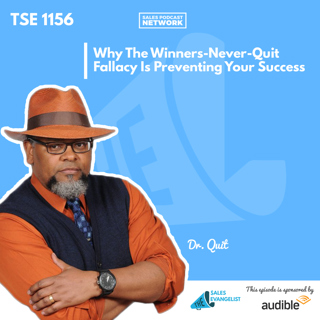
TSE 1156: Why The Winners-Never-Quit Fallacy Is Preventing Your Success

Some people believe that quitting is bad, but Dr. Stanley Robertson believes that the winners-never-quit fallacy is preventing your success.

Dr. Stan — CFO for a non-profit in Chicago — takes issue with the idea that quitting is always bad and he wants to share ideas about how to become a successful quitter.

Quitting

Quitting is simply giving up on something. You can quit going to the gym or quit a bad relationship or quit eating certain foods. You can quit just about anything.

It’s easy to see from these examples that quitting isn’t always bad, but he takes it a step further. He believes that the winners-never-quit fallacy prevents people, and sellers, from finding success.

Sometimes we have to quit things, and sometimes it’s even desirable to quit things. In fact, we should be quitting things all the time.

Dr. Stan got the idea from his son, who is a Marine Corps officer. As he approached the end of his tour of duty, he called his dad one day to say he was considering quitting. He wasn’t sure he wanted to continue being a Marine Corps officer.

Dr. Stan’s advice at the time was to keep going. He pointed to the benefits, the prestige, and the opportunities it would provide. His son, who was 23 at the time, would be able to retire at 43. These were the things he thought were good. Eventually, he rethought his response, and he told his son that he should quit if that’s what he really wanted.

Quit shaming

Based upon that experience, he came up with the concept of “quit shaming,” or embarrassing people because they quit things. We tend to look down on people who divorce from a bad marriage, or who quit a job that isn’t working out, or who quit an investment. We sometimes even hide the fact that we quit because we fear the pushback.

When Dr. Stan was young, a guy offered to sell him a VHS — which was new technology at the time — for $200, where it typically sold for $600. Stan bought the VHS only to find that the box was full of bricks rather than a VHS. He was devastated to lose all his money.

In order to replace the income, Stan stole things. He eventually went into the Marine Corps himself, where his petit theft ended in a court-martial, with Stan losing his stripes. He knew he had to quit making those same choices. In the end, he gave up stealing and earned his law degree.

Every human being goes through a growth process that demands that they give up things along the way. In fact, seasons of life sometimes lead us to quit things. Take, for example, Arnold Swarzenegger, who gave up body-building for acting, and then gave up acting for politics.

Our life cycle often causes us to give up things, but some people can’t disengage from the things they are doing because they are emotionally tied to them.

Course correction

The point isn’t to quit altogether because something isn’t working out. Instead, make a course correction. Do the next right thing.

In order to be successful in life, you have to create new things and new goals to replace the things you gave up.

The biggest challenge for people who need to disengage from things is emotional trauma. If you’re going to quit, acknowledge the negative emotions. Recognize that some people will try to embarrass you, so you must develop a plan forward. The negativity will be less impactful if you have a new plan in place.

We have a problem disengaging from things. Researchers conducted a study called the Jigsaw Puzzle Study in which they studied two groups who were tasked with completing a jigsaw puzzle. One group completed the puzzle, while the group was intentionally interrupted. Researchers discovered that the group who completed the puzzle was happy, while the other group spent twice as much time thinking about the puzzle.

The human brain is hard-wired for completion. When we give up something, our brains are hard-wired to complete that circle.

Times you shouldn’t quit

  1. Don’t quit because things are hard. If you struggle to sell your product, don’t quit. Continue working, and push through those struggles to become a better seller.
  2. Don’t quit because you haven’t succeeded yet. The get-rich-quick concept isn’t realistic, and your success could happen next month.
  3. Don’t quit because you covet your neighbor’s success. Never compare yourself to someone else’s performance. It’s ok to gain inspiration from your neighbor, but don’t quit because of it.

How to quit

Interestingly, most people don’t struggle to continue on a given path because that concept has been drilled into our psyche. Ninety-nine out of 100 people will advise you to keep going. Dr. Stan’s work focuses on those people who want or need to give up something but they struggle to disengage. He teaches them how to make that break.

One of his clients struggled with her weight and her husband belittled her for it. She didn’t want to give up the relationship, partly because they had a business together. She feared that people would question her decision to quit, but eventually, she got a divorce. Once she gave up the business and the marriage, she lost all the weight and her confidence soared.

Abandon a deal

For sellers, this could appear as a deal that you’ve invested so much time in that you’re hesitant to walk away. Even when your gut tells you that it will never close, you continue investing your time and resources into it because you’re emotionally tied to it.

The truth is that failure to let go of the wrong deal can cause you to miss a better opportunity that can succeed. Sometimes buyers aren’t going to buy, and it’s ok to walk away from those deals. #WrongDeal

The sunk-cost fallacy refers to the tendency to make decisions based upon what happened in the past rather than making decisions based upon the outcoming you’re hoping for. The fact that a deal didn’t work out in the past has no bearing on what might happen in the future. We often make decisions because we’ve spent so much money on something.

Ringling Brothers had been in business for 146 years making all kinds of money, but last year they went out of business. They had been sued by animal rights activists and the company wouldn’t give up the use of animals. The company was emotionally invested in the use of animals, despite the fact that other groups like Cirque Du Soleil hold wildly successful circuses with no animals.

Blockbuster should have quit using VHS and moved to DVD or streaming. The company should have engaged in new technology, but they had invested so much in their inventory that they couldn’t disengage.

You should not be prevented from giving up things for fear of other people’s opinions. Don’t let anyone else stop you from changing course. Always make the decision for yourself. Do not fail to disengage because of what others might say about you.

“Winners never quit fallacy” episode resources

Check out Dr. Stan’s book, Quit: The Last Principle of Success at www.thequitdoctor.com.

Connect with me at donald@thesalesevangelist.com.

If you’re a sales rep looking to hone your craft and learn from the top 1% of sellers, make plans to attend the Sales Success Summit in Austin, Tx, October 14-15. Scheduled on a Monday and Tuesday to limit the impact to the sales week, the Sales Success Summit connects sellers with top-level performers who have appeared on the podcast. Visit Top1Summit.com to learn more and register!

You can also connect with me at donald@thesalesevangelist.com or try our first module of TSE Certified Sales Training Program for free. This episode has been made possible with the help of TSE Certified Sales Training Program, a training course designed to help sellers in improving their performance. We want you guys to go out each and every single day to find more ideal customers and do big things.

I hope you like and learned many things from this episode. If you did, please review us and give us a five-star rating on Apple podcast or in any platform you’re using - Google Podcast, Stitcher, and Spotify. You can also share this with your friends and colleagues.

Audio provided by Free SFX and Bensound.

Mentioned in this episode:

HubSpot and bluëmago | STUDIOS

HubSpot and bluëmago | STUDIOS hubpspot.com/marketers bluemangostudios.com

Tämä jakso on lisätty Podme-palveluun avoimen RSS-syötteen kautta eikä se ole Podmen omaa tuotantoa. Siksi jakso saattaa sisältää mainontaa.

Jaksot(2000)

Practical Ways Sales and Marketing Can Work to Increase Revenue in 2026 | Mark Kapczynski - 2023

Practical Ways Sales and Marketing Can Work to Increase Revenue in 2026 | Mark Kapczynski - 2023

Sales and marketing are supposed to work together, but in most companies, they don't. Not to the level your revenue actually needs. In this episode, I sat down with Mark Kapczynski, co-founder of Kont...

27 Heinä 28min
LinkedIn Response Series - Messages That Generate Responses | Donald C. Kelly - 2022

LinkedIn Response Series - Messages That Generate Responses | Donald C. Kelly - 2022

This wraps up our four part LinkedIn Response Series. Over the last few episodes, I covered your headline, your banner, and how to turn profile views into real conversations. In this final episode, I'...

24 Heinä 16min
LinkedIn Response Series - LinkedIn Connection Requests | Donald C. Kelly - 2021

LinkedIn Response Series - LinkedIn Connection Requests | Donald C. Kelly - 2021

show notes

20 Heinä 16min
LinkedIn Response Series - LinkedIn Profile Views To Appointments | Donald C. Kelly - 2020

LinkedIn Response Series - LinkedIn Profile Views To Appointments | Donald C. Kelly - 2020

Getting a notification that someone viewed your LinkedIn profile can be exciting, but most sellers don't know what to do next. In this episode of the LinkedIn Response Series, I am sharing how to turn...

17 Heinä 16min

LinkedIn Response Series - Your LinkedIn Headline | Donald C. Kelly - 2019

LinkedIn Response Series - Your LinkedIn Headline | Donald C. Kelly - 2019

Your LinkedIn headline is one of the first things prospects see, yet many salespeople waste it by listing their job title and company name. In this first episode of the LinkedIn Response Series, I exp...

13 Heinä 25min
How to Ensure That Admin Tasks Don't Overwhelm Your Day | Anthony Iannarino - 2018

How to Ensure That Admin Tasks Don't Overwhelm Your Day | Anthony Iannarino - 2018

Administrative tasks are part of every sales role, but they should never take priority over selling. I'm revisiting a conversation from the archive with Anthony Iannarino to share practical ways to ke...

10 Heinä 33min

Bad Mouthing Your Competitor | Donald C. Kelly - 2017

Bad Mouthing Your Competitor | Donald C. Kelly - 2017

How do you handle competitor questions without sounding defensive, desperate, or unprofessional?In this solo episode, Donald C. Kelly shares three practical strategies for talking about competitors wi...

6 Heinä 14min

7 Steps to Making 7 Figures in Enterprise SaaS Sales | Brandon Fluharty - 2016

7 Steps to Making 7 Figures in Enterprise SaaS Sales | Brandon Fluharty - 2016

What separates sales professionals who earn six figures from those who consistently earn seven?In this episode, Donald sits down with Brandon Fluharty, enterprise SaaS sales leader, speaker, and autho...

3 Heinä 42min

Suosittua kategoriassa Liike-elämä ja talous

sijotuskasti
psykopodiaa-podcast
mimmit-sijoittaa
ostan-asuntoja-podcast
oppimisen-psykologia
rss-oivalluksia-rahasta-elamasta
rss-hilden-kaira-podcast
rss-rahapodi
hyva-paha-johtaminen
rahapuhetta
rss-10x-finland
rss-karon-grilli
rss-sami-miettinen-neuvottelija
rss-paasipodi
rss-rahamania
pomojen-suusta
rss-rikasta-elamaa
rss-ysin-muijat
syo-nuku-saasta
rss-inderes