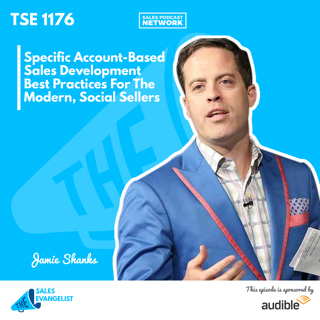

TSE 1176: Specific Account-Based Sales Development Best Practices For The Modern, Social Sellers

TSE 1176: Specific Account-Based Sales Development Best Practices For The Modern, Social Sellers

From account selection to sales plays, Jamie Shanks helps sales professionals understand and adopt best practices for the modern, social sellers.

Jamie is the CEO of Sales For Life, which is the de-facto standard in modernizing account-based sales motion. The company specializes in social or digital selling. It evaluates how you sell today and infuses modern digital sales activities into your process.

Account-based selling

Account-based selling refers to focusing on a set number of accounts, whether it’s organized by territory or strategic value. Instead of relying on inbound leads or channel leads, you must go outbound.

Jamie named his book Spear Selling based on a sales analogy of fishing: inbound efforts are a little like fishing with a net because you can’t choose the fish that land in your net. When you fish with a spear, you swim in the deep water and choose the whales you’re going to hunt.

Typically, companies focus on account-based motion because they need to increase their average annual contract value (ACV) or lifetime value (LTV).

Adopting an account-based approach

Companies often get the very first step wrong, which is account selection. Many companies use what Jamie calls wallet-share based thinking. When he was working with a company in the health and wellness space, an account exec pointed to Peloton as a company he was focused on connecting with. When questioned, the AE mentioned that one of the company leaders was a bike enthusiast who thought it might be a good fit.

The truth is that the health company has no more strategic connection to Peloton than its competitors do. In fact, if they went through the data of relationships, they might discover that the competitors have greater social proximity to the account. That means you may devote 8 months trying to win this account to find that there’s a hurdle you didn’t account for.

Getting the account selection process right is half the equation.

Companies that ask their sales professionals to build a list of accounts will likely find that they stack ranked companies based on revenue, number of employees, and market share potential. They didn’t think about the fact that people buy from people and relationships matter.

Sales is a game of relationships. If you could reverse-engineer your existing advocates and customers and identify which accounts have the highest social proximity, you’ll have an advantage that your competitors can’t take from you.

Account-based models

A centralized model looks at the equation and asks how certain sales resources like inside sales, BDRs, SDRs, and LDRs can mine the total addressable market. It maps green-flag accounts based on relationships, opportunities, and strengths. They could be referrals, partners to your existing customers, or others you’re connected to. Red-flag accounts are those where your competitors have relationships, strengths, and opportunities.

The decentralized model seeks to identify those accounts that a company already has connections to. The idea is that the company can activate those accounts faster than the competitors can.

Companies might go with the centralized model because it uses the $20-an-hour inside sellers to do the work instead of the more-expensive AEs. They might choose the decentralized model because they want everyone in the field to be able to unearth the total addressable market of their area. Each person is the CEO of his own territory.

Account selection is a skill that everyone needs to master.

Modern digital sellers

The modern digital seller selects accounts based on relationships or social proximity and then plans those accounts using four pillars.

  • Triggers
  • Referrals
  • Insights
  • Competitive Intelligence

These sellers build a war room or a simple one-page document that outlines the compelling stories that they can share with their audiences. When they target the accounts, they’ll use digital technology like video or LinkedIn to share insights and monitor buying engagement.

Use account segmentation to think about how much time you’ll spend on every account. Apply Pareto’s Law realizing that you’ll spend 80 percent of your time on 20 percent of your accounts which will yield 80 percent of your return. You won’t spend the same amount of time on every account.

These sales concepts have existed forever, but you’ll accelerate your momentum because digital technology allows you to identify who cares, who you should focus on, and how you can move the deal through the cycle more quickly.

Digital sales

Social selling includes elements like LinkedIn and Twitter and Facebook, but those aren’t the only elements. Modern digital sellers use any available technology to aid in the sales process.

Companies that engage in digital account-based selling might go through the following steps:

  1. Map the total addressable market.
  2. Map the accounts that exist within each vertical.
  3. Which accounts do we not have but have open opportunities?
  4. Which accounts have we never spoken to?
  5. Of those companies we’ve never spoken to, where do we have a competitive advantage like a trigger or a referral?

If they use tools like LinkedIn to map the social networks of their customer base, they can determine whether anyone knows someone at those companies. Together with marketing, the account executives can storyboard to create a series of sales plays, which might include social media or digital tools.

They can use LinkedIn to communicate with key executives and invite them to an event because they know that conversion is twice as high with physical meetings as with virtual ones. They are using digital tools to bring customers into the analog world.

Sales play

Sales plays are no different than football plays. The play seeks to achieve a certain result. The seller needs a first-down. Digital sellers might use video, emails, phone calls and other tools to tell the story of them versus their competitors.

Your goal at an account is to activate the account. The activation cycle is the number of plays that you’ll run against that account. In that time, you’ll either qualify them or replace them. You cannot call into this account forever.

The best account-based teams have a defined activation cycle. Let’s assume it’s 90 days. If you don’t activate within 90 days, you’ll replace it with an account that has a great relationship opportunity.

Sales plays exist inside that cycle. You might have three to eight different stories you tell along that 90-day journey. Those sales plays or touchpoints are organized as cadences and sequences.

If you want to win the biggest and best accounts in the world, most companies aren’t coming inbound. You have to tell compelling stories to push them off their status quo.

Build a series

Once you’ve identified your targets, you must build a series of plays and stories that make the person actually care.

  • What are three to eight different things they want to know about?
  • Do they want to know about market trends?
  • Do they want to see a real-life video of a customer experience?
  • Will they want to know where they stand compared to their competitors?

What does the future hold for your customer? Think about the customer and develop a series of stories before you start hammering away at the phone. #StorySelling

Get started using all of the available tools. Jamie calls LinkedIn Sales Navigator one of his favorite. There are 500 million people on that platform. He calls it the world's largest party.

“TSE 1176: Specific Account-Based Sales Development Best Practices For The Modern, Social Sellers” episode resources

Grab a copy of Jamie’s book, Spear Selling.

If you’re a sales rep looking to hone your craft and learn from the top 1% of sellers, make plans to attend the Sales Success Summit in Austin, Tx, October 14-15. Scheduled on a Monday and Tuesday to limit the impact to the sales week, the Sales Success Summit connects sellers with top-level performers who have appeared on the podcast. Visit Top1Summit.com to learn more and register!

You can also connect with me at donald@thesalesevangelist.com or try our first module of TSE Certified Sales Training Program for free. This episode has been made possible with the help of

Tämä jakso on lisätty Podme-palveluun avoimen RSS-syötteen kautta eikä se ole Podmen omaa tuotantoa. Siksi jakso saattaa sisältää mainontaa.

Jaksot(2000)

Practical Ways Sales and Marketing Can Work to Increase Revenue in 2026 | Mark Kapczynski - 2023

Practical Ways Sales and Marketing Can Work to Increase Revenue in 2026 | Mark Kapczynski - 2023

Sales and marketing are supposed to work together, but in most companies, they don't. Not to the level your revenue actually needs. In this episode, I sat down with Mark Kapczynski, co-founder of Kont...

27 Heinä 28min
LinkedIn Response Series - Messages That Generate Responses | Donald C. Kelly - 2022

LinkedIn Response Series - Messages That Generate Responses | Donald C. Kelly - 2022

This wraps up our four part LinkedIn Response Series. Over the last few episodes, I covered your headline, your banner, and how to turn profile views into real conversations. In this final episode, I'...

24 Heinä 16min

LinkedIn Response Series - LinkedIn Connection Requests | Donald C. Kelly - 2021

LinkedIn Response Series - LinkedIn Connection Requests | Donald C. Kelly - 2021

show notes

20 Heinä 16min

LinkedIn Response Series - LinkedIn Profile Views To Appointments | Donald C. Kelly - 2020

LinkedIn Response Series - LinkedIn Profile Views To Appointments | Donald C. Kelly - 2020

Getting a notification that someone viewed your LinkedIn profile can be exciting, but most sellers don't know what to do next. In this episode of the LinkedIn Response Series, I am sharing how to turn...

17 Heinä 16min

LinkedIn Response Series - Your LinkedIn Headline | Donald C. Kelly - 2019

LinkedIn Response Series - Your LinkedIn Headline | Donald C. Kelly - 2019

Your LinkedIn headline is one of the first things prospects see, yet many salespeople waste it by listing their job title and company name. In this first episode of the LinkedIn Response Series, I exp...

13 Heinä 25min
How to Ensure That Admin Tasks Don't Overwhelm Your Day | Anthony Iannarino - 2018

How to Ensure That Admin Tasks Don't Overwhelm Your Day | Anthony Iannarino - 2018

Administrative tasks are part of every sales role, but they should never take priority over selling. I'm revisiting a conversation from the archive with Anthony Iannarino to share practical ways to ke...

10 Heinä 33min

Bad Mouthing Your Competitor | Donald C. Kelly - 2017

Bad Mouthing Your Competitor | Donald C. Kelly - 2017

How do you handle competitor questions without sounding defensive, desperate, or unprofessional?In this solo episode, Donald C. Kelly shares three practical strategies for talking about competitors wi...

6 Heinä 14min
7 Steps to Making 7 Figures in Enterprise SaaS Sales | Brandon Fluharty - 2016

7 Steps to Making 7 Figures in Enterprise SaaS Sales | Brandon Fluharty - 2016

What separates sales professionals who earn six figures from those who consistently earn seven?In this episode, Donald sits down with Brandon Fluharty, enterprise SaaS sales leader, speaker, and autho...

3 Heinä 42min

Suosittua kategoriassa Liike-elämä ja talous

sijotuskasti
psykopodiaa-podcast
mimmit-sijoittaa
ostan-asuntoja-podcast
oppimisen-psykologia
rss-oivalluksia-rahasta-elamasta
rss-hilden-kaira-podcast
rahapuhetta
rss-rahapodi
hyva-paha-johtaminen
rss-inderes
rss-10x-finland
rss-karon-grilli
raharesepti
rss-perho-rajoilla
rss-rahamania
rss-rikasta-elamaa
rss-paikoillenne-valmiit-laakikseen
rss-sami-miettinen-neuvottelija
syo-nuku-saasta