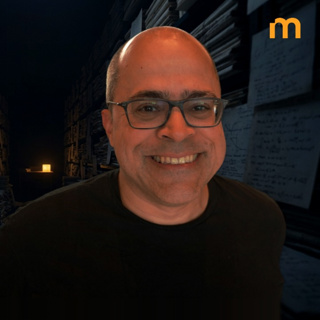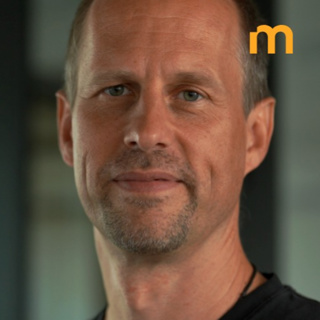

Autopoitic Enactivism and the Free Energy Principle - Prof. Friston, Prof Buckley, Dr. Ramstead

Autopoitic Enactivism and the Free Energy Principle - Prof. Friston, Prof Buckley, Dr. Ramstead

We explore connections between FEP and enactivism, including tensions raised in a paper critiquing FEP from an enactivist perspective.


Dr. Maxwell Ramstead provides background on enactivism emerging from autopoiesis, with a focus on embodied cognition and rejecting information processing/computational views of mind.


Chris shares his journey from robotics into FEP, starting as a skeptic but becoming convinced it's the right framework. He notes there are both "high road" and "low road" versions, ranging from embodied to more radically anti-representational stances. He doesn't see a definitive fork between dynamical systems and information theory as the source of conflict. Rather, the notion of operational closure in enactivism seems to be the main sticking point.


The group explores definitional issues around structure/organization, boundaries, and operational closure. Maxwell argues the generative model in FEP captures organizational dependencies akin to operational closure. The Markov blanket formalism models structural interfaces.


We discuss the concept of goals in cognitive systems - Chris advocates an intentional stance perspective - using notions of goals/intentions if they help explain system dynamics. Goals emerge from beliefs about dynamical trajectories. Prof Friston provides an elegant explanation of how goal-directed behavior naturally falls out of the FEP mathematics in a particular "goldilocks" regime of system scale/dynamics. The conversation explores the idea that many systems simply act "as if" they have goals or models, without necessarily possessing explicit representations. This helps resolve tensions between enactivist and computational perspectives.


Throughout the dialogue, Maxwell presses philosophical points about the FEP abolishing what he perceives as false dichotomies in cognitive science such as internalism/externalism. He is critical of enactivists' commitment to bright line divides between subject areas.


Prof. Karl Friston - Inventor of the free energy principle https://scholar.google.com/citations?user=q_4u0aoAAAAJ

Prof. Chris Buckley - Professor of Neural Computation at Sussex University https://scholar.google.co.uk/citations?user=nWuZ0XcAAAAJ&hl=en

Dr. Maxwell Ramstead - Director of Research at VERSES https://scholar.google.ca/citations?user=ILpGOMkAAAAJ&hl=fr


We address critique in this paper:

Laying down a forking path: Tensions between enaction and the free energy principle (Ezequiel A. Di Paolo, Evan Thompson, Randall D. Beere)

https://philosophymindscience.org/index.php/phimisci/article/download/9187/8975


Other refs:

Multiscale integration: beyond internalism and externalism (Maxwell J D Ramstead)

https://pubmed.ncbi.nlm.nih.gov/33627890/


MLST panel: Dr. Tim Scarfe and Dr. Keith Duggar


TOC (auto generated): 0:00 - Introduction 0:41 - Defining enactivism and its variants 6:58 - The source of the conflict between dynamical systems and information theory 8:56 - Operational closure in enactivism 10:03 - Goals and intentions 12:35 - The link between dynamical systems and information theory 15:02 - Path integrals and non-equilibrium dynamics 18:38 - Operational closure defined 21:52 - Structure vs. organization in enactivism 24:24 - Markov blankets as interfaces 28:48 - Operational closure in FEP 30:28 - Structure and organization again 31:08 - Dynamics vs. information theory 33:55 - Goals and intentions emerge in the FEP mathematics 36:58 - The Good Regulator Theorem 49:30 - enactivism and its relation to ecological psychology 52:00 - Goals, intentions and beliefs 55:21 - Boundaries and meaning 58:55 - Enactivism's rejection of information theory 1:02:08 - Beliefs vs goals 1:05:06 - Ecological psychology and FEP 1:08:41 - The Good Regulator Theorem 1:18:38 - How goal-directed behavior emerges 1:23:13 - Ontological vs metaphysical boundaries 1:25:20 - Boundaries as maps 1:31:08 - Connections to the maximum entropy principle 1:33:45 - Relations to quantum and relational physics

Tämä jakso on lisätty Podme-palveluun avoimen RSS-syötteen kautta eikä se ole Podmen omaa tuotantoa. Siksi jakso saattaa sisältää mainontaa.

Jaksot(252)

When AI Decides You're a Threat — Brad Carson

When AI Decides You're a Threat — Brad Carson

Brad Carson was the Army's General Counsel, served two terms in Congress and was Acting Under Secretary of Defense for Personnel and Readiness. He now heads Americans for Responsible Innovation, the A...

31 Touko 1h 20min

Intelligence is collective, not artificial — Prof. Michael I. Jordan (UC Berkeley / Inria)

Intelligence is collective, not artificial — Prof. Michael I. Jordan (UC Berkeley / Inria)

Michael I. Jordan, described by Science magazine as the most influential computer scientist alive, has never thought of himself as an AI researcher. In this conversation he explains why that distincti...

21 Touko 1h 17min

 The AI Models Smart Enough to Know They're Cheating — Beth Barnes & David Rein [METR]

The AI Models Smart Enough to Know They're Cheating — Beth Barnes & David Rein [METR]

Beth Barnes and David Rein on the one graph that ate the AI timelines discourse, and why the two people who built it are the most careful about how you read it.**SPONSOR**Prolific - Quality data. From...

4 Touko 1h 53min

When AI Discovers The Next Transformer - Robert Lange (Sakana)

When AI Discovers The Next Transformer - Robert Lange (Sakana)

Robert Lange, founding researcher at Sakana AI, joins Tim to discuss *Shinka Evolve* — a framework that combines LLMs with evolutionary algorithms to do open-ended program search. The core claim: syst...

13 Maalis 1h 18min

"Vibe Coding is a Slot Machine" - Jeremy Howard

"Vibe Coding is a Slot Machine" - Jeremy Howard

Dive into the realities of AI-assisted coding, the origins of modern fine-tuning, and the cognitive science behind machine learning with fast.ai founder Jeremy Howard. In this episode, we unpack why A...

3 Maalis 1h 26min

 Evolution "Doesn't Need" Mutation - Blaise Agüera y Arcas

Evolution "Doesn't Need" Mutation - Blaise Agüera y Arcas

What if life itself is just a really sophisticated computer program that wrote itself into existence?Blaise Agüera y Arcas presenting at ALife 2025 — the most technically detailed public walkthrough o...

16 Helmi 55min

VAEs Are Energy-Based Models? [Dr. Jeff Beck]

VAEs Are Energy-Based Models? [Dr. Jeff Beck]

What makes something truly *intelligent?* Is a rock an agent? Could a perfect simulation of your brain actually *be* you? In this fascinating conversation, Dr. Jeff Beck takes us on a journey through ...

25 Tammi 46min

Abstraction & Idealization: AI's Plato Problem [Mazviita Chirimuuta]

Abstraction & Idealization: AI's Plato Problem [Mazviita Chirimuuta]

Professor Mazviita Chirimuuta joins us for a fascinating deep dive into the philosophy of neuroscience and what it really means to understand the mind.*What can neuroscience actually tell us about how...

23 Tammi 53min