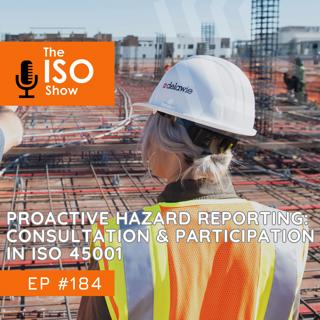
#184 Proactive Hazard Reporting – Consultation and Participation in ISO 45001
The ISO Show30 Heinä 2024

#184 Proactive Hazard Reporting – Consultation and Participation in ISO 45001

In the workplace, everyone is responsible for safety.

It's not just for managers or senior management to worry about where legislation is concerned, everyone from the top to the bottom needs to be actively ensuring the safety of others.

ISO 45001 highlights the importance of this in its most recent iteration, which includes a specific requirement for the consultation and participation of workers. But, how does this work in practice?

Today Ian Battersby explains what consultation and participation of workers in ISO 45001 is, and how you can incorporate elements of reactive and proactive hazard reporting to meet that requirement.

You'll learn

· What is consultation and participation of workers in ISO 45001?

· What is the identification of hazards?

· What's the difference between reactive and proactive hazard reporting?

· Common approaches to reactive and proactive hazard reporting

· Proactive hazard reporting in action

Resources

· Isologyhub

In this episode, we talk about:

[00:30] Join the isologyhub – To get access to a suite of ISO related tools, training and templates. Simply head on over to isologyhub.com to either sign-up or book a demo.

[02:05] Episode summary: Ian Battersby will be explaining reactive and proactive hazard reporting, and how this relates to the consultation and participation of workers (clause 5.4) requirement in ISO 45001.

[02:30] What is 'Consultation and Participation of workers? – ISO 45001's clause 5.4 states:

"The organization must have a process for consultation and participation of workers at all levels and functions, and their representatives in the development, planning, implementation, performance evaluation and actions for improvement of the OH&S management system."

ISO 45001 expects occupational health and safety aspects to be fully embodied within the organisation structure. All workers should be aware of their responsibilities, and work together to meet the organisation's health and safety goals.

Everyone is responsible for safety.

Consultation implies two-way communication, so workers can provide feedback to be considered by the organisation before taking a decision. This is important; the organisation has to consider workers' feedback before making decisions

Participation implies the contribution of workers, including non-managerial workers, to decision-making related to OH&S performance and to proposed changes.

[05:50] Hazard Identification – A specific issue which must be considered is the identification of hazards:

· Identifying hazards and assessing risks and opportunities (Clauses 6.1.1 and 6.1.2);

· Determining actions to eliminate hazards and reduce OH&S risks

There are numerous sources for consideration when it comes to hazards

· How work is organised

· Routine/non-routine activities

· Past incidents

· Emergency situations

· People

· Processes

· Workplace design

· Equipment

· Change

[07:35] What's the difference between proactive and reactive hazard reporting? – Proactive is about spotting hazards in advance and putting in place measures to minimise the chances of them materialising and causing harm (eg, through an accident)

Reactive is in response to an event which has already occurred, such as an accident; a hazard existed without being spotted already and dealt with.

[08:20] A common approach to proactive hazard reporting Risk Assessment. Consider hazard sources (i.e. people, processes, equipment, workplace etc) and consider what may happen; what could go wrong. Then consider what controls could be put in place to try and prevent that happening.

Risk assessment can help you to demonstrate worker consultation and participation by including those affected:

· Involved in or affected by an activity

· Those delivering a process

· Using equipment

· Occupying a workplace

Those people have valuable knowledge and understanding, sometimes moreso than someone in a supervisory / managerial role.

And an absolute must: recording that all employees have read, understand and are committed to the controls included in Risk Assessments; that process may also give rise to workers' further involvement – through querying, suggesting change etc

This also helps the culture of hazard spotting and promotes engagement among the workforce, both of which are vital in driving a proactive approach

[11:10] A common approach to reactive hazard reporting: Accident reporting systems is the obvious choice. However, there are ways you can make this more proactive.

There are various levels to accident reporting. Traditional systems wait until an accident occurs before recording and acting upon it.

Some organisations also record near misses: where an event has occurred, but no harm has been caused.

This approach in itself can be very valuable; and it provides an opportunity to act before any harm has occurred.

However, we can go a step further and allow the workforce to observe what's happening; their surroundings and listen to what they feel may present a hazard to them and their colleagues (remember, everyone is responsible for safety).

[13:00] Join the isologyhub and get access to limitless ISO resources – From as little as £99 a month, you can have unlimited access to hundreds of online training courses and achieve certification for completion of courses along the way, which will take you from learner to practitioner to leader in no time. Simply head on over to the isologyhub to sign-up or book a demo.

[15:30] Proactive hazard reporting in action: Ian recounts his experience in a previous company where their proactive hazard reporting led to meaningful change.

This took place in a large manufacturing plant, but there was also significant office-based activity as well.

Because of the nature of the work, many people would not have access to online systems so there was both online and paper systems; this is important; if everybody is responsible, everybody needs access and engagement is vital.

In addition to the traditional accident/near miss system, there was a safety observation card (all data ended up in the same database). It was simple to fill out, would have only taken about 5 minutes at most.

In an organisation of 500ish, we received 2200 observation cards per year by the time I left.

When combined with accidents/incidents, there's a predictable cycle: more reports, poor quality, more accidents, better quality, improved actions, fewer accidents.

[17:30] Creating an observation card: It should be easy to understand and record what's necessary, recommended content includes:

· Date / Time

· Who was involved – employee / contractor / visitor ect

· Location of hazard / incident

· Description of hazard / incident (ideally in 10 words or less)

You could get more granular and include:

· Identification of an unsafe condition or unsafe act

· Type of hazard or incident: slip, trip or fall / exit obstructed / machinery being used unsafely / unsafe structure / not using PPE

You could also include an option for actions taken if you decide to inform a manager of the issue, if you've corrected someone on the use of equipment or PPE ect.

[21:15] The Importance of peer inspections: Often they would have supervisors from one area, checking a different one. This fresh pair of eyes may offer new insight into something that you usually miss!

Note that you should also encourage any site visitors to do the same. The fact that you'd ask them to report any incident also displays that you take safety seriously, and are open to feedback to improve.

[22:40] Hazard scoring: In order to judge that quality, they went a step further and graded all observations from 1-3:

1. Saw something but didn't act

2. Saw it, acted to put it safe there and then

3. Saw it, acted to prevent it happening again

This allowed them to judge how effective hazard spotting is in removing cause and filters out points-scoring.

[22:45] The results speak for themselves:

Increasing number of observations

Increasing number of participants

Increasing quality of observations

Reducing number and severity of accidents.

Over five years, they increased the number of observations per employee ten-fold.

As a result, they reduced lost time accidents over 75%

This was a superb example of a personal safety campaign and a great demonstration of consultation and participation,

It's not difficult to do, but it needs leadership commitment, constant and clear comms, user-friendly systems and effective analysis / reporting.

If you'd like to book a demo for the isologyhub, simply contact us and we'd be happy to give you a tour.

We'd love to hear your views and comments about the ISO Show, here's how:

Share the ISO Show on Twitter or Linkedin

Leave an honest review on iTunes or Soundcloud. Your ratings and reviews really help and we read each one.

Subscribe to keep up-to-date with our latest episodes:

Stitcher | Spotify | YouTube |iTunes | Soundcloud | Mailing List

Tämä jakso on lisätty Podme-palveluun avoimen RSS-syötteen kautta eikä se ole Podmen omaa tuotantoa. Siksi jakso saattaa sisältää mainontaa.

Jaksot(200)

#258 What is BS 99001? Quality Management For The Built Environment

#258 What is BS 99001? Quality Management For The Built Environment

Many of you will be familiar with ISO 9001, the leading Quality Management Standard, which provides a solid foundation for managing any business. However, for certain industries, ISO 9001 alone is not...

16 Syys 44min
#257 How to meet legislative and ISO requirements in leasehold properties

#257 How to meet legislative and ISO requirements in leasehold properties

Many businesses do not own the property they operate in, this can lead to complex questions over who has ownership over certain property and facility related legal obligations. Managing areas such as...

19 Elo 33min

#256 BedX – Supporting Businesses Looking To Tender For Universal Bedfordshire and Beyond

#256 BedX – Supporting Businesses Looking To Tender For Universal Bedfordshire and Beyond

There has been a lot of buzz around the upcoming Universal Project currently in development in Bedfordshire. It's estimated to generate around £50 billion in economic benefit, along with the creation ...

5 Elo 45min

#255 AI Due Diligence - Information Security Checks Before You Integrate AI

#255 AI Due Diligence - Information Security Checks Before You Integrate AI

AI can be fantastic for relieving a lot of administrative burdens, allowing individuals to focus on more complex tasks that need a human touch. However, many are all too quick to install and integrate...

22 Heinä 19min
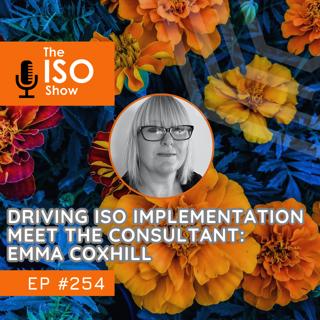
#254 Driving ISO Implementation – Meet the Consultant: Emma Coxhill

#254 Driving ISO Implementation – Meet the Consultant: Emma Coxhill

The path towards becoming an ISO consultant is often a meandering one. It's not often a career that many aspire to, yet despite that, there are still thousands of ISO professionals worldwide. We're c...

1 Heinä 25min
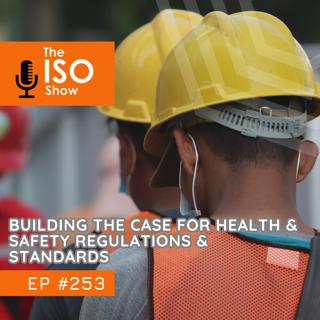
#253 Building The Case For Health & Safety Regulations & Standards

#253 Building The Case For Health & Safety Regulations & Standards

Everyone who goes to work should have the right to go home after work. This is a sentiment that wasn't necessarily formally recognised until the 1970's here in the UK.   Health & Safety often gets mo...

24 Kesä 27min
#252 Wavenet's On-going Commitment to Best Practice – Successfully Maintaining Seven ISO Standards

#252 Wavenet's On-going Commitment to Best Practice – Successfully Maintaining Seven ISO Standards

Anyone that has undergone the ambitious task of Implementing an ISO Standard will know how much work goes into creating and maintaining a single ISO certification. Now imagine juggling seven ISO certi...

17 Kesä 33min

#251 Driving The Demand For GHG Emissions - How Davies Group Tackled Carbon Verification

#251 Driving The Demand For GHG Emissions - How Davies Group Tackled Carbon Verification

Watch the video interview here Carbon verification is quickly becoming a necessary step for many businesses, whether due to regulatory compliance, market demand or as part of a voluntary scheme. The...

10 Kesä 34min

Suosittua kategoriassa Liike-elämä ja talous

sijotuskasti
vallattomat
psykopodiaa-podcast
mimmit-sijoittaa
rss-rahapodi
rss-oivalluksia-rahasta-elamasta
ostan-asuntoja-podcast
oppimisen-psykologia
lakicast
rss-paasipodi
rss-alanvaihtajat
rss-porssipodi
rss-karon-grilli
rss-startup-ministerio
rss-inderes
rss-siksi-viestinta
rahapuhetta
hyva-paha-johtaminen
rss-pinnan-alle
rss-sami-miettinen-neuvottelija