Prolonged Field Care Podcast: Rethinking Triage

Prolonged Field Care Podcast: Rethinking Triage

In this podcast episode, Dennis, Stacy Shackelford, and Doc Rush discuss the critical topic of triage in emergency medical situations, particularly in military contexts. They explore the current challenges in triage practices, emphasizing the need for a shift in thinking towards large-scale events and the importance of adapting strategies based on the number of casualties. The conversation highlights the significance of immediate actions in the first hour post-injury and the necessity of training medics to handle chaotic situations effectively. The episode concludes with a call for a more standardized approach to triage that prioritizes population health over individual patient categorization. This conversation delves into the complexities of tactical medicine in combat situations, emphasizing the importance of prioritizing tactics over medicine, the necessity of clinical experience for medics, and the psychological challenges faced in high-stress environments. The discussion also covers the decision-making process in evacuation scenarios, the identification of surgical needs, and the training required for mass casualty incidents. The speakers advocate for a simplified approach to triage and the need for ongoing training to prepare medics for the realities of their roles.


Takeaways


Triage practices need to evolve with changing conflict scenarios.

Current triage systems are not standardized and often ineffective.

Immediate actions in the first hour post-injury are crucial.

Training should focus on large-scale event responses, not just individual cases.

The first pass actions should prioritize stopping bleeding and ensuring airway clearance.

Medics should be prepared for chaotic situations and make quick decisions.

Understanding the scale of an event is essential for effective triage.

The concept of treating the population rather than individuals is vital.

Preparation and rehearsal are key to effective triage in emergencies.

Triage decisions should be offloaded to allow for rapid response. Tactics often take precedence over medical interventions in combat.

Medics should have regular clinical rotations to enhance their skills.

Risk management in evacuation decisions is crucial for team leaders.

Psychological preparation is essential for medics facing trauma.

Identifying surgical needs should focus on unstable patients.

Basic principles of triage should guide decision-making in emergencies.

Training for mass casualty scenarios is vital for operational readiness.

Medics must be prepared for the reality of not saving every patient.

Experience and pattern recognition are key to effective triage.

Simplicity in approach can lead to better outcomes in chaotic situations.


Chapters


00:00 Introduction to Triage and Its Importance

07:00 Current Challenges in Triage Practices

14:13 Revising Triage Approaches for Large-Scale Events

19:55 Practical Strategies for Effective Triage

30:12 Conclusion and Future Directions in Triage

31:13 Understanding Tactical Medicine in Combat Situations

36:00 The Importance of Clinical Experience for Medics

39:42 Risk Management in Evacuation Decisions

43:03 Preparing Medics for Psychological Challenges

46:07 Identifying Surgical Needs in Critical Care

49:54 The Role of Basic Principles in Triage

52:44 Training for Mass Casualty Scenarios

Thank you to Delta Development Team for in part, sponsoring this podcast. ⁠⁠⁠⁠⁠⁠⁠⁠⁠⁠deltadevteam.com⁠⁠⁠⁠⁠⁠⁠⁠⁠⁠ For more content go to ⁠⁠⁠⁠⁠⁠⁠⁠⁠⁠www.prolongedfieldcare.org⁠⁠⁠⁠⁠⁠ ⁠⁠⁠⁠ Consider supporting us: ⁠⁠⁠⁠⁠⁠⁠⁠⁠⁠patreon.com/ProlongedFieldCareCollective⁠⁠⁠⁠⁠⁠ or ⁠⁠⁠⁠⁠⁠www.lobocoffeeco.com/product-page/prolonged-field-care

Tämä jakso on lisätty Podme-palveluun avoimen RSS-syötteen kautta eikä se ole Podmen omaa tuotantoa. Siksi jakso saattaa sisältää mainontaa.

Jaksot(629)

Pack to the Vessel: Hemorrhage Control Is Not a Mind-less Skill

Pack to the Vessel: Hemorrhage Control Is Not a Mind-less Skill

Mike Weisman — 25 years as a Navy Corpsman and SARC, 27 years on a busy Vegas fire department, now clinical education at Celox — does not sell magic dust. He sells a hydraulic problem.A femoral-rate b...

17 Syys 38min
296 - Mission Capable Pain Control: The TCCC Analgesia Update Explained

296 - Mission Capable Pain Control: The TCCC Analgesia Update Explained

OTFC is gone. That was not a small supply hiccup. It punched a hole in the old TCCC pain plan.George Barbee, a PA and co-author of TCCC Guideline Change 25-03, walks Dennis through why the committee r...

14 Syys 39min
SOMA 26' - Ultrasound-Augmented Triage A Proposal To Refine Field Decision Making In Tactical Combat Casualty Care

SOMA 26' - Ultrasound-Augmented Triage A Proposal To Refine Field Decision Making In Tactical Combat Casualty Care

Recorded live at SOMA 26In a near-peer MASCAL, one medic and one junior medic may face twenty penetrating torso casualties, one unit of blood, and no time to empirically needle or finger-decompress ev...

10 Syys 26min
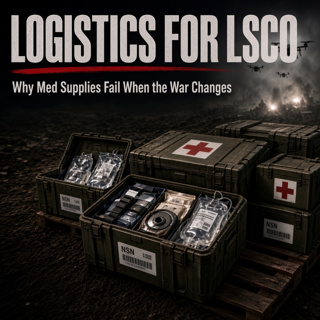
295- Logistics For LSCO: Why SOF Med Supplies Fail When The War Changes

295- Logistics For LSCO: Why SOF Med Supplies Fail When The War Changes

Medical logistics was an afterthought for a lot of us in GWOT. You submitted a request, something showed up, and everyone joked that the warehouse never read the order. That model does not survive lar...

7 Syys 35min
SOMA 26' - Role 1.5: Fighting Tourniquet Syndrome at the Forefront

SOMA 26' - Role 1.5: Fighting Tourniquet Syndrome at the Forefront

Ukrainian orthopedic and reconstructive surgeon describes what prolonged field care actually looks like when evacuation from the front line to Role 2 takes three to four days, and sometimes longer. Af...

3 Syys 21min

294 - Do Antibiotics Really Reduce Mortality in Trauma? Wound Care First in Prolonged Field Care

294 - Do Antibiotics Really Reduce Mortality in Trauma? Wound Care First in Prolonged Field Care

Antibiotics are not magic. In this episode of the PFC Podcast, Dennis sits down with Ryan to cut through the common myth that “I’ve given antibiotics, so the wound is protected.” They unpack why vigor...

31 Elo 36min
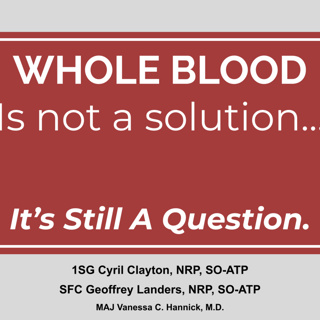
SOMA 26' - Fresh Whole Blood is Not The Answer: It's Still a Question

SOMA 26' - Fresh Whole Blood is Not The Answer: It's Still a Question

Whole Blood Is Not a Solution (Until Conventional Forces Can Deliver It)Recorded live at SOMA 26Dr. Vanessa Hanick (emergency physician, former active-duty Army, now National Guard) and 1SG Cy Clayton...

27 Elo 28min
293 - Dead Tissue Kills in Prolonged Field Care: 4 C’s, Early Debridement & Delayed Primary Closure Lessons from the Field

293 - Dead Tissue Kills in Prolonged Field Care: 4 C’s, Early Debridement & Delayed Primary Closure Lessons from the Field

In this episode of the PFC Podcast, Dennis sits down with missionary surgeon Jason to cut through the noise on real-world wound care in austere and unconventional warfare environments. From the bridge...

24 Elo 49min

Suosittua kategoriassa Koulutus

rss-murhan-anatomia
aamukahvilla
psykopodiaa-podcast
adhd-podi
voi-hyvin-meditaatiot-2
psykologia
rss-luonnollinen-synnytys-podcast
koulu-podcast-2
rss-liian-kuuma-peruna
rss-duodecim-lehti
rss-uskonto-on-tylsaa
kesken
rss-koira-haudattuna
rss-arkea-ja-aurinkoa-podcast-espanjasta
rss-vapaudu-voimaasi
ihminen-tavattavissa-tommy-hellsten-instituutti
rss-niinku-asia-on
rahapuhetta
ilona-rauhala
rss-saavutus