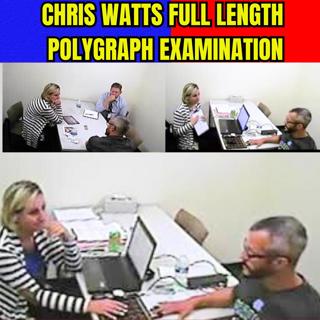
Chris Watts Full Length Polygraph Examination
Chris Watts Full Length Polygraph Examination Chris Watts' full-length polygraph examination was a pivotal moment in the investigation into the disappearance of his pregnant wife, Shanann, and their two daughters, Bella and Celeste. Conducted by FBI agent Tammy Lee, the polygraph was designed to assess the truthfulness of Watts' statements about his family's whereabouts and well-being. During the examination, Watts answered questions related to his involvement in their disappearance. Despite his attempts to appear calm and cooperative, the polygraph results showed clear signs of deception, with a score so low it confirmed dishonesty. The polygraph failure became a turning point in the investigation, as it prompted investigators to confront Watts with the evidence of his lies. After failing the test, Watts initially attempted to shift blame, claiming that Shanann had harmed their daughters, leading him to retaliate. However, under intense questioning, he eventually confessed to killing Shanann and their children. The polygraph examination revealed not only his deception but also his inability to maintain his fabricated story under pressure. This examination remains a crucial piece of evidence, showcasing the use of polygraph tests in criminal investigations and highlighting Watts' calculated efforts to conceal his horrific actions. During Chris Watts' polygraph examination, he was asked a series of direct and specific questions aimed at determining whether he was being truthful about his involvement in the disappearance of his wife, Shanann, and their daughters, Bella and Celeste. While the exact wording of every question may vary slightly depending on the source, the critical questions typically included: "Did you physically harm Shanann in any way?" This question aimed to directly assess whether he was responsible for any physical harm to his wife. "Are you responsible for the disappearance of Shanann?" This was a key question to determine if Watts had any role in orchestrating her disappearance. "Do you know where Shanann is now?" Investigators used this to gauge whether Watts was concealing knowledge about her whereabouts. "Do you know where Bella and Celeste are right now?" This question focused specifically on his missing daughters. "Are you lying about the last time you saw Shanann?" This addressed inconsistencies in his initial statements about the timeline of events. Context During the TestThe questions were strategically framed to avoid ambiguity and assess Watts' truthfulness about the events. Polygraph results revealed that Watts showed clear signs of deception, scoring exceptionally low—indicating dishonesty. Afterward, he was confronted by investigators about his failure, which led to further questioning and his eventual confession. Chris Watts, polygraph examination, polygraph questions, failed polygraph, Shanann Watts, Bella Watts, Celeste Watts, disappearance investigation, physical harm, truthfulness, criminal confession, interrogation techniques, FBI questioning, law enforcement, family murder case, deceptive behavior, investigation turning point, direct questions, criminal psychology, true crime, high-profile case, forensic analysis.

Jaksot(300)

Homeless Couple Calls 911 on Bigfoot ACTUAL AUDIO

Homeless Couple Calls 911 on Bigfoot ACTUAL AUDIO

Homeless Couple Calls 911 on Bigfoot ACTUAL AUDIO

4 Heinä 202413min

The Brutal Murder Of The Chohan Family - True Crime Documentary

The Brutal Murder Of The Chohan Family - True Crime Documentary

The Brutal Murder Of The Chohan Family - True Crime Documentary Mr Chohan had a successful business worth £5m. Kenneth Regan was known as Captain Cash from his drug dealing days, and along with his two henchmen, they hatched a plot to take over the Chohan’s business and use it to front their drug smuggling ring. Mr Chohan, his young wife, her mother, and the couple’s their two baby sons were lured into a trap and brutally murdered, covered up as an innocent but tragic sudden disappearance. The plot was only foiled by a family murder in New Zealand, refusing to believe that they would all vanish, as a result of tax avoidance or a business agreement gone sour. The bodies of the three adults washed up along the coasts of the UK, but the two babies were never found.

3 Heinä 202447min

Hometown Tragedy: The Missing Paperboys - True Crime Investigation

Hometown Tragedy: The Missing Paperboys - True Crime Investigation

Hometown Tragedy: The Missing Paperboys - True Crime Investigation A 12-year-old paperboy's disappearance during his Sunday morning route shocks a peaceful Iowa city. Panic sets in when a second paperboy goes missing.

2 Heinä 202423min

I Am A Psychologist That Evaluates Serial Killers

I Am A Psychologist That Evaluates Serial Killers

I Am A Psychologist That Evaluates Serial Killers

2 Heinä 202417min

Real and Scary Encounters with the Grim Reaper

Real and Scary Encounters with the Grim Reaper

Real and Scary Encounters with the Grim Reaper For thousands of years, various cultures have had figures to represent death. One of the most common and enduring of these is the Grim Reaper—usually a skeletal figure, who is often shrouded in a dark, hooded robe and carrying a scythe to “reap” human souls. But how and when did this imagery come to be associated with death? The Grim Reaper seems to have appeared in Europe during the 14th century. It was during this time that Europe was dealing with what was then the world’s worst pandemic, the Black Death, believed to be the result of the plague. It is estimated that about one-third of Europe’s entire population perished as a result of the pandemic, with some areas of the continent suffering far greater losses than others. The original outbreak of the plague occurred during 1347–51, and outbreaks then recurred several other times after that. So, clearly, death was something that the surviving Europeans had on their mind, and it is not surprising that they conjured an image to represent it.But why the skeletal figure? Why the scythe? Why the robe? Skeletons are symbolic of death, representing the human body after it has decayed. The robe is thought to be reminiscent of the robes that religious figures of the time wore when conducting funerary services. The scythe is an apt image taken from agricultural practices of the time: harvesters used scythes to reap or harvest crops that were ready to be plucked from the earth…and, well, that’s kind of what happens when humans die: they are plucked from this earth.

2 Heinä 202424min

Tortured To Death: Murdering The Nanny (True Crime Documentary)

Tortured To Death: Murdering The Nanny (True Crime Documentary)

Tortured To Death: Murdering The Nanny (True Crime Documentary) This moving documentary examines the disturbing case of a couple who tortured and murdered their French nanny and then burnt her body in their back garden. Tortured To Death: Murdering The Nanny True Crime Documentary True Crime Podcast 2024 REAL Police Interrogations, 911 Calls True Crime Documentaries

2 Heinä 202444min

The Bikini Killer Serial Killer Documentary Charles Sobhraj 

The Bikini Killer Serial Killer Documentary Charles Sobhraj 

The Bikini Killer Serial Killer Documentary Charles Sobhraj  The man who needs no introduction in the world of serial killers. Charles Sobhraj a.k.a Bikini Killer, The Serpent and The Splitting Killer was born in Saigon, . Born in Vietnam in 1944, Charles Sobhraj embarked on a life of crime in Europe in the 1960s. He committed an estimated two dozen murders in the 1970s

2 Heinä 202452min

Wayne Williams The Atlanta Child Murders - Serial Killer Documentary

Wayne Williams The Atlanta Child Murders - Serial Killer Documentary

Wayne Williams The Atlanta Child Murders - Serial Killer Documentary Wayne Williams - 28 victims serial killer: The Atlanta child murders. About. The Atlanta murders of 1979–1981, sometimes called the Atlanta Child Murders . Wayne Williams - 28 victims serial killer: The Atlanta child murders. About. The Atlanta murders of 1979–1981, sometimes called the Atlanta Child Murders

1 Heinä 20241h 39min

Suosittua kategoriassa Tiede

rss-mita-tulisi-tietaa
utelias-mieli
rss-duodecim-lehti
tiedekulma-podcast
docemilia
rss-poliisin-mieli
rss-kasvatuspsykologiaa-kaikille
rss-laakaripodi
rss-tervetta-skeptisyytta
mielipaivakirja
rss-radplus
rss-tiedetta-vai-tarinaa
radio-antro
filocast-filosofian-perusteet
rss-lihavuudesta-podcast
rss-ilmasto-kriisissa
rss-taivaanranta
rss-luontopodi-samuel-glassar-tutkii-luonnon-ihmeita