233. Shocks and surprises at the war’s end

233. Shocks and surprises at the war’s end

Following the German surrender in May 1945, the ‘Big Three’ – the United States, the Soviet Union and Britain – met for the third and last time in conference. And this time, appropriately, they met on German territory, in Potsdam near Berlin. It was Soviet-held territory too, perhaps significant given the power with which the Soviet Union was emerging from the war.

Indeed, its delegation was the only one to keep the same leader, Joseph Stalin, at its head, as he had been at Tehran and Yalta.

Roosevelt had died.

As for the British, after nearly ten years without a general election, they finally held one, and to general surprise, the victorious war Prime Minister Churchill was defeated by his deputy, Clement Attlee, the Labour leader. Attlee would form the first ever Labour government with a parliamentary majority. He would also take over from Churchill as leader of the British delegation at Potsdam.

The conference took place under the shadow of the first successful test of a nuclear device, the day before the conference started. The US was now a nuclear power. That gave it quite an edge in international power politics.

Although the device had been designed to use against Nazi Germany, since only Japan was left in the war, and given how high the casualties would be in an invasion of the Japanese home islands, the Americans dropped an atom bomb on Hiroshima on 6 August 1945. To make sure the message had got through, they dropped another on Nagasaki on the 9th. The Japanese surrendered on the 15th, the only concession to their sensibilities being that the Emperor was not deposed.

When the final Japanese surrender document was signed on 2 September, World War 2 was at last over.


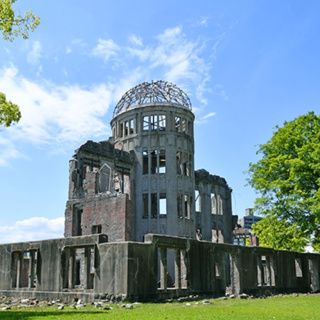
Illustration: The A-bomb dome in Hiroshima, Japan. Public Domain

Music: Bach Partita #2c by J Bu licensed under an Attribution-NonCommercial-No Derivatives (aka Music Sharing) 3.0 International License


Jaksot(274)

265. War in a unipolar world

265. War in a unipolar world

By the latter part of the twentieth century, the world had become unipolar. The Soviet Empire collapsed even more rapidly than the British one had after the Berlin Wall fell in 1989. China was not yet...

26 Loka 202514min
264. Ethics, votes and wars

264. Ethics, votes and wars

We saw in the last episode, that Britain’s involvement in the NATO intervention in Kosovo could be regarded as part of an ‘ethical foreign policy’, since its objective, many felt, was humanitarian, th...

12 Loka 202514min
263. Tragedy at home, ethics abroad

263. Tragedy at home, ethics abroad

Divorce, contrary to what many believe, was not permitted by the Church of England. Henry VIII didn’t divorce two wives, he had the marriages annulled, declaring in effect that they’d never happened. ...

5 Loka 202514min
262. Uncool

262. Uncool

In the early years of Blair’s premiership, his supporters liked to refer to Britain as ‘Cool Britannia’, in a play on the title of the song ‘Rule Britannia’. Last week, we talked about some of the coo...

28 Syys 202514min
261. Cool Britannia

261. Cool Britannia

The Blair government threw itself into action as soon as it was formed.Rather confirming the existence of a deal between them, something they’ve never confirmed, Blair quickly appointed Gordon Brown C...

21 Syys 202514min

260. New Dawn

260. New Dawn

It was a new dawn. Or at least so Tony Blair said, as he emerged from his landslide victory in the 1997 General Election. It’s what he would say, isn’t it?Still, there was some truth to the claim. It ...

14 Syys 202514min

259. Major error, major success, Major’s out

259. Major error, major success, Major’s out

We’re just about ready to move on from John Major but, before we do, we need to spend a few moments on two major events of his second premiership. One was a significant breakthrough, in Ireland, even ...

7 Syys 202514min

258. Major’s bastards and Labour’s deal

258. Major’s bastards and Labour’s deal

By winning the 1992 general election, John Major had gained his own mandate to form a government, instead of imply inheriting Margaret Thatcher’s. He’d shown himself capable of leading the Conservativ...

31 Elo 202514min

Suosittua kategoriassa Historia

olipa-kerran-otsikko
gogin-ja-janin-maailmanhistoria
mayday-fi
huijarit
mystista
rss-ikiuni
tsunami
konginkangas
totuus-vai-salaliitto
rouva-diktaattori
rss-kirkon-ihmeellisimmat-tarinat
rss-i-dont-like-mondays-2
rss-sattuu-sita-suomessakin
historiaa-suomeksi
apinan-vuosi
maailmanpuu
rss-peter-peter
tiedetta-ja-sirkushuveja-vanhojen-aikojen-podcast
rss-subjektiivinen-todistaja